

Jan-Sep 2026 Global EV Battery Electrolyte Loading at 1,267K ton, Up 23.1% YoY
- Jan-Sep 2026 Electrolyte Loading Excluding China at 455K ton, Up 36.1% YoY
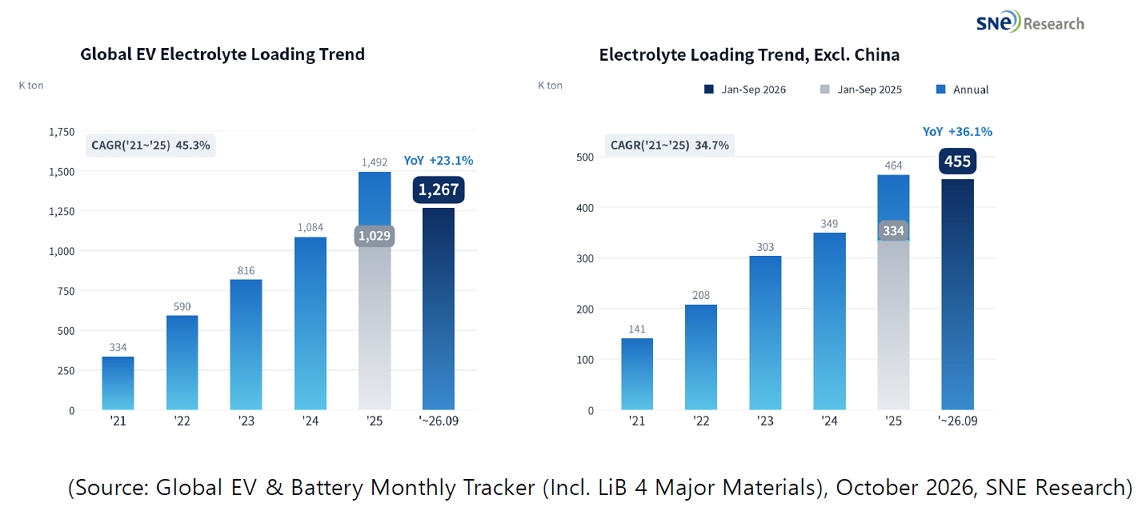
In Jan-Sep 2026, total electrolyte loading in EVs (EV, PHEV, HEV) registered worldwide was approximately 1,267K ton, up 23.1% from 1,029K ton in the same period last year. Over the same period, the market excluding China grew 36.1% to approximately 455K ton, outpacing the overall market by 13.0%p, and its share of the total rose 3.4%p from 32.5% to 35.9%.
Electrolyte is the material that serves as the pathway for lithium ions moving between the cathode and anode, and it consists of electrolyte salts, solvents, and additives. Because the formulation determines charging speed, power, low-temperature performance, lifespan, and safety, the ability to tailor formulations and design additives for each customer is increasingly decisive for competitiveness as high-voltage and fast-charging cells become more common.
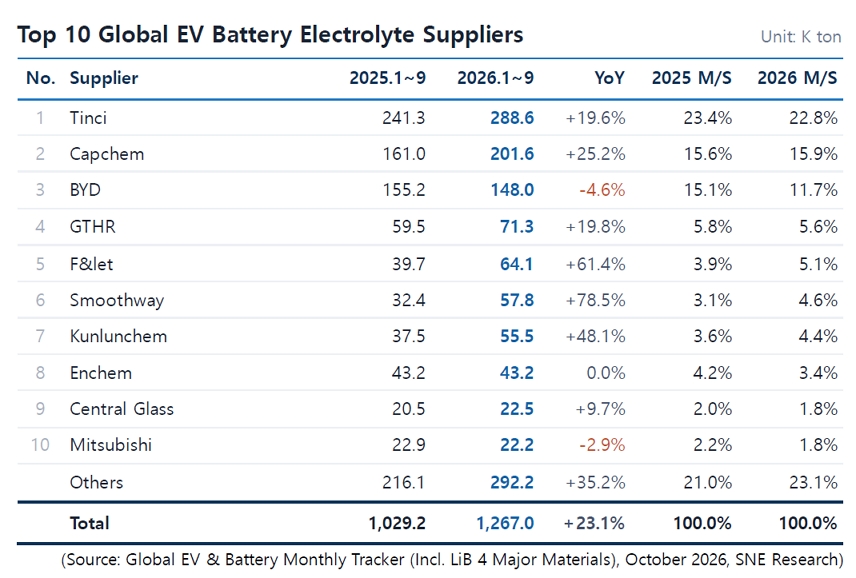
By company, Tinci kept first place with approximately 289K ton, up 19.6%, and Capchem solidified second place with approximately 202K ton, up 25.2%. BYD, on the other hand, fell 4.6% to approximately 148K ton. Mid-sized Chinese players such as Smoothway (78.5%), F&let (61.4%), Kunlunchem (48.1%), and GTHR (19.8%) maintained high growth. Korea's Enchem stayed flat YoY at approximately 43K ton, while Japan's Central Glass grew 9.7%, overtaking Mitsubishi for ninth place.
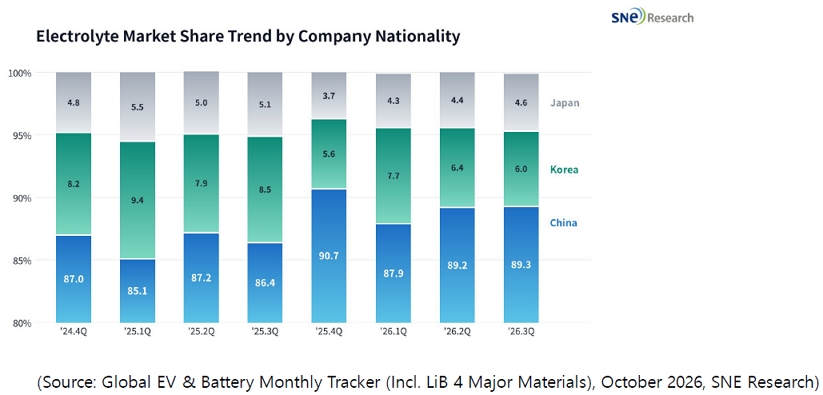
By company nationality, Chinese companies' share in Q3 2026 was 89.3%, up 2.9%p from 86.4% in the same quarter last year. Over the same period, Korean companies' share fell 2.5%p from 8.5% to 6.0%, and Japanese companies' share fell 0.5%p from 5.1% to 4.6%. Compared with Q2 (89.2%), the Chinese share rose only 0.1%p, but it has stayed above 87% for four consecutive quarters, cementing Chinese companies' supply dominance.
Growth in the electrolyte market was driven by both higher EV battery installations and the spread of LFP. As the market excluding China grew faster than the overall market, the demand share of Europe and Asia (excl. China) increased, and larger battery capacity per vehicle also contributed to higher loading.
The electrolyte market has recently entered a pause as raw material prices weaken. Major Chinese suppliers saw first-half earnings improve significantly on surging ESS battery shipments and higher selling prices, and Tinci passed the Hong Kong Stock Exchange listing review in October to raise funds for building plants in Morocco and the US. In late October, however, cell production grew more slowly than expected and lithium carbonate prices lacked clear support, so raw material prices such as LiPF6 and VC weakened and electrolyte prices also declined. Cost-sharing negotiations are also under way ahead of China's consumption tax on batteries for the domestic market and the abolition of the VAT rebate on battery exports next January. Going forward, while Chinese suppliers' cost and scale advantages are likely to persist, local production bases in North America and Europe, the stability of electrolyte salt and additive procurement, and the ability to supply high-performance electrolytes for ESS are expected to determine each company's position.