

Jan-Sep 2026 Global (Excl. China) EV Battery Usage at 426.7GWh, Up 24.7% YoY
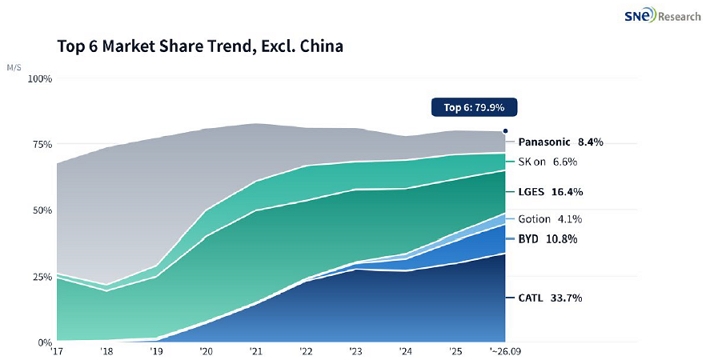
- CATL and BYD Combined Share Up 7.8%p to 44.5%; Chinese Share Expands
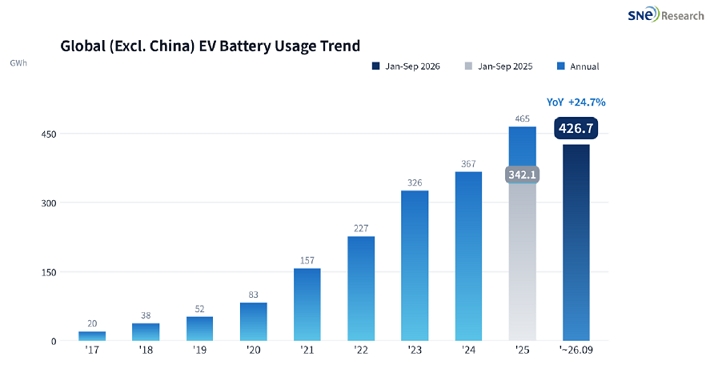
In Jan-Sep 2026, total battery usage in EVs (EV, PHEV, HEV) sold in global markets excluding China reached approximately 426.7GWh, up 24.7% YoY. This outpaced overall global growth (19.7%) by 5.0%p, and growth in September alone rose to 21.1% from 18.8% in August, as demand in Europe and Asia continued to offset weakness in North America.
(Source: Global EV and Battery Monthly Tracker, October 2026, SNE Research)
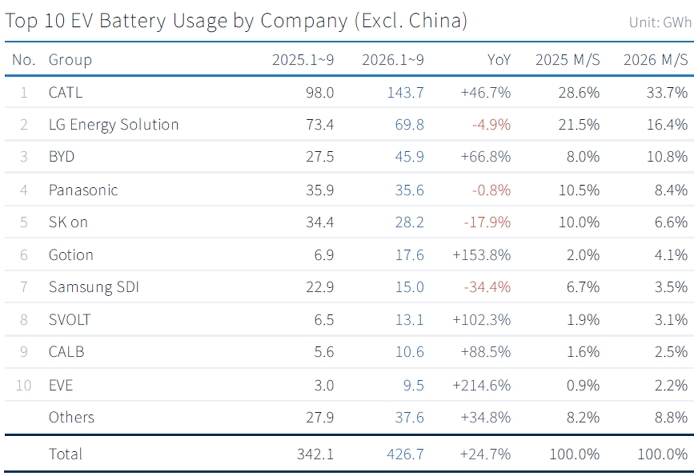
In Jan-Sep 2026, combined global (excl. China) usage of the three Korean battery makers (LG Energy Solution, SK on, and Samsung SDI) was 113.0GWh, down 13.5% YoY. Their combined market share fell 11.7%p from 38.2% to 26.5%. The decline was concentrated in North America, where the three companies' usage roughly halved from 56.1GWh to 28.1GWh. In contrast, their usage in Europe rose 7.2% from 58.7GWh to 63.0GWh, and in Asia 33.2% from 13.1GWh to 17.5GWh.
(Source: Global EV and Battery Monthly Tracker, October 2026, SNE Research)
LG Energy Solution posted 69.8GWh, down 4.9% YoY, but held second place in the non-China market. Usage rose 13.2% in Europe to 38.6GWh and 49.4% in Asia to 11.1GWh, but North America fell 44.9% from 29.9GWh to 16.5GWh, weighing on overall results. Its market share declined 5.1%p from 21.5% to 16.4%. In Q3, utilization of its North American ESS lines climbed to around 90%, driving record quarterly revenue. The ESS conversion of its North American plants and a broader European customer base are seen as key to defending its market share.
SK on's usage fell 17.9% to 28.2GWh, and its market share dropped 3.4%p from 10.0% to 6.6%. The company supplies batteries to Hyundai Motor Group, Ford, Volkswagen, and Mercedes-Benz, among others, but its usage declined 46.7% in North America and 2.2% in Europe. SK on is broadening its demand base beyond EVs, converting part of its Georgia plant into LFP lines for ESS and signing a contract to supply 9GWh over five years from 2027 to a US ESS company.
Samsung SDI recorded 15.0GWh, down 34.4%, the steepest decline among the top 10. Its market share also shrank 3.2%p from 6.7% to 3.5%. European usage was similar to the previous year at 9.4GWh, but North America plunged 66.2% from 12.0GWh to 4.1GWh. In Q3, the company posted its highest operating profit in 12 quarters on sales of ESS and data center BBUs, and in October it began mass production of LFP cells for ESS at the StarPlus Energy plant in the US. The key question is how much of the gap in EV demand ESS can fill.
Panasonic ranked fourth with 35.6GWh, down 0.8%. Tesla's North American volumes supported its results, but growth fell well short of the non-China market, and its market share declined 2.1%p from 10.5% to 8.4%. Given its Tesla-centric customer base, mass production of next-generation cylindrical cells and the conversion of some lines at its Kansas plant for data center use remain key variables for growth.
CATL recorded 143.7GWh in the global (excl. China) market in Jan-Sep 2026, up 46.7% YoY. Its market share rose 5.1%p from 28.6% to 33.7%. European usage grew 35.4% from 71.5GWh to 96.8GWh, and usage in Asia more than doubled to 27.1GWh. On September 22, its Debrecen plant in Hungary (Phase 1, 34GWh) began trial production on its first two lines, which is expected to broaden its local supply base for European customers such as Mercedes-Benz and BMW.
Second-tier Chinese players such as Gotion, SVOLT, CALB, and EVE also grew sharply. Gotion rose 153.8% to 17.6GWh, overtaking Samsung SDI for sixth place, while SVOLT grew 102.3% to 13.1GWh and CALB 88.5% to 10.6GWh. EVE grew 214.6% to 9.5GWh, the highest growth rate among the top 10. The combined market share of the six Chinese companies, including CATL and BYD, rose 13.3%p from 43.1% to 56.4%, exceeding half of the non-China market.
BYD held third place with 45.9GWh, up 66.8%, and its market share rose 2.8%p from 8.0% to 10.8%. Growth was evenly spread across Europe (17.4GWh, up 68.8%), Asia (14.8GWh, up 41.0%), and South America (7.1GWh, up 135.7%). With September overseas sales of about 180,000 units, more than double the same month last year, exports and local production of its own EVs are expanding rapidly, and its usage growth in the non-China market is likely to continue for the time being.
(Source: Global EV and Battery Monthly Tracker, October 2026, SNE Research)
In Jan-Sep 2026, the non-China market grew 24.7%, but performance diverged sharply by supplier. The three Korean makers and Panasonic all lost share, while Chinese players rapidly expanded volumes in Europe, Asia, and South America. The LFP share of the non-China market rising 11.9%p from 15.8% to 27.7% reflects the same trend. In North America, Ford began producing LFP cells using technology licensed from CATL, and in Europe LFP adoption is growing, mainly in entry-level models, making price competitiveness a key criterion in supplier selection.
Going forward, regional policies and demand diversification are expected to determine supplier competitiveness. In North America, where EV demand has weakened since tax credits ended, LG Energy Solution and Samsung SDI found a path to an earnings rebound through higher ESS sales in Q3, and SK on has also signaled that ESS results will be reflected from next year. The pace of converting EV lines to ESS is now driving utilization. In Europe, discussions on easing the 2035 phase-out target for internal combustion engines are under way alongside stricter local-content requirements for components, while Chinese players are ramping up local plants. Local production capability, price competitiveness, and supply chain traceability in preparation for the Battery Passport taking effect in February 2027 are likely to determine market position.