

Global EV Sales Reach 16.06 Million Units in January-September 2026, Up 5.8% Year-on-Year
- Europe up 32.2% and Asia (ex-China) up 74.7% amid a domestic decline in China
(Source: Global EV and Battery Monthly Tracker, October 2026, SNE Research)
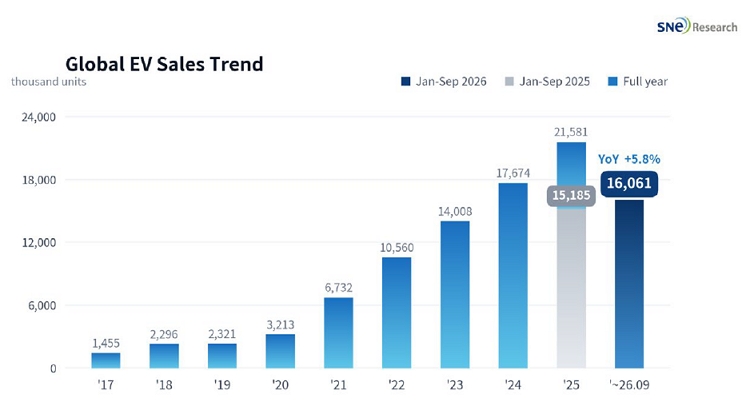
Global EV (BEV+PHEV) sales totaled 16.06 million units in January-September 2026, up 5.8% year-on-year. September sales of 2.27 million units were the highest monthly level this year, but growth from a year earlier was 2.2%, as weak domestic demand in China continued into September. By type, BEVs rose 13.6% to 11.63 million units, while PHEVs fell 10.4% to 4.43 million units, lifting the BEV share 5.0 percentage points from 67.4% to 72.4%. The market excluding China grew 30.0% to 7.33 million units.
(Source: Global EV and Battery Monthly Tracker, October 2026, SNE Research)
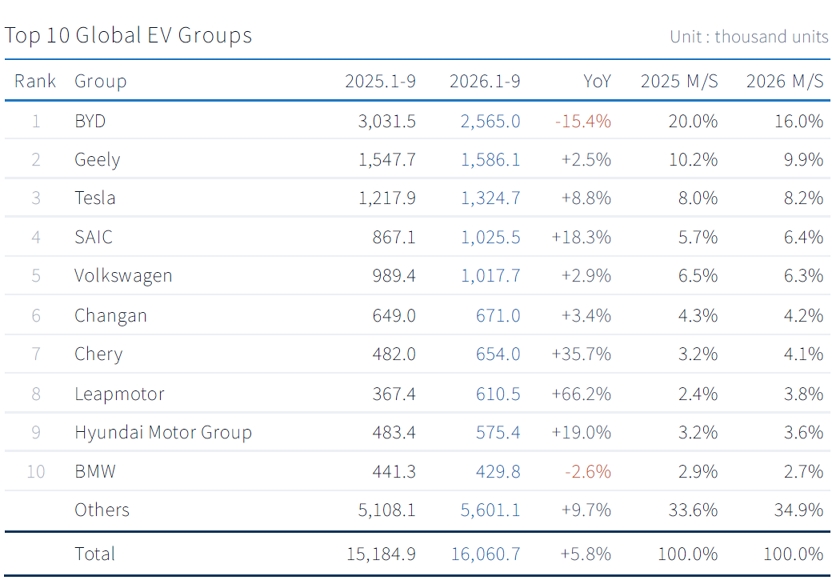
By group, BYD ranked first with 2.56 million units but fell 15.4% year-on-year, and its share declined 4.0 percentage points from 20.0% to 16.0%. Its deliveries in China fell 32.9% to 1.71 million units. Overseas deliveries increased, with Europe (300,000 units) up 78.8% and Asia (ex-China) up 55.9%.
Geely ranked second with 1.59 million units, up 2.5%, and Tesla third with 1.32 million units, up 8.8%. Tesla's deliveries fell 11.9% in China and 2.3% in North America but rose 29.7% in Europe and 75.8% in Asia (ex-China), and its share rose from 8.0% to 8.2%. SAIC grew 18.3% to 1.03 million units, ranking fourth narrowly ahead of Volkswagen (1.02 million units, 2.9%).
Among Chinese OEMs, Changan rose 3.4% to 671,000 units and ranked sixth. Chery grew 35.7% to 654,000 units, and its European deliveries rose 307.2%. Hyundai Motor Group grew 19.0% year-on-year to 575,000 units, and its share rose from 3.2% to 3.6%. By region, its deliveries rose 23.4% in Europe and 64.3% in Asia (ex-China), while North America fell 27.3%.
Leapmotor grew 66.2% to 610,000 units, the highest growth rate among the top 10 groups. Its deliveries in China rose 45.2%, and European deliveries through Stellantis' sales network increased 434.5%. Its share rose 1.4 percentage points year-on-year to 3.8%, and it ranked eighth. BMW ranked tenth with 430,000 units, down 2.6% year-on-year.
Sales by groups outside the top 10 rose 9.7% to 5.60 million units, and their share increased 1.3 percentage points from 33.6% to 34.9%. Eleventh-placed Toyota and twelfth-placed Renault-Nissan grew 61.6% and 31.5% respectively, while Stellantis (-5.1%) and Mercedes-Benz (-3.0%) declined.
(Source: Global EV and Battery Monthly Tracker, October 2026, SNE Research)
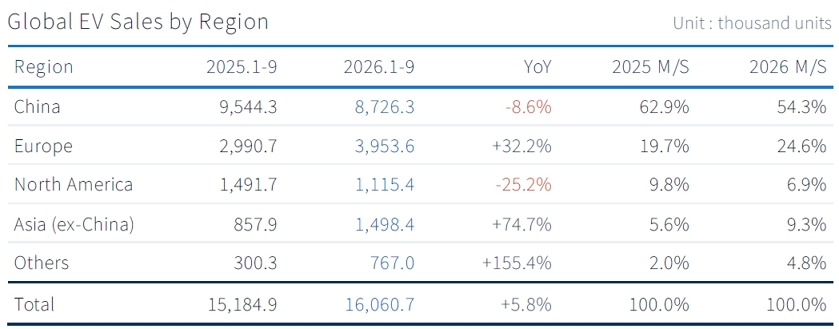
By region, China had the largest volume with 8.73 million units, but it fell 8.6% year-on-year, and its share declined 8.6 percentage points from 62.9% to 54.3%. BEVs rose 0.2%, while PHEVs fell 24.3%. September deliveries fell 13.0% from a year earlier, reflecting purchases concentrated last year ahead of subsidy cuts in some regions.
Europe grew 32.2% to 3.95 million units, and its share rose 4.9 percentage points from 19.7% to 24.6%. BEVs and PHEVs rose 37.7% and 20.8% respectively, and September deliveries grew 45.2% from a year earlier. By country, Germany (42.1%), France (54.3%) and Italy (73.5%) increased. Since this year, Germany has again been providing EV purchase subsidies for low- and middle-income households.
North America fell 25.2% year-on-year to 1.12 million units, and its share declined 2.9 percentage points from 9.8% to 6.9%. September deliveries fell 35.9% from a year earlier, reflecting purchases concentrated last September ahead of the end of the U.S. EV tax credit at the end of that month. U.S. deliveries in the third quarter were at a similar level to the second quarter, and January-September BEV and PHEV deliveries fell 20.8% and 41.1% respectively.
Deliveries in Asia (ex-China) rose 74.7% year-on-year to 1.50 million units, and its share increased 3.7 percentage points from 5.6% to 9.3%. By country, Indonesia (116.1%), Thailand (78.0%), Vietnam (75.9%), Korea (69.4%), Japan (69.3%) and India (59.4%) increased. Other regions rose 155.4% to 767,000 units, lifting their share from 2.0% to 4.8%, with large increases in Brazil (147.1%) and Australia (132.9%).
Global EV deliveries grew 5.8% in January-September, with shifts in share by region and by company. Deliveries fell in China and North America but rose in Europe, Asia (ex-China) and other regions. By company, Leapmotor (66.2%), Chery (35.7%), Hyundai Motor Group (19.0%) and SAIC (18.3%) gained share, while BYD's share fell 4.0 percentage points as the decline in China outweighed higher overseas deliveries.
In the fourth quarter, whether China's domestic market recovers, the extent of the U.S. recovery and whether growth in Europe continues will affect full-year results. China has been levying a consumption tax on lithium-ion batteries sold domestically since September and plans to abolish the export VAT rebate on batteries in January next year. With the EU's Industrial Accelerator Act (IAA), which includes requirements for locally produced components, under discussion, Chinese OEMs' expansion of local production and supply of affordable models are expected to be variables in future competition for share.