

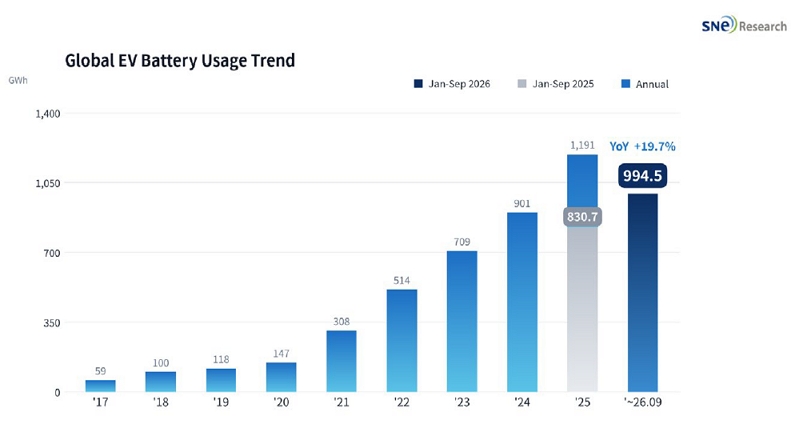
Jan-Sep 2026 Global EV Battery Usage at 994.5GWh, Up 19.7% YoY
- 7 Chinese Firms' Share 73.0% (+3.5%p); 3 Korean Firms 12.6% (-4.1%p)
In Jan-Sep
2026, total battery usage in EVs (EV, PHEV, HEV) registered worldwide was
approximately 994.5GWh, up 19.7% from the same period last year (830.7GWh).
Usage in September alone reached a monthly record of 145.1GWh, but YoY growth
slowed to 15.8% from 18.3% in August, and cumulative growth continued to hover
slightly below 20%.
(Source: Global EV and Battery Monthly Tracker, October 2026, SNE Research)
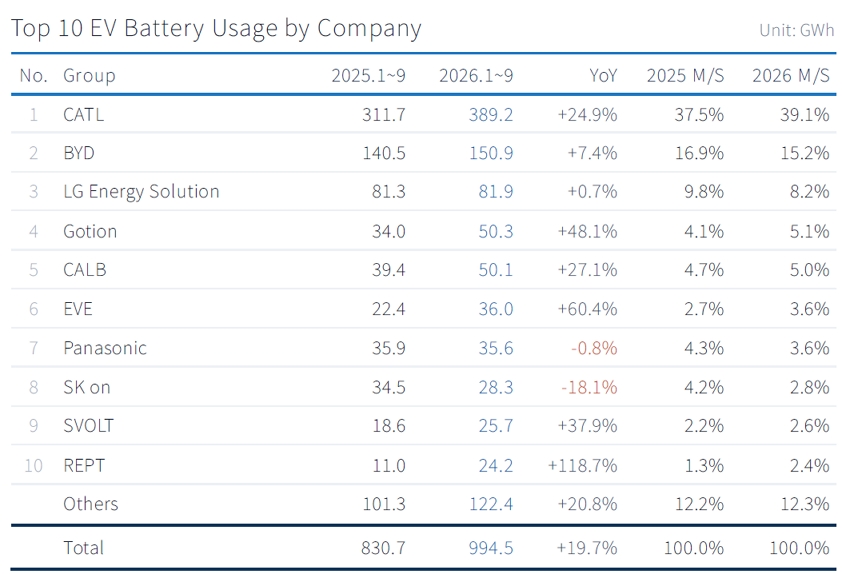
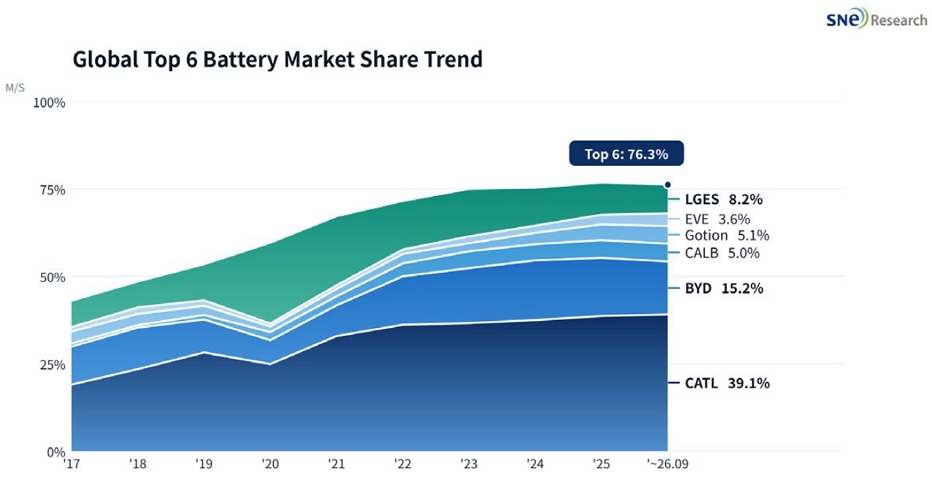
CATL kept first place with 389.2GWh, up 24.9% YoY, and its market share rose 1.6%p from 37.5% to 39.1%. Second-place BYD grew 7.4% to 150.9GWh, but its market share slipped 1.7%p from 16.9% to 15.2%. The two companies' combined share was 54.3%, nearly unchanged from the same period last year (54.4%), but the growth gap widened to 17.5%p between CATL, which has steadily expanded its overseas OEM customer base, and BYD, whose volumes are tied to sales of its own vehicles.
(Source: Global EV and Battery Monthly Tracker, October 2026, SNE Research)
Among Korean companies, LG Energy Solution kept third place with 81.9GWh, up 0.7% YoY. Supply to major OEMs such as Tesla, GM, Hyundai Motor Group, and Volkswagen continued, but growth fell well short of the market, and its market share declined 1.6%p from 9.8% to 8.2%. Usage increased in Europe (38.6GWh, up 13.2%) and Asia (11.1GWh, up 49.4%), but North America fell 44.9% from 29.9GWh to 16.5GWh, offsetting most of the gains.
SK on remained in eighth place with 28.3GWh, down 18.1%, and its market share fell 1.4%p from 4.2% to 2.8%. It supplies batteries to Hyundai Motor Group, Ford, Volkswagen, and Mercedes-Benz, among others, but was hit hard by a 46.7% drop in North American usage, from 14.2GWh to 7.6GWh. In Q3, it posted an operating loss of KRW 80.5 billion, though the loss was narrower than the previous quarter's level excluding one-off factors. The company is moving quickly to secure demand beyond EVs, converting part of its Georgia plant into LFP lines for ESS and signing a 9GWh supply contract with a US ESS company.
Japan's Panasonic slipped one spot to seventh with 35.6GWh, down 0.8%. Tesla's North American volumes, which account for most of its usage, declined slightly to 34.9GWh, and its market share fell 0.7%p from 4.3% to 3.6%. With its customer base concentrated on Tesla, North American sales trends drive its results. Panasonic is working to stabilize production at its Kansas plant while shifting some lines to battery production for AI data centers.
Second-tier Chinese players sustained strong growth across the upper ranks and moved up the table. Gotion rose 48.1% to 50.3GWh, narrowly overtaking CALB (50.1GWh, up 27.1%) for fourth place, and EVE grew 60.4% to 36.0GWh, passing Panasonic for sixth. SVOLT increased 37.9% to 25.7GWh and REPT 118.7% to 24.2GWh, with REPT holding tenth place by keeping a 1.2GWh lead over 11th-place Sunwoda (23.0GWh). The combined share of the seven Chinese companies, including CATL and BYD, was 73.0%, up 3.5%p from 69.5% in the same period last year. This reflects their expansion into commercial vehicles, ESS, and overseas OEMs, backed by a strong domestic base and LFP cost competitiveness.
BYD's usage growth was limited to 7.4% because its EV sales in China fell 32.9%, reducing its usage in China by 7.1% from 112.9GWh to 104.9GWh. In contrast, its usage outside China rose 66.8% from 27.5GWh to 45.9GWh, and September overseas sales more than doubled YoY to about 180,000 units, accounting for nearly 40% of total sales. With its sales network and local production expanding mainly in Europe, Southeast Asia, and South America, the impact of the domestic slowdown is expected to gradually diminish as the overseas share rises.
(Source: Global EV and Battery Monthly Tracker, October 2026, SNE Research)
In Jan-Sep 2026, the global EV battery market sustained growth of around 20%, but the gap between regions widened. China grew 16.2% to 567.8GWh, Europe 33.1%, Asia (excl. China) 74.1%, and South America 176.8%, while North America fell 24.3% to 85.9GWh. The LFP share rose 5.2%p from 52.5% to 57.7%, and average battery capacity per vehicle increased 11.2% from 35.7kWh to 39.7kWh, supporting usage growth that outpaced unit sales. However, the burden of price competition has begun to show in profitability, with CATL's Q3 net profit growth of 14.5% falling well short of its revenue growth (58.6%). China imposed a 2% consumption tax on lithium-ion batteries for the domestic market from September and plans to abolish the VAT rebate on battery exports next January, while in the US, Korean companies are rapidly converting North American EV lines to ESS. Through year-end, each supplier's pricing strategy and pace of demand diversification are expected to shape the competitive landscape.