

China’s Hydrogen Fuel Cell System Market Projected to Reach KRW 12.8 Trillion by 2040, with Annual FCEV Sales of 933,000 Units
Following the First Pilot Phase, Five City Clusters Shift to an Integrated Application Framework…Market Opportunities for Korean Companies Reach Up to KRW 648 Billion in FC Components
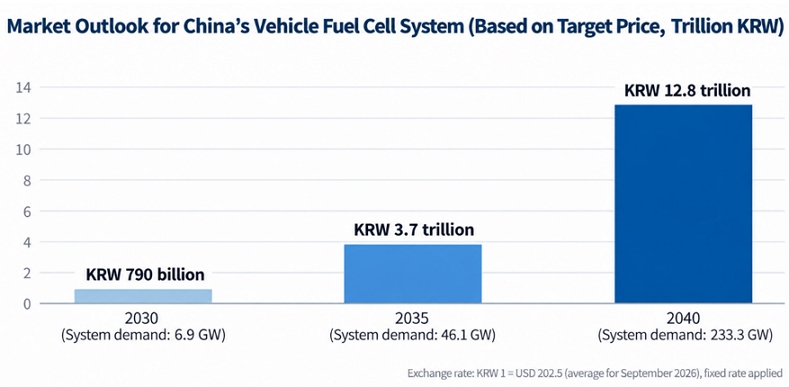
According to SNE Research’s newly published report, <2026> China Hydrogen Industry Outlook: Market Transition and Growth Opportunities (~2040), China’s vehicle fuel cell (FC) system market is projected to expand approximately 16-fold, from around KRW 790 billion in 2030 to KRW 12.8 trillion by 2040, based on target system costs. Over the same period, annual fuel cell electric vehicle (FCEV) sales in China are expected to increase from 38,000 to 933,000 units, while green hydrogen production is forecast to rise from 2.0 million tonnes to 17.6 million tonnes per year. These projections suggest that China’s hydrogen industry is poised to move beyond the demonstration phase and enter a period of large-scale commercialization.
(Source: <2026> China Hydrogen Industry Outlook: Market Transition and Growth Opportunities (~2040), SNE Research)
2030 Marks a Turning Point…FC System Demand to Reach 233.3 GW, Accounting for 35.9% of Global Demand
Market growth is expected to accelerate significantly after 2030. China's demand for vehicle fuel cell (FC) systems, estimated at 6.9 GW in 2030, is projected to increase to 46.1 GW by 2035 and 233.3 GW by 2040, driven by higher power output requirements and wider adoption in heavy-duty commercial vehicles, including 49-ton tractor-trailers. Even as target system costs decline from RMB 570 per kW to below RMB 270 per kW, the overall market is expected to expand as demand growth outpaces cost reductions.
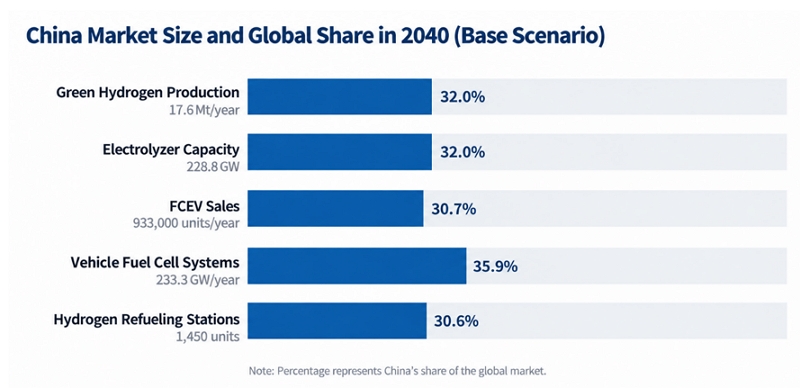
By 2040, China is expected to account for 35.9% of global FC system demand, 30.7% of FCEV sales, and 30.6% of hydrogen refueling stations (1,450 stations). Although China's global shares of green hydrogen production and electrolyzer capacity are projected to decline from 54.1% in 2030 to 32.0% in 2040, this reflects the expansion of hydrogen markets worldwide rather than a contraction of China's market. In absolute terms, green hydrogen production and electrolyzer capacity are expected to increase approximately ninefold and sevenfold, respectively.
(Source: <2026> China Hydrogen Industry Outlook: Market Transition and Growth Opportunities (~2040), SNE Research)
Following a Subsidy Gap, Five City Clusters Transition to an Integrated Hydrogen Application Framework…Hydrogen Price Target Set at RMB 25/kg by 2030
China's hydrogen policy landscape is also at a turning point. Following the conclusion of the first phase of FCEV demonstration city clusters (2021–2025), an approximately eight-month subsidy gap led to a sharp decline in FCEV sales. In the first half of 2026, FCEV sales in China fell 54.5% year-on-year to just 918 units. However, in March 2026, China's Ministry of Industry and Information Technology (MIIT), Ministry of Finance (MOF), and National Development and Reform Commission (NDRC) jointly announced an integrated hydrogen application demonstration program under the "1+N+X" framework. In August of the same year, five city clusters were designated: the Beijing region, the Guangdong–Hong Kong–Macao region, Northeast China–Yangtze River Delta, Xinjiang–Sichuan–Chongqing, and Yellow River–Central Plains.
The policy sets targets of reducing the end-user hydrogen price to RMB 25/kg (approximately KRW 5,100) or below and reaching 100,000 FCEVs in operation by 2030. Since September, implementation has accelerated across designated regions, including the Guangdong region, which aims to deploy 16,000 FCEVs and establish 100 hydrogen refueling stations, and Inner Mongolia, which received an initial allocation of RMB 470 million (approximately KRW 95 billion) in central government incentives. SNE Research noted that this policy transition signals a shift in China's hydrogen strategy from a primary focus on vehicle deployment toward broader demand creation encompassing industrial applications and green fuels.
Hydrogen Prices, Refueling Capacity, and Offtake Agreements—not Manufacturing Capacity—Will Determine the Pace of Growth
SNE Research identified hydrogen prices, hydrogen refueling station capacity, and long-term offtake agreements, rather than manufacturing capacity, as the key factors determining the pace of growth in China's hydrogen market. To meet FCEV hydrogen demand with a network of 1,450 refueling stations by 2040, each station would require a designed refueling capacity of approximately 22 tonnes per day, assuming a 65% utilization rate. If capacity remains at 12 tonnes per day, as seen in current large-scale facilities, the network would be able to meet only about 55% of projected demand. Similarly, while announced green fuel projects, including green methanol and green ammonia, represent approximately 8.1 million tonnes of hydrogen equivalent, only around 1.1 million tonnes have reached the operational or final investment decision (FID) stage.
Opportunities for Korean Companies Lie in Supply Chain Bottlenecks…FC Components and Testing Market Could Reach KRW 648 Billion
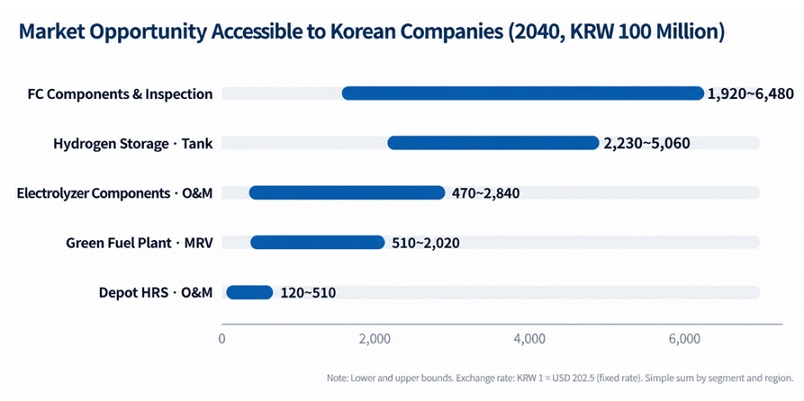
The report assessed the market opportunities realistically accessible to Korean companies within China's hydrogen supply chain bottlenecks, using a TAM–SAM–Accessible Opportunity framework. By 2040, fuel cell components and testing are expected to represent the largest accessible market opportunity, estimated at approximately KRW 192–648 billion, followed by hydrogen storage and tanks at KRW 223–506 billion, electrolyzer components and operations and maintenance (O&M) at KRW 47–284 billion, green fuel processing and measurement, reporting, and verification (MRV) at KRW 51–203 billion, and depot hydrogen refueling station equipment and O&M at KRW 12–51 billion.
(Source: <2026> China Hydrogen Industry Outlook: Market Transition and Growth Opportunities (~2040), SNE Research)
The analysis suggests that opportunities for Korean companies lie not in competing with Chinese manufacturers in finished products, but in areas where Chinese companies still require external technologies and expertise, such as high-reliability components, testing and validation, safety solutions, and operations and maintenance (O&M).
SNE Research forecasts that China will emerge as one of the world's largest markets for hydrogen-powered commercial vehicles and fuel cell systems after 2030, as declining hydrogen prices coincide with the expansion of large-scale refueling infrastructure. The firm also recommends that Korean companies adopt a phased market entry strategy tailored to the demand characteristics and partnership structures of each designated city cluster.
* Note: All KRW figures have been converted using a fixed exchange rate of RMB 1 = KRW 202.5 (September 2026 monthly average), applied consistently throughout the forecast period.
This press release is based on SNE Research's report, <2026> China Hydrogen Industry Outlook: Market Transition and Growth Opportunities (~2040).