

Global EV Battery Electrolyte[1] Consumption Reaches 1,075K tons in Jan-Aug 2026,[2] Up 23.0% Year-on-Year
- Ex-China electrolyte consumption reaches 385K tons in January-August 2026, up 34.7% year-on-year
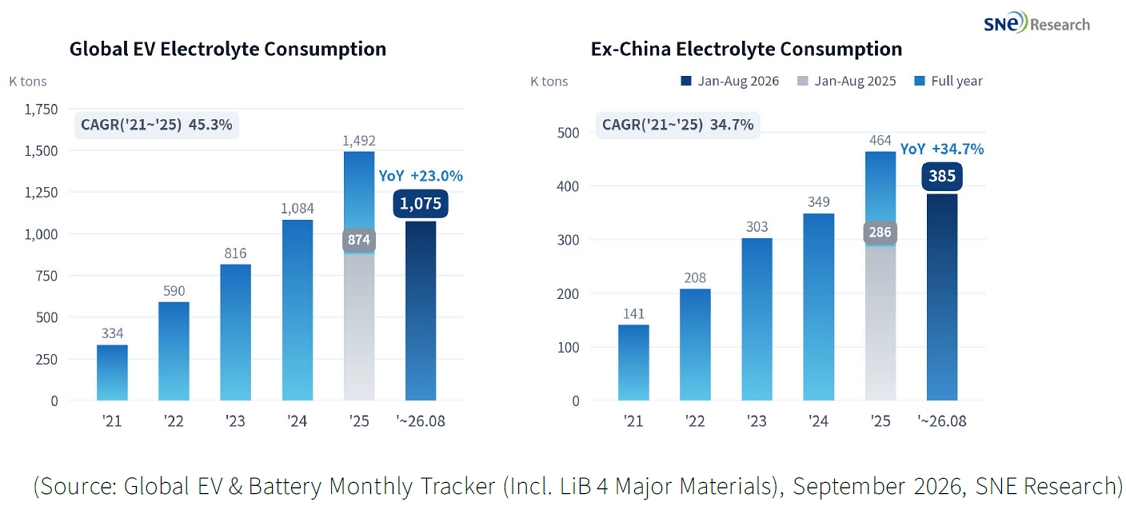
Electrolyte
serves as the pathway for lithium ions moving between the cathode and anode,
and consists of electrolyte salts, solvents and additives. Because its
composition determines charging speed, power, low-temperature performance,
lifespan and safety, the ability to design customer-specific formulations and
additives is becoming more important as high-voltage and fast-charging cells
increase.
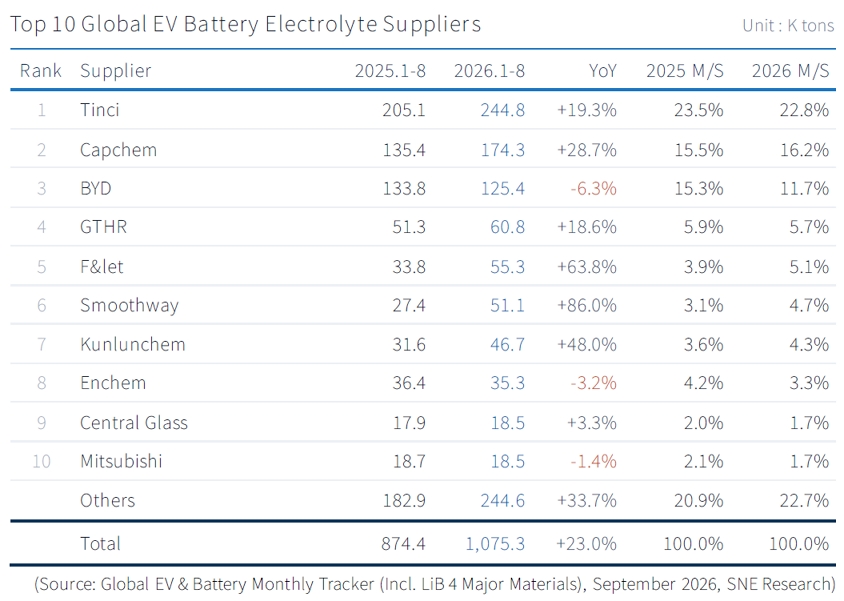
By company,
Tinci held first place with approximately 245K tons, up 19.3%, and Capchem
consolidated second place with approximately 174K tons, up 28.7%. BYD, by
contrast, fell 6.3% to approximately 125K tons. Mid-sized Chinese suppliers
such as Smoothway (86.0%), F&let (63.8%), Kunlunchem (48.0%) and GTHR
(18.6%) continued to post high growth. Korea's Enchem declined 3.2% to
approximately 35K tons, and Japan's Central Glass newly entered the top 10 with
3.3% growth.
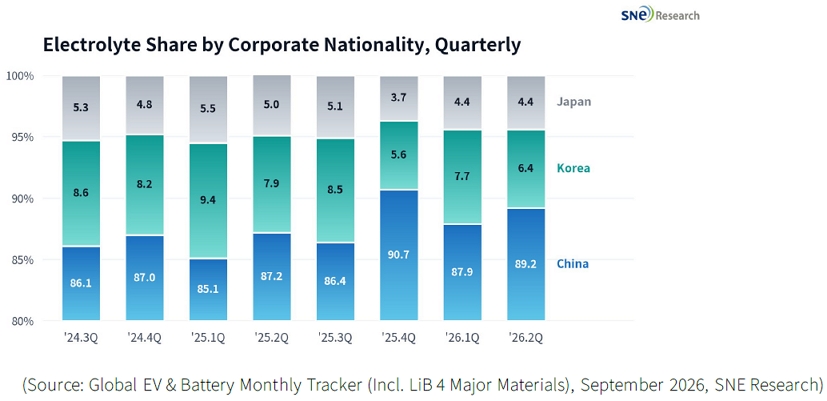
By
corporate nationality, Chinese companies held an 89.2% share in the second
quarter of 2026, up 2.0 percentage points from 87.2% a year earlier. Over the
same period, Korean companies fell 1.5 percentage points from 7.9% to 6.4%, and
Japanese companies 0.6 percentage points from 5.0% to 4.4%. Compared with the
first quarter (87.9%), the Chinese share was also 1.3 percentage points higher,
showing Chinese suppliers' advantage becoming more entrenched each quarter.
Growth in the electrolyte market was driven jointly by higher EV battery installations and the spread of LFP. With the ex-China market growing faster than the total, the share of demand from Europe and Asia (ex-China) increased, and larger battery capacity per vehicle also contributed to higher consumption.
The recent focus of the electrolyte market is ESS demand and raw material prices. Major Chinese suppliers posted sharply improved first-half results on surging shipments of ESS batteries, and prices of key additives such as VC remain well above the start of the year. In September, LiPF6 prices edged up on high utilization and low inventories, but falling lithium carbonate prices limited the increase. With China levying a consumption tax on domestically sold lithium-ion batteries from September, negotiations between cell makers and automakers over sharing the cost are also continuing. Going forward, as Chinese suppliers' cost and scale advantages persist, local production bases in North America and Europe, stable sourcing of electrolyte salts and additives, and capability in high-performance electrolytes for ESS will determine each supplier's standing.
[2] Based on batteries installed in EVs registered during the period.