

Global EV Battery Separator[1] Consumption Reaches 13,732 Mil m2 in Jan-Aug 2026,[2] Up 24.6% Year-on-Year
- Chinese separator suppliers held a 91.6% share in the second quarter of 2026, up 1.6 percentage points from the first quarter
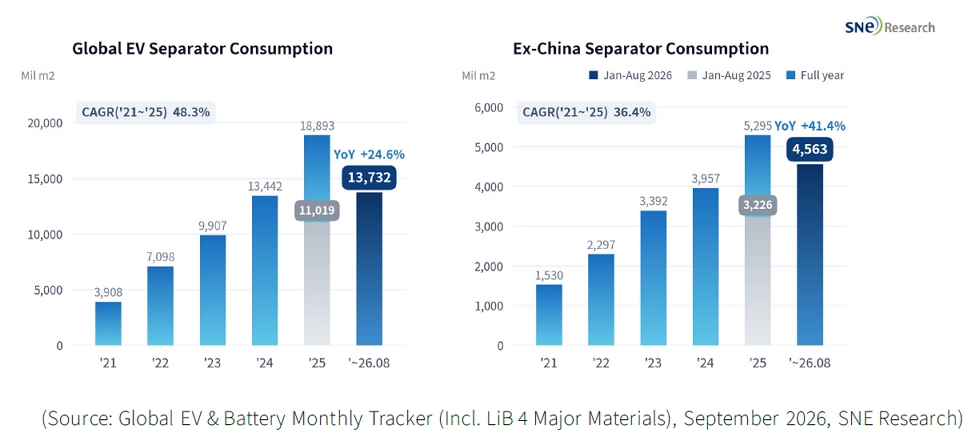
Separator consumption for batteries installed in electric vehicles (EV, PHEV, HEV) registered worldwide reached approximately 13,732 Mil m2 in January-August 2026, up 24.6% from 11,020 Mil m2 a year earlier. Over the same period, the ex-China market grew 41.4% to approximately 4,563 Mil m2, far above the overall growth rate, and its share of total consumption rose 3.9 percentage points from 29.3% to 33.2%.
The separator prevents short circuits by keeping the cathode and anode apart inside the battery, while its micropores allow lithium ions to pass through. Its thickness, pore structure and heat resistance affect battery safety, power and lifespan, and as demand for large cells and fast charging grows, thinner and more heat-resistant products are gaining share.
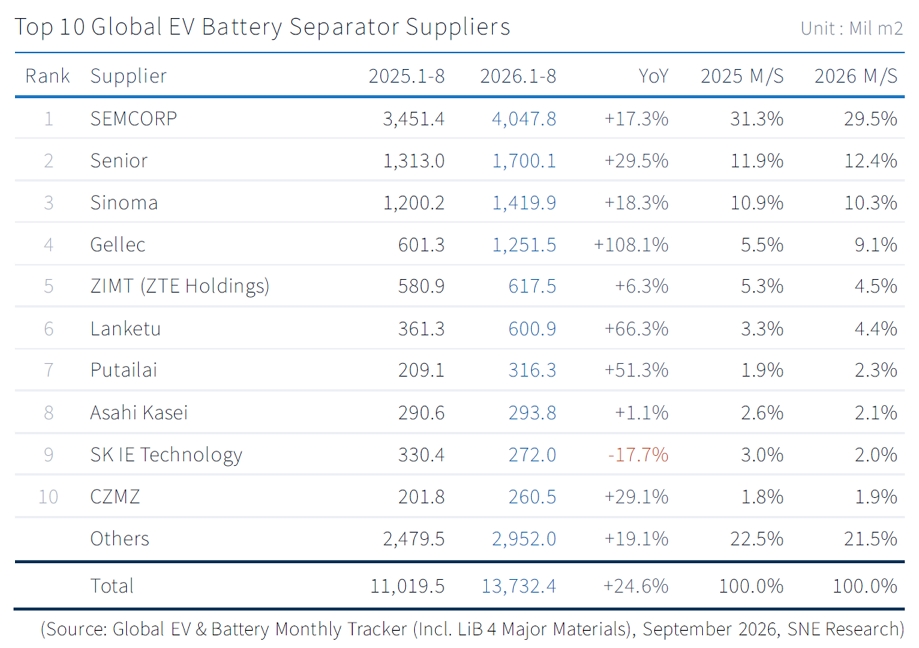
In the global separator market in January-August 2026, SEMCORP held first place with approximately 4,048 Mil m2, up 17.3%, followed by Senior (29.5%) and Sinoma (18.3%). Gellec kept fourth place with approximately 1,252 Mil m2, up 108.1%, and Lanketu (66.3%) and Putailai (51.3%) also expanded quickly. CZMZ grew 29.1% and newly entered the top 10. By contrast, ZIMT (ZTE Holdings) rose only 6.3%, Asahi Kasei was virtually flat at 1.1% growth, and SK IE Technology fell 17.7%.
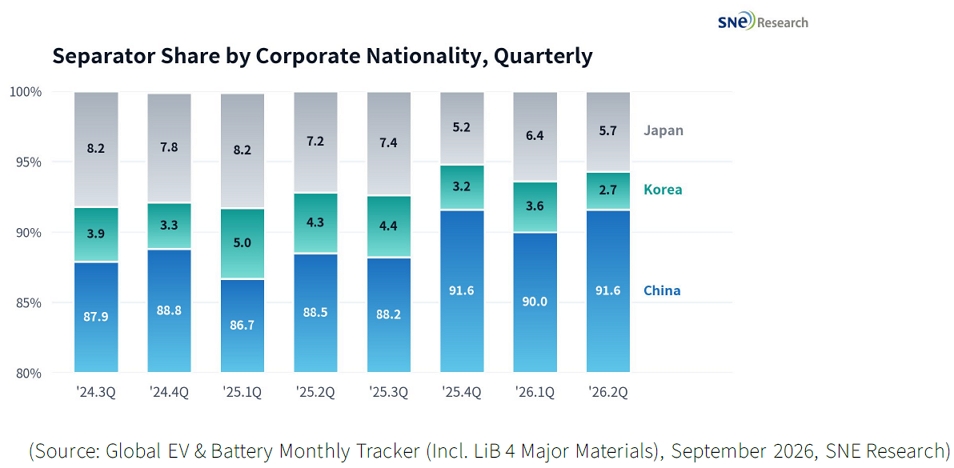
By nationality, Chinese suppliers held a 91.6% share in the second quarter of 2026, up 1.6 percentage points from the first quarter (90.0%) and 3.1 percentage points from a year earlier (88.5%). Over the same period, Japanese suppliers fell from 7.2% to 5.7% and Korean suppliers from 4.3% to 2.7%. As Chinese suppliers capture most of the additional demand with their scale and cost competitiveness, Korean and Japanese suppliers are restructuring around high-value products and local supply in North America and Europe.
[2] Based on batteries installed in EVs registered during the period.