

Global EV Battery Anode Material Consumption Reaches 1,020K tons in Jan-Aug 2026, Up 21.1% Year-on-Year
- Ex-China
market records 402K tons, growing 27.5% and outpacing the global average
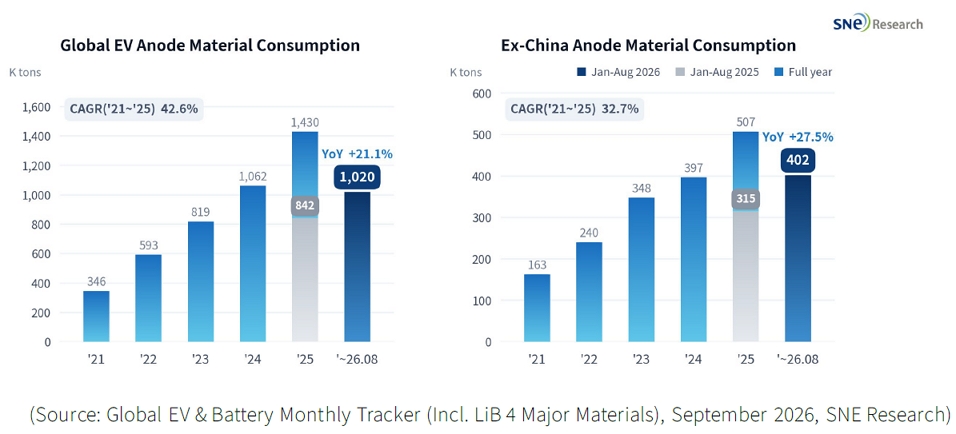
Global anode material consumption for electric vehicles reached 1,020K tons in January-August 2026, up 21.1% from 842K tons a year earlier, exceeding 1,000K tons for the first time on a January-August basis. Over the same period, the ex-China market grew 27.5% from 315K tons to 402K tons, 6.4 percentage points above the global average. The ex-China share of the total also rose 2.0 percentage points from 37.4% to 39.4%.
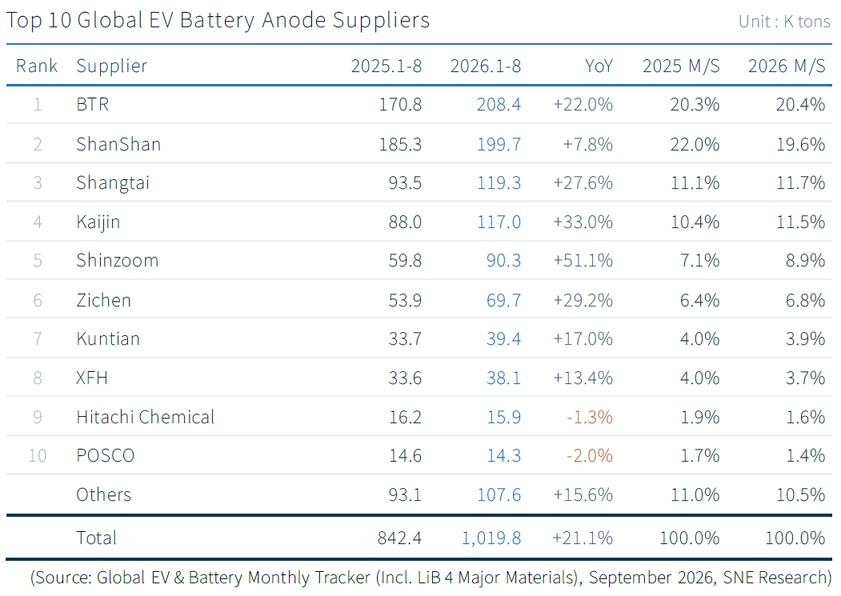
By supplier, BTR held first place, growing 22.0% from 171K tons to 208K tons. ShanShan rose only 7.8% from 185K tons to 200K tons and remained second, with the gap between the two widening to around 9K tons. Their combined share fell to 40.0% from 42.3% a year earlier, as the weight of the leaders gradually disperses.
Growth was even faster in the middle ranks. Shinzoom rose 51.1% from 60K tons to 90K tons, the highest growth rate among the top 10, and Kaijin (117K tons, 33.0%), Zichen (70K tons, 29.2%) and Shangtai (119K tons, 27.6%) all outpaced the market average. In particular, the gap between Shangtai and Kaijin narrowed to around 2K tons, intensifying competition for third place.
Kuntian (39K tons) and XFH (38K tons) rose 17.0% and 13.4% respectively, below the market average. Japan's Hitachi Chemical declined 1.3% to 16K tons, and Korea's POSCO fell 2.0% to 14K tons. As competition among Chinese suppliers extends to cost and yield improvements in synthetic graphite and customer diversification, growth rates by supplier are diverging clearly.
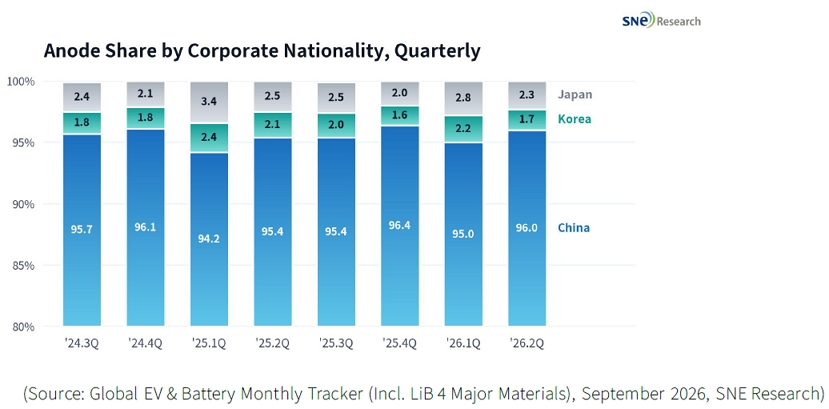
By corporate nationality, Chinese companies held a 96.0% share in the second quarter of 2026, up 1.0 percentage points from 95.0% in the first quarter and 0.6 percentage points higher than 95.4% a year earlier. Over the same period, Korean companies fell from 2.1% to 1.7% and Japanese companies from 2.5% to 2.3%. Even as ex-China demand rises rapidly, diversification of supplier nationality has made little progress.
Anode material consumption in the ex-China market rose from 315K tons to 402K tons, a growth rate of 27.5%. Expanding battery production in Europe and Asia (ex-China) drove demand, but a 23.7% decline in EV battery usage in North America partly limited growth in the ex-China market.
Efforts to build production outside China are continuing. The U.S. Department of Commerce issued final anti-dumping and countervailing duty determinations of around 160% on Chinese active anode material in February, but the International Trade Commission found no injury in March, so no duty orders took effect. Still, with a 25% Section 301 tariff applied to natural graphite since January, discussions on building North American and Southeast Asian supply chains continue, and most new facilities target mass production from 2027 onward, making a quick change in the supply structure difficult.
The key to future competition is securing commercial production capacity that meets origin requirements. Whether China resumes its export controls on synthetic graphite anode material, whose suspension has been extended to January 2027, and the prospect of further U.S. tariff measures are simultaneously pressing for a reorganization of the supply chain, so stable raw material sourcing and next-generation technologies such as silicon anodes will determine each supplier's standing. The growing demand for traceability at the material stage under the EU battery passport mandate taking effect in February 2027 is also raising the importance of local production sites.