

Global EV Battery Cathode Material Consumption Reaches 1,917K tons in Jan-Aug 2026, Up 21.8% Year-on-Year
- LFP share rises 5.0 percentage points to 65.4%, while the ex-China market grows 30.0% and drives expansion
(Source: Global EV & Battery Monthly Tracker (Incl. LiB 4 Major Materials), September 2026, SNE Research)
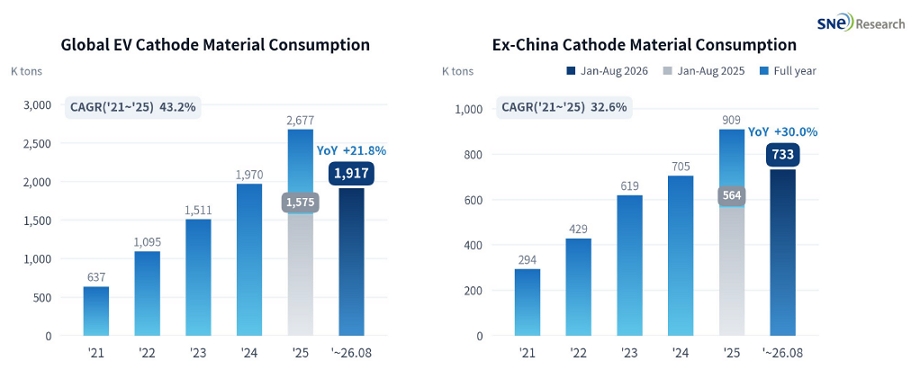
Global cathode material consumption for xEVs reached 1,917K tons in January-August 2026, up 21.8% from 1,575K tons a year earlier. Over the same period, the ex-China market grew 30.0% from 564K tons to 733K tons, outpacing the overall market. The ex-China share of total consumption also rose 2.4 percentage points from 35.8% to 38.2%.
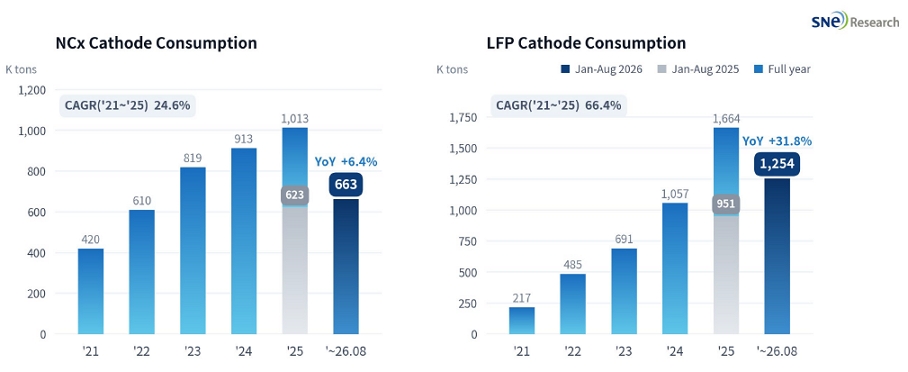
By material, LFP grew 31.8% to 1,254K tons, while NCx rose only 6.4% to 663K tons. The LFP share of total cathode material rose 5.0 percentage points from 60.4% to 65.4%. In the ex-China market, the LFP share jumped 14.1 percentage points from 20.8% to 34.9%, as LFP becomes a mainstream material beyond China in Europe and Asia.
(Source: Global EV & Battery Monthly Tracker (Incl. LiB 4 Major Materials), September 2026, SNE Research)
(Source: Global EV & Battery Monthly Tracker (Incl. LiB 4 Major Materials), September 2026, SNE Research)
NCx (ternary) cathode material consumption reached 663K tons in January-August 2026, up 6.4% from 623K tons a year earlier. The growth gap with LFP widened to 25.4 percentage points, and demand continued to narrow toward premium and high-performance models that require high energy density.
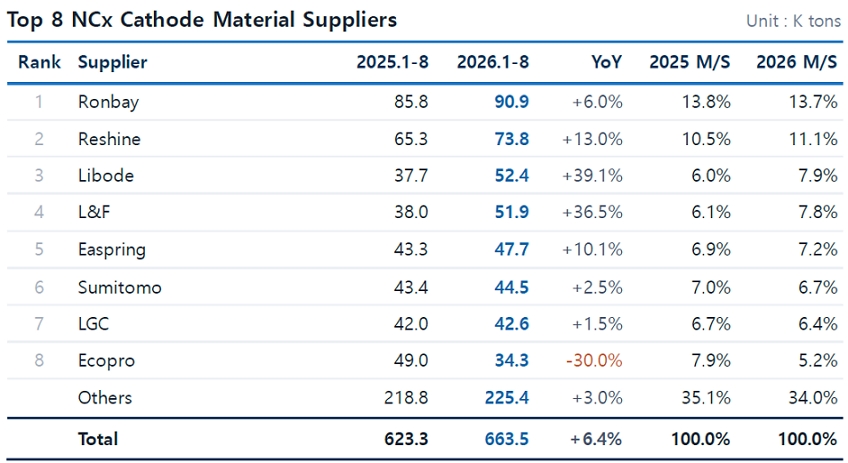
By supplier, Ronbay kept the lead, rising from 86K tons to 91K tons, followed by Reshine, which rose from 65K tons to 74K tons. Libode grew 39.1% from 38K tons to 52K tons and L&F 36.5% from 38K tons to 52K tons, the highest growth rates among the leading suppliers. Easpring (48K tons), Sumitomo (45K tons) and LGC (43K tons) posted only moderate increases, while Ecopro fell 30.0% from 49K tons to 34K tons.
Results by company diverged according to customer mix and supply regions. L&F sustained double-digit growth by increasing ternary volumes and, targeting ESS demand in North America, signed a KRW 160 billion supply agreement with SK On in September and began mass production of LFP cathode material at the end of the third quarter. Ecopro, on the other hand, saw its consumption decline as sales of its main customers' electrified models remained weak, but it is strengthening its response to European customers with its Hungarian plant, which started mass production in June, as a base.
(Source: Global EV & Battery Monthly Tracker (Incl. LiB 4 Major Materials), September 2026, SNE Research)
LFP cathode material rose 31.8% to 1,254K tons from 951K tons a year earlier. As adoption spread from entry-level models to mid-size vehicles and new models from overseas automakers, LFP accounted for most of the growth in the cathode market.
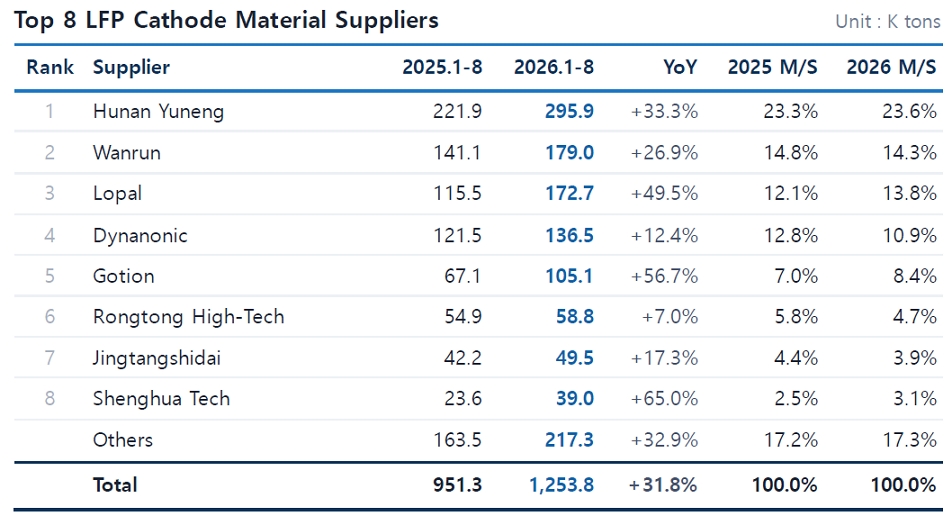
Among LFP suppliers, Lopal grew 49.5% to 173K tons, overtaking Dynanonic for third place. First-placed Hunan Yuneng rose 33.3% to 296K tons, and second-placed Wanrun grew 26.9% to 179K tons, narrowing its lead over Lopal to around 6K tons. Gotion grew 56.7% to 105K tons and Shenghua Tech 65.0% to 39K tons, the fastest growth among the leading suppliers, while Dynanonic (137K tons, 12.4%), Rongtong High-Tech (59K tons, 7.0%) and Jingtangshidai (50K tons, 17.3%) trailed the market average.
In the LFP market, the advantage of Chinese suppliers vertically integrated from raw materials to finished material persisted. While moves to normalize material prices have emerged under the Chinese government's stance against excessive competition, the 2% consumption tax levied on domestically sold lithium-ion batteries since September is making cost-sharing negotiations between cell makers and material suppliers more difficult.
By corporate nationality, the share of Chinese suppliers rose 3.3 percentage points to 87.3% from 84.0% a year earlier, while Korean suppliers fell 3.0 percentage points from 12.0% to 9.0% and Japanese suppliers 0.4 percentage points from 4.0% to 3.6%. Korean companies are accelerating the transition to add LFP to their ternary-centered portfolios. Cooperation between Korean material and cell makers on a non-Chinese LFP supply chain is also taking shape, as shown by SK On's LFP cathode purchase agreement of about KRW 1.1 trillion with POSCO Future M in September. However, the agreement covers ESS volumes for its plant in Georgia, U.S., with supply running from 2027 to 2029, so it will take time before changes show up in EV consumption.
Going forward, competition will hinge on how quickly suppliers can build production sites and product lines that fit regional supply-chain rules. North American supply-chain requirements, discussions on requirements for locally produced components that the EU is pursuing alongside its Battery Booster package unveiled in June, and the battery passport mandate taking effect in February 2027 are all tightening at once. Whether China resumes its export controls on cathode and battery technology, whose suspension was extended to January 2027 under a U.S.-China agreement, also remains a variable, so gaps between suppliers are expected to widen depending on LFP and high-performance ternary technology and local sourcing capability.