

Global EV Sales Excluding China Reach 6.223 Million Units in January-August 2026, Up 28.9% Year-on-Year
- Asia (ex-China) surges 77.0% while North America falls 24.9%, as regional trends diverge
(Source: Global EV and Battery Monthly Tracker, September 2026, SNE Research)
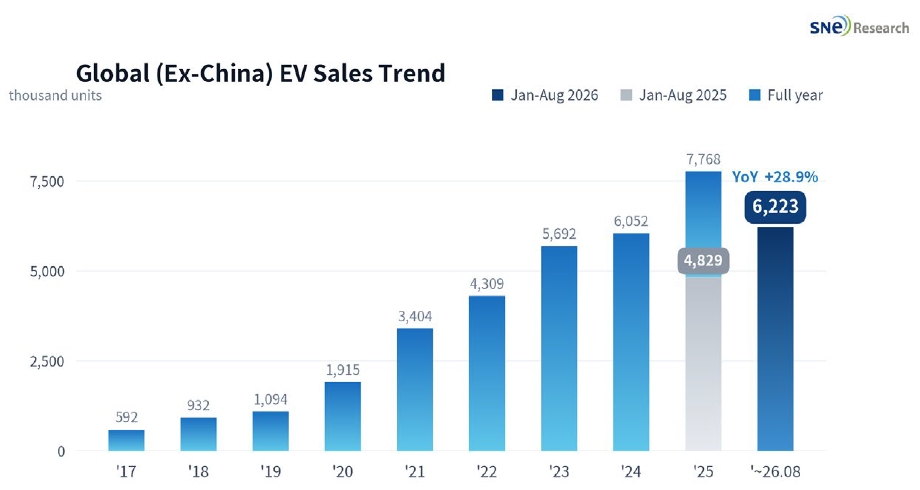
In January-August 2026, global EV (BEV+PHEV) sales excluding China totaled 6.223 million units, up 28.9% from 4.829 million units a year earlier. Growth far exceeded the global rate (5.9%), continuing the shift of demand outside China. Growth in the single month of August was 17.8%, below the cumulative rate, reflecting a base effect from the same month last year, when U.S. buyers rushed to purchase ahead of the end of the tax credit. By type, BEVs rose 32.1% to 4.633 million units, growing faster than PHEVs (20.4%).
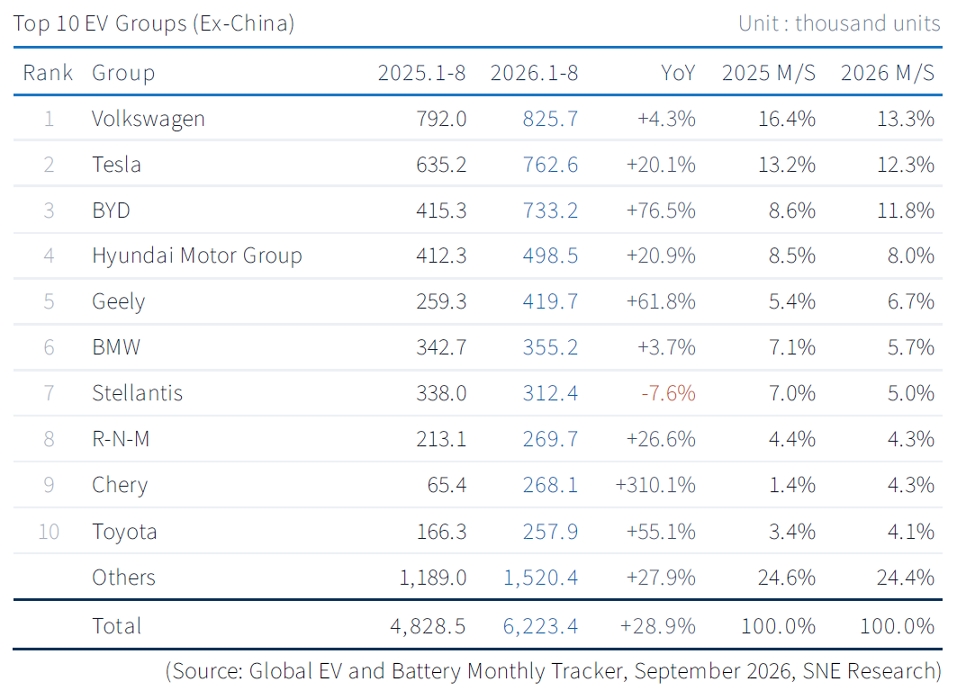
By company, Volkswagen retained first place with 826,000 units, up 4.3% year-on-year. However, growth well below the market average cut its share 3.1 percentage points from 16.4% to 13.3%. Deliveries in Europe rose 12.8%, but a 72.7% plunge in North America limited its growth.
Tesla held second place with 763,000 units, up 20.1%, but its share slipped 0.9 percentage points from 13.2% to 12.3%. Deliveries in North America, its largest market, fell 1.5%, while growth of 21.9% in Europe and 87.2% in Asia (ex-China) lifted its ex-China results.
BYD ranked third with 733,000 units, a sharp 76.5% increase, and its share rose 3.2 percentage points from 8.6% to 11.8%. Deliveries in Europe grew 76.5% to 246,000 units, and Asia (ex-China) rose 54.7%. By expanding sales networks and local production at the same time in Europe, Southeast Asia and South America, BYD narrowed the gap with second-placed Tesla to around 30,000 units.
Hyundai Motor Group grew 20.9% to 499,000 units, but fell short of the market average and its share edged down from 8.5% to 8.0%. Despite strong sales in Europe and Asia (ex-China), a 23.4% drop in North American deliveries weighed on results. As Chinese groups expand rapidly, competition for fourth and fifth place is intensifying.
In terms of growth, Chinese groups stood out. Chery grew 310.1% to 268,000 units, the steepest rise among the top 10 groups, and Geely increased 61.8% to 420,000 units. Chery lifted its European deliveries to 4.6 times the previous year's level on the back of export brands such as OMODA and JAECOO. Toyota rose 55.1% to 258,000 units, placing tenth, and R-N-M grew 26.6% to 270,000 units. BMW (355,000 units, 3.7%), by contrast, was nearly flat, and Stellantis fell 7.6% to 312,000 units.
Groups outside the top 10 grew 27.9% to 1.520 million units, but their share edged down from 24.6% to 24.4%. While 11th-placed Mercedes-Benz fell 3.8%, VinFast grew 82.9% to rise to 12th place, showing a clear divergence between emerging brands and established OEMs in the middle ranks as well.
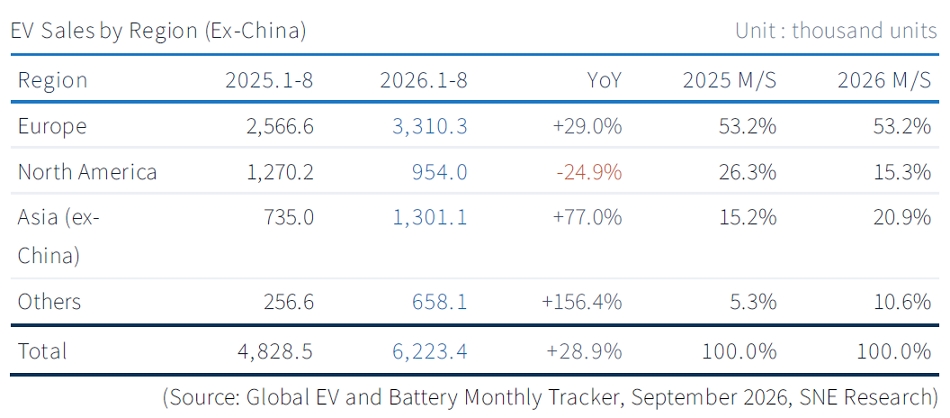
By region, Europe grew 29.0% to 3.310 million units and remained the largest source of demand in the ex-China market. Its share stayed at 53.2%, the same level as a year earlier. Major countries including Germany (39.7%), France (43.1%), the UK (31.5%) and Italy (77.3%) grew by double digits or more, supported by national subsidies, responses to emission regulations and launches of affordable new models.
North America, by contrast, fell 24.9% to 954,000 units, and its share dropped 11.0 percentage points from 26.3% to 15.3%. A 31.4% decline in U.S. deliveries weighed heavily, as price burdens after the end of the tax credit coincided with the discontinuation of some models and production adjustments. Other regions surged 156.4% to 658,000 units, doubling their share from 5.3% to 10.6%.
Asia (ex-China) grew 77.0% to 1.301 million units, the fastest growth of any region. Its share rose 5.7 percentage points from 15.2% to 20.9%. Korea grew 81.3% and remained the largest market in the region, and India, Thailand, Vietnam and Indonesia all grew by more than 50%. Local production and price competitiveness of Chinese OEMs combined with new model launches by local brands.
The ex-China EV market grew 28.9% in January-August 2026, but regions moved in opposite directions. North America fell 24.9% amid a gap in policy support and high vehicle prices, while Asia (ex-China) and other emerging markets expanded rapidly on the back of aggressive entry by Chinese OEMs. Among the top 10 groups, the combined share of three Chinese groups, BYD, Geely and Chery, rose from 15.3% a year earlier to 22.8%. Through the end of the year, whether the effect of European subsidies lasts, when the U.S. market finds a floor, and how quickly Chinese OEMs expand local production will shape the competitive landscape of the ex-China market.