

January-August 2026 Global[1] EV Battery Usage[2] Reaches 844.2 GWh, Up 19.7% Year-on-Year
- Seven Chinese suppliers' share rose 3.6
percentage points to 73.3%, while the three Korean suppliers fell 3.9
percentage points to 12.7%
Total battery usage in electric vehicles (EV, PHEV, HEV)
registered around the world in January-August 2026 came to approximately 844.2
GWh, up 19.7% year-on-year. Usage in the single month of August was 116.8 GWh,
up 14.3% from a year earlier, but the increase was smaller than in July
(23.3%), pulling the cumulative growth rate below 20%.
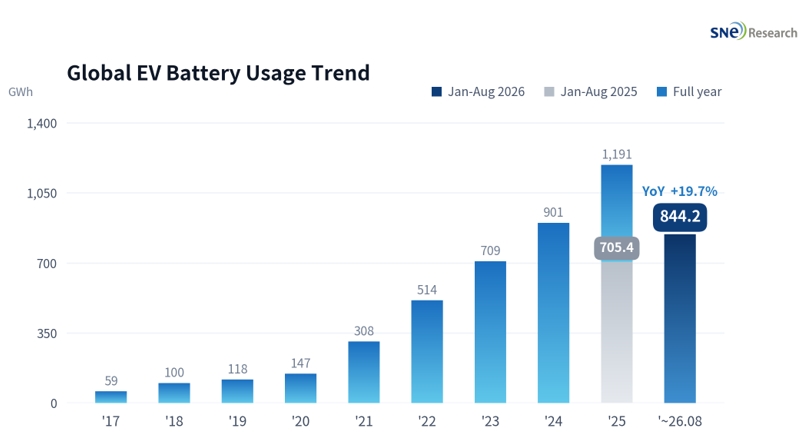
(Source: Global EV and Battery Monthly Tracker, September 2026, SNE Research)
CATL held first place with 333.0 GWh, up 25.2% year-on-year. Its share rose 1.7 percentage points from 37.7% to 39.4%. Second-placed BYD grew 6.2% to 127.9 GWh, but its share fell 2.0 percentage points from 17.1% to 15.1%. The two companies' combined share of 54.6% was close to the 54.8% of a year earlier, yet the gap in growth rates persisted between CATL, which broadened supply to overseas automakers, and BYD, whose main demand base is sales of its own vehicles.
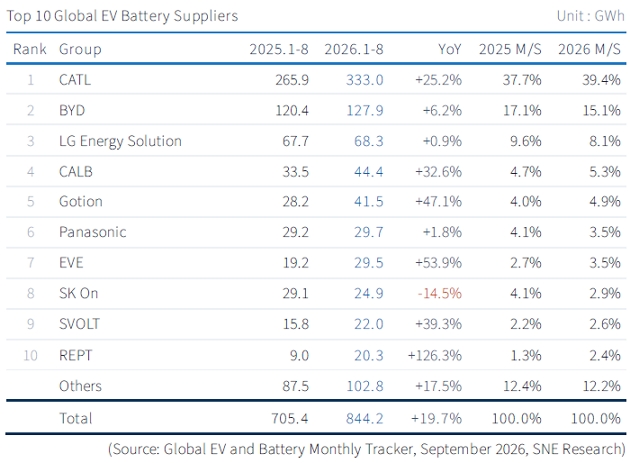
Among Korean suppliers, LG Energy Solution kept third place with 68.3 GWh, up 0.9% year-on-year. Supply to major OEMs such as Tesla, GM, Hyundai Motor Group and Volkswagen continued, but growth fell far short of the market, and its share declined 1.5 percentage points from 9.6% to 8.1%. Usage increased in Europe and Asia, but North American usage dropped 42.3% from 25.2 GWh to 14.6 GWh, offsetting most of the gains.
SK On fell 14.5% to 24.9 GWh and stayed in eighth place, with its share down 1.2 percentage points from 4.1% to 2.9%. It supplies batteries to Hyundai Motor Group, Ford, Volkswagen and Mercedes-Benz, among others, but the 41.8% drop in North American usage, from 11.7 GWh to 6.8 GWh, weighed heavily. After unwinding its joint venture with Ford and moving to sole operation of its Tennessee plant, the company is securing LFP materials for its North American ESS business and speeding up the search for demand beyond electric vehicles.
Japan's Panasonic ranked sixth with 29.7 GWh, up 1.8%. Tesla volumes in North America supported usage, but with growth well below the market average its share fell 0.6 percentage points from 4.1% to 3.5%. With a customer base centered on Tesla, North American sales trends drive its results, and Panasonic is stabilizing operations at its Kansas plant while also pursuing a plan to convert part of its capacity to batteries for data centers over the medium to long term.
Chinese suppliers continued to grow at rates around 30% across the upper ranks. CALB ranked fourth with 44.4 GWh, up 32.6%, and Gotion fifth with 41.5 GWh, up 47.1%. EVE grew 53.9% to 29.5 GWh and SVOLT 39.3% to 22.0 GWh, while REPT held tenth place with 20.3 GWh, up 126.3%. Its lead over 11th-placed Sunwoda (19.3 GWh) widened to 1.0 GWh. Adding CATL and BYD to these five, the combined share of the seven Chinese suppliers reached 73.3%, up 3.6 percentage points from 69.7% a year earlier. This reflects the expansion of their customer base into commercial vehicles, ESS and overseas OEMs on the strength of domestic volume and LFP cost competitiveness.
BYD's usage grew only 6.2% year-on-year, mainly because its EV deliveries in China fell 33.6%. By contrast, its usage in the ex-China market rose 66.5% from 23.8 GWh to 39.7 GWh, and its overseas sales hit a monthly record in August. As BYD expands its sales networks and local production in Europe, Southeast Asia and South America, the impact of the domestic slowdown is expected to ease as the overseas share rises.
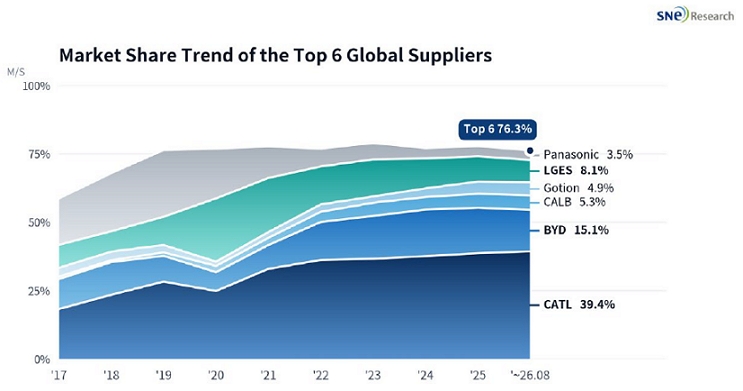
(Source: Global EV and Battery Monthly Tracker, September 2026, SNE Research)
The global EV battery market kept growing at around 20% in January-August 2026, but the divergence between regions widened. China rose 16.9% to 483.7 GWh, Europe grew 29.2%, Asia (ex-China) 76.0% and South America 179.9%, while North America fell 23.7% to 73.1 GWh. In the United States, demand has remained weak since the federal EV tax credit ended, and battery makers are increasingly converting EV lines to ESS production. On the product side, the LFP share rose 5.1 percentage points from 52.2% to 57.3%, and average capacity per vehicle grew 11.9% from 35.1 kWh to 39.2 kWh, supporting usage growth that outpaced vehicle sales. China began levying a 2% consumption tax on lithium-ion batteries sold domestically in September and plans to abolish the export VAT rebate on batteries in January next year, so the pricing policies of Chinese suppliers and the pace of their overseas production are likely to shape competition through the end of the year.
[2] Based on batteries installed in EVs registered during the period.