

Global EV Battery Anode Material Consumption Reaches 873K tons in Jan-Jul 2026, Up 21.7% Year-on-Year
- Ex-China market records 354K tons, growing 29.4% and outpacing the global average
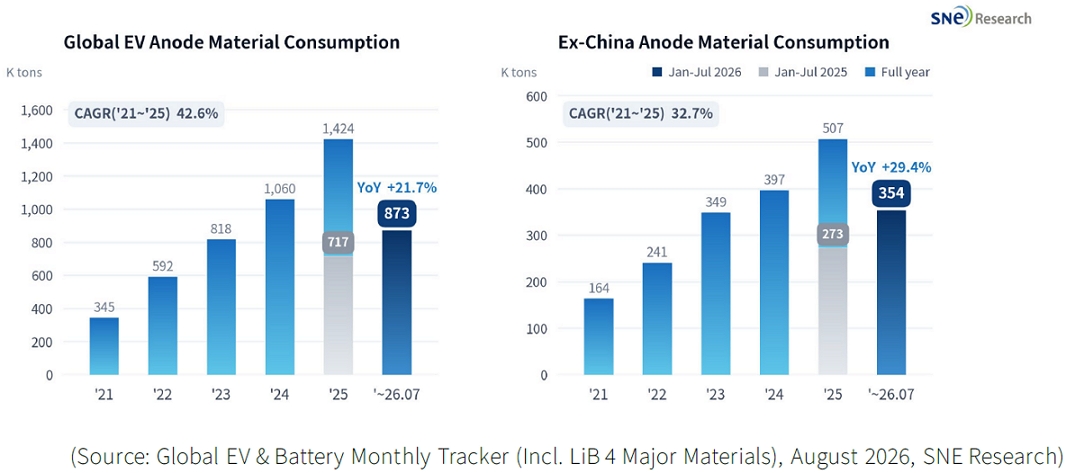
Global anode material consumption for electric vehicles reached approximately 873K tons in January-July 2026, a 21.7% increase from 717K tons a year earlier. Over the same period, the ex-China market expanded 29.4% from 273K tons to 354K tons, outpacing the global average. The ex-China share of total consumption also rose from 38.1% to 40.5%, making the geographic broadening of demand more pronounced.
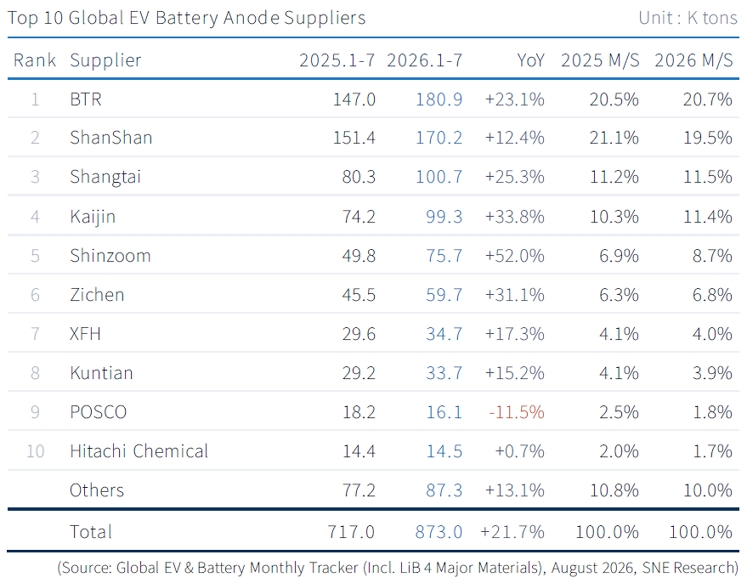
By supplier, BTR moved into first place, growing 23.1% from 147K tons to 181K tons. ShanShan, which had held the top position until the previous period, slipped to second as its volume rose only 12.4%, from 151K tons to 170K tons. The two companies still account for a combined share of roughly 40.2%, but the lead changed hands as ShanShan's growth fell well short of the market average.
Mid-tier suppliers expanded more quickly. Shangtai grew 25.3% from 80K tons to 101K tons and Kaijin grew 33.8% from 74K tons to 99K tons. Shinzoom posted the highest growth rate among major suppliers at 52.0%, rising from 50K tons to 76K tons, while Zichen increased 31.1% from 46K tons to 60K tons.
The leading suppliers added volume on the strength of scale and established customer bases, while Kaijin, Shinzoom and Zichen outpaced the market average by winning new customers and expanding capacity. As competition among Chinese suppliers extends to cost and yield improvements in artificial graphite and to broader natural and artificial graphite portfolios, growth rates are diverging clearly by supplier. Korean supplier POSCO declined 11.5% to 16K tons.
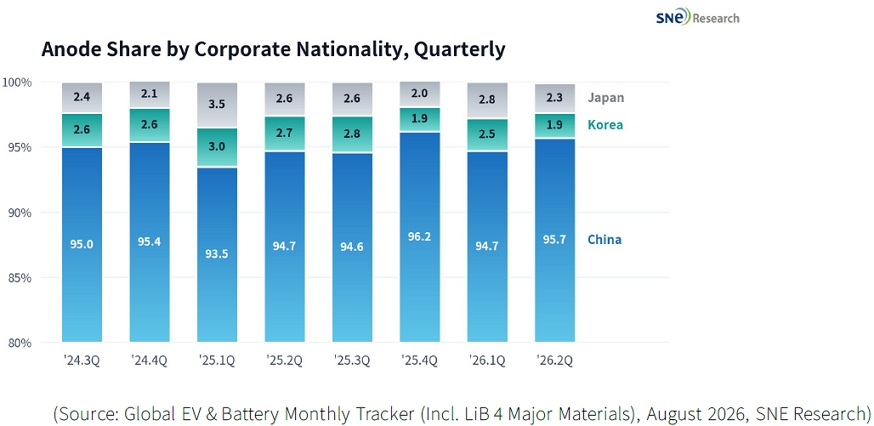
By corporate nationality, Chinese companies held a 95.7% share in the second quarter of 2026, up 1.0 percentage points from 94.7% in the first quarter and 1.0 percentage points higher than 94.7% a year earlier. Korean companies fell from 2.5% to 1.9% and Japanese companies from 2.8% to 2.3%. Even as ex-China demand grows rapidly, actual supply is becoming more concentrated among Chinese suppliers, widening the gap between the diversification of demand regions and the diversification of the supply chain.
Anode material consumption in the ex-China market rose from 273K tons to 354K tons, a growth rate of 29.4%. That is 7.7 percentage points above the global growth rate of 21.7%, as expanding battery production in North America, Europe and Asia (ex-China) broadened the ex-China demand base.
Investment in ex-China production is also continuing. Korean and international suppliers are preparing artificial graphite anode production sites in Southeast Asia and North America, but most target commercial mass production from 2027 onward and are therefore not reflected in this period's figures. With supply conversion lagging a phase of rapid demand growth, Chinese suppliers continue to absorb most of the volume in the ex-China market.
The decisive factors in future competition will be securing regulation-compliant origin and commercial production capacity. Graphite-based materials are simultaneously exposed to export controls and trade measures, so certification, raw material sourcing and next-generation capabilities such as silicon anode materials are expected to determine each supplier's position. With the EU battery passport mandate taking effect in February 2027 adding supply chain information requirements at the material level, the pace of securing local production sites is becoming increasingly important.