

Global EV Battery Cathode Material Consumption Reaches 1,639K tons in Jan-Jul 2026, Up 22.3% Year-on-Year
- Ex-China market records 644K tons, growing 31.8% and driving market expansion
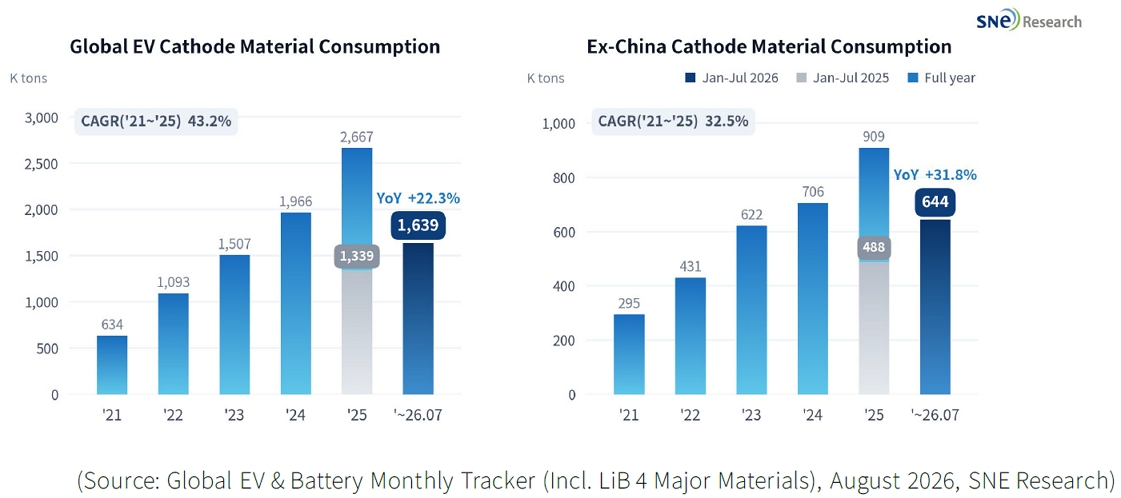
Global cathode material consumption for xEVs reached 1,639K tons in January-July 2026, a 22.3% increase from 1,339K tons a year earlier. Over the same period, the ex-China market expanded 31.8% from 488K tons to 644K tons, growing faster than the overall market. The ex-China share of total consumption also rose from 36.5% to 39.3%, up 2.8 percentage points, making the spread of cathode material demand from a China-centered market to ex-China markets more pronounced.
By material, LFP consumption grew 31.0% and NCx (ternary) consumption grew 9.5%. The LFP share of total cathode material rose from 59.8% a year earlier to 64.1%, up 4.3 percentage points. Adoption of LFP, which has advantages in cost, cycle life and safety, continued to increase, while ternary materials sustained demand centered on premium and high-performance electric vehicles and remained at relatively moderate growth.
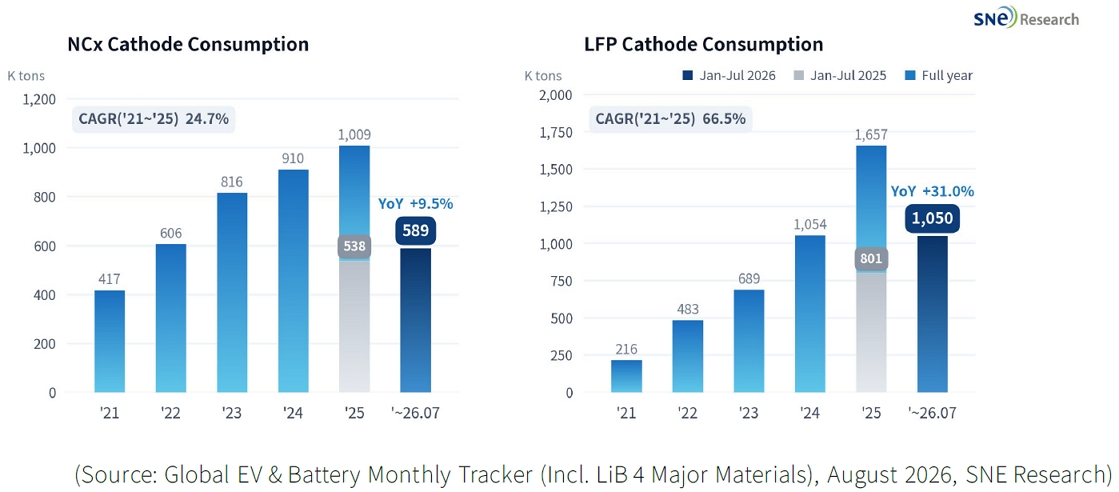
NCx (ternary) cathode material consumption reached 589K tons in January-July 2026, a 9.5% increase from 538K tons a year earlier. Demand for premium electric vehicles requiring high energy density and long driving range supported the growth, but supplier results diverged clearly depending on sales by customer and production adjustments by region.
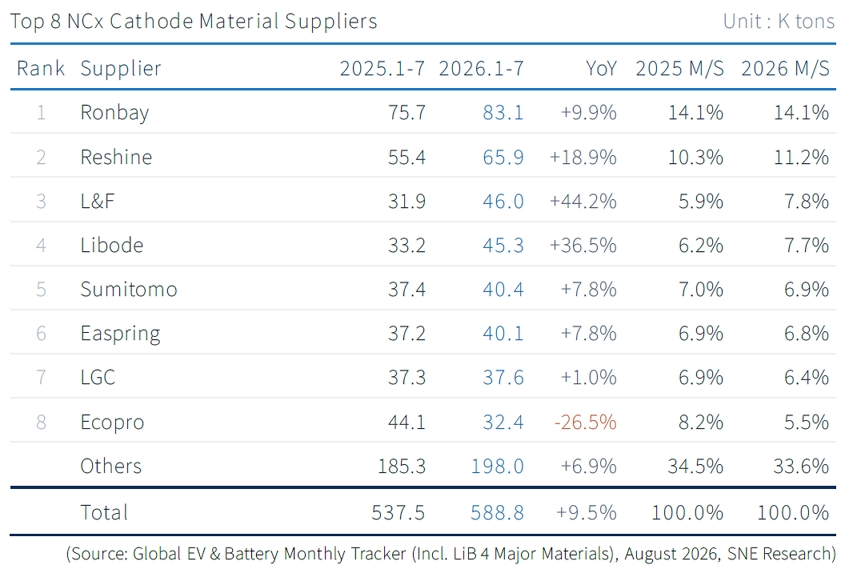
By supplier, Ronbay maintained the lead, rising from 76K tons to 83K tons, followed by Reshine, which rose from 55K tons to 66K tons. L&F grew 44.2% from 32K tons to 46K tons and Libode grew 36.5% from 33K tons to 45K tons, the highest growth rates among the leading suppliers. Sumitomo at 40K tons, Easpring at 40K tons and LGC at 38K tons recorded only moderate increases, while Ecopro declined 26.5% from 44K tons to 32K tons.
Performance by company diverged according to existing customer volumes and the timing of entry into new supply chains. L&F sustained double-digit growth by increasing ternary volumes alongside preparations for LFP mass production outside China. Ecopro, by contrast, saw slowing sales of its main customer's electrified models translate into lower consumption, but it is reinforcing its supply chain responsiveness by securing a local high-nickel cathode material production site in Europe.
Over the same period, LFP cathode material consumption reached 1,050K tons, a 31.0% increase from 801K tons a year earlier. As its range of application broadened beyond entry-level to mid-size electric vehicles, LFP further strengthened its position as a mainstream material.
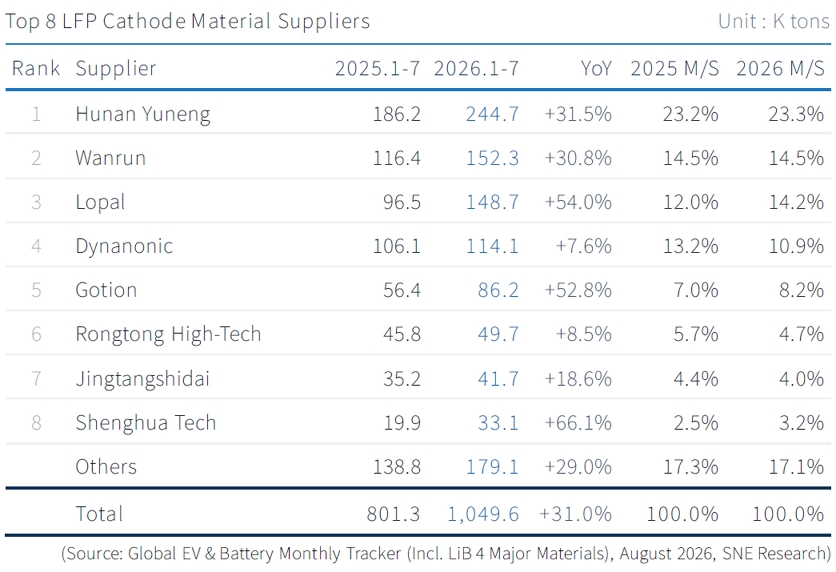
By supplier, Hunan Yuneng held first place, rising from 186K tons to 245K tons. Wanrun rose from 116K tons to 152K tons and Lopal from 97K tons to 149K tons, increases of 30.8% and 54.0% respectively. Dynanonic was relatively moderate at 114K tons, up 7.6%, while Gotion grew 52.8% from 56K tons to 86K tons. Rongtong High-Tech recorded 50K tons and Jingtangshidai 42K tons, and Shenghua Tech reached 33K tons, up 66.1%, the highest growth rate among the leading suppliers.
In the LFP market, the advantage of Chinese suppliers with integrated value chains and large domestic demand continued. Most of the leading suppliers recorded growth rates above the market average and widened the gap in scale, while rapid capacity additions and low-price competition created pressure on profitability and quality, prompting the Chinese government to move toward managing production capacity and restoring pricing order.
By corporate nationality, the share of Chinese suppliers rose 3.0 percentage points to 86.7% from 83.7% a year earlier, while Korean suppliers fell 2.7 percentage points from 12.2% to 9.5% and Japanese suppliers fell 0.3 percentage points from 4.1% to 3.8%. With demand outside China rising 31.8%, the importance of local production and de-China supply chains also increased. Korean suppliers are pursuing a shift that adds LFP to their existing ternary-centered portfolios and are targeting ex-China demand by securing local production sites in Europe and North America and through long-term supply contracts. On a consumption basis, however, the share of Chinese suppliers remains overwhelming, and an actual shift in volumes is expected to take time.
The key variable going forward is how quickly companies can secure production sites and product lineups aligned with supply chain regulations by region. North America's localization requirements, Europe's support for in-region production, and the supply chain information management requirements arising from the battery passport mandate taking effect in February 2027 are all strengthening at the same time. Combined with China's management of excess production, the gap between companies based on LFP and high-performance ternary technology, local sourcing, and cost and quality management capabilities is expected to widen further.