

Global EV Sales Excluding China Reach 5.434 Million Units in January-July 2026, Up 30.5% Year-on-Year
- Europe and Asia (ex-China) drive growth, while North America falls 22.7%
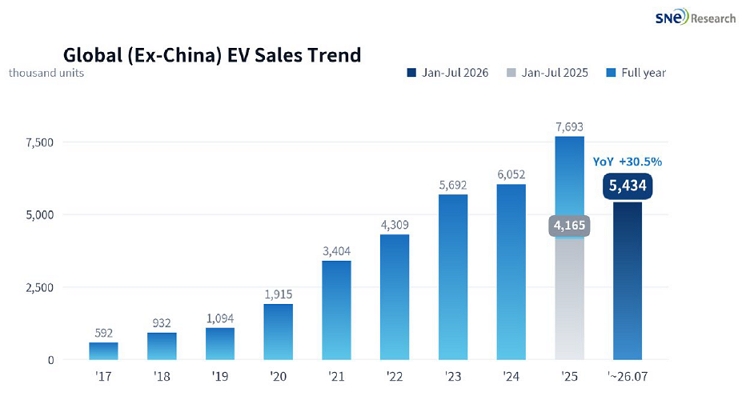
(Source: Global EV and Battery Monthly Tracker, August 2026, SNE Research)
In January-July 2026, global EV (BEV+PHEV) sales excluding China totaled 5.434 million units, up 30.5% from 4.165 million units a year earlier. The ex-China market grew at nearly five times the overall global market growth rate (6.3%), showing that the center of gravity of growth is shifting rapidly outside China. Europe remained the largest source of demand, while Asia (ex-China) and other emerging markets led the expansion in volume with high growth rates, and North America alone recorded negative growth, leaving regional trends clearly divided.
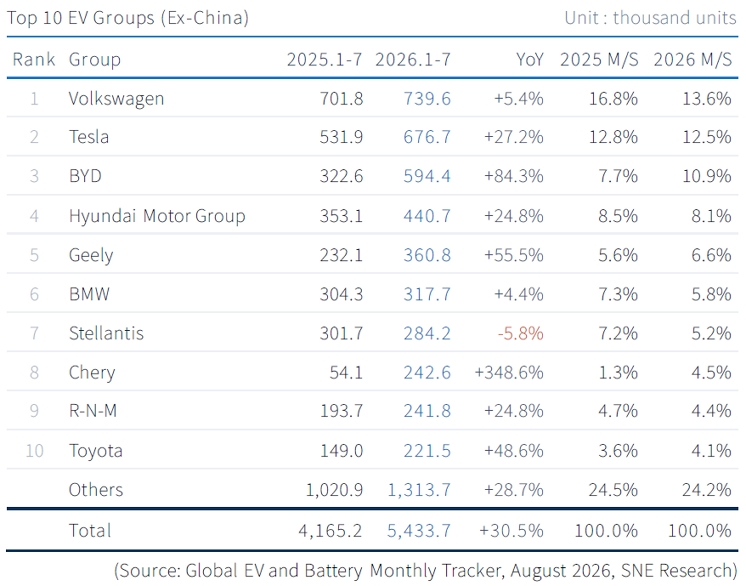
By company, Volkswagen retained first place with 740,000 units, up 5.4% year-on-year. However, this was far below the 30.5% average growth rate of the ex-China market, and its share fell 3.2 percentage points from 16.8% to 13.6%. It continued to benefit from the recovery in European BEV demand, but the gap at the top of the field narrowed noticeably as Tesla and Chinese OEMs expanded rapidly overseas.
Tesla held second place with 677,000 units, up 27.2%. Its share edged down from 12.8% to 12.5%. With competition from Chinese and local brands intensifying in Europe and policy support weakening in North America, its subsequent growth is likely to depend on region-specific pricing and product strategies.
BYD kept third place with 594,000 units, a sharp 84.3% increase, and its share rose 3.2 percentage points from 7.7% to 10.9%. Its sales base outside China expanded rapidly into Europe, Southeast Asia and Latin America, while local production and a broader product lineup also contributed to growth. Price competitiveness based on the Blade battery and plans to build out overseas charging infrastructure are additional factors strengthening its push into the ex-China market.
Hyundai Motor Group posted 441,000 units, up 24.8%, but came in below the market average, and its share edged down from 8.5% to 8.1%. The recovery in European EV sales and a diverse electrified lineup drove the increase in volume, but competition for share intensified further as Chinese groups such as BYD, Geely and Chery grew strongly.
Geely recorded high growth with 361,000 units, up 55.5%, and Chery with 243,000 units, up 348.6%. In Chery's case in particular, the expansion of export brands such as OMODA and JAECOO appears to have driven the increase in ex-China sales. Toyota also rose 48.6% to 221,000 units, placing tenth. By contrast, BMW managed only a 4.4% increase to 318,000 units, and Stellantis fell 5.8% to 284,000 units. R-N-M rose 24.8% to 242,000 units but fell short of the market average.
Other companies outside the top 10 groups posted 1.314 million units, up 28.7%, but their share edged down from 24.5% to 24.2%. Overall volume increased, but leading Chinese players such as BYD, Geely and Chery expanded their scale faster and absorbed a substantial portion of the growth. The competitive structure of the ex-China market is shifting from one centered on established global OEMs to a multipolar stage in which Chinese OEMs and local brands compete alongside them.
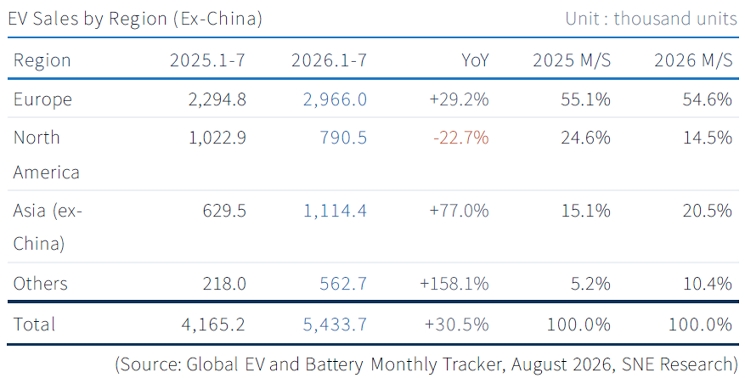
By region, Europe recorded 2.966 million units, up 29.2% year-on-year, remaining the largest source of demand in the ex-China market. Its share edged down from 55.1% to 54.6%, but absolute sales increased substantially. Responses to tighter emissions regulations, the introduction of affordable new models and incentives in individual countries supported demand. The share of battery electric vehicles has continued to rise steadily in major markets, and the spread of the electrification transition across the market as a whole is also continuing.
By contrast, North America fell 22.7% to 790,000 units, and its share dropped 10.1 percentage points from 24.6% to 14.5%. This is attributed to the greater purchase burden after the U.S. tax credits for new, used and commercial clean vehicles expired at the end of September 2025, compounded by high vehicle prices and model transitions at some companies. Other regions surged 158.1% to 563,000 units, expanding their share from 5.2% to 10.4% and adding to the growth of the ex-China market.
Asia (ex-China) recorded 1.114 million units, up 77.0%, emerging as the fastest-growing axis. Its share also rose 5.4 percentage points from 15.1% to 20.5%. In major markets including India and Thailand, new model launches, adoption policies and expanded local production worked at the same time. The price competitiveness and expanded supply of Chinese OEMs such as BYD, Chery and Geely also accelerated the pace of growth.
The ex-China EV market grew 30.5% in January-July 2026, but regional directions diverged in opposite ways. North America fell 22.7% under the impact of the end of the U.S. federal EV tax credit, high vehicle prices and the burden of model transitions, while Asia (ex-China) grew 77.0% on the back of surging EV sales in major markets such as India and Thailand and expanded local production in Southeast Asia. This gap is assessed as stemming less from a simple difference in demand than from differences in the continuity of policy support, the supply of affordable models and local production bases. In the second half, whether Europe's growth continues, how long the incentive vacuum in North America lasts, and how quickly Chinese OEMs expand their localization in Asia are expected to determine the share structure of the ex-China market.