

Global (Ex-China) EV Battery Usage[1] in January-July 2026[2] Reaches 316.2 GWh, Up 25.8% Year-on-Year
- CATL and BYD hold a combined
44.6% share, as Chinese suppliers expand their influence in the ex-China market
as well
Total battery usage in electric vehicles (EV, PHEV,
HEV) sold in the global (ex-China) market in January-July 2026 was
approximately 316.2 GWh, up 25.8% year-on-year. This outpaced the growth rate
of the overall global market (20.4%) over the same period, continuing the trend
in which markets outside China lift the pace of overall growth.
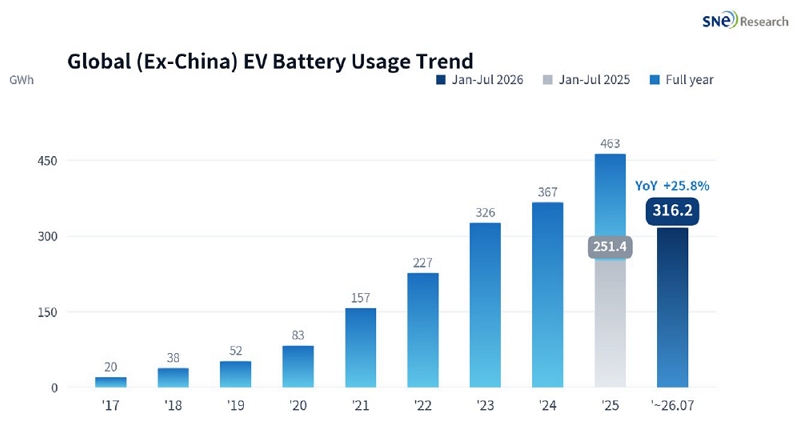
(Source: Global EV and Battery Monthly Tracker, August 2026, SNE Research)
In January-July 2026, the combined global (ex-China) EV battery usage of the three Korean suppliers - LG Energy Solution, SK On and Samsung SDI - was 86.1 GWh, down 8.9% year-on-year. Their combined share declined from 37.6% a year earlier to 27.2%, down 10.4 percentage points. LG Energy Solution recorded 51.6 GWh, down 1.7%; SK On 22.2 GWh, down 9.9%; and Samsung SDI 12.3 GWh, down 29.4%. With the ex-China market continuing to post double-digit growth while only the three Korean suppliers saw usage decline, the gap with Chinese suppliers widened further.
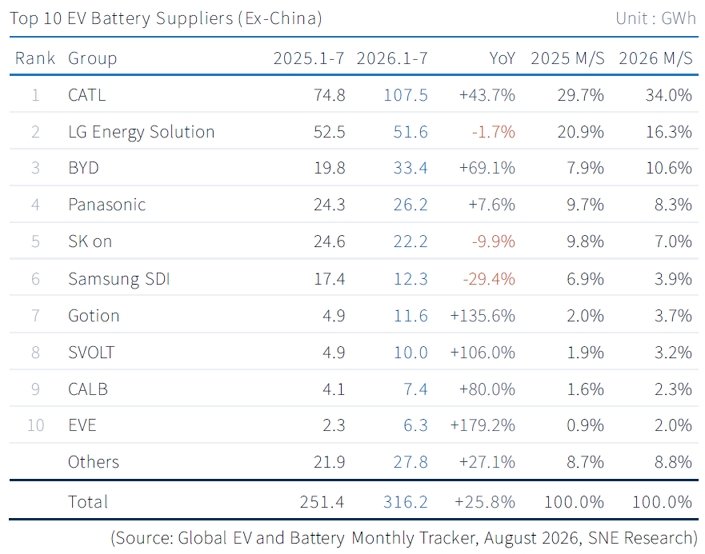
LG Energy Solution recorded 51.6 GWh, down 1.7% year-on-year, but held second place in the ex-China market. Supply to major global OEMs such as Tesla, GM, Hyundai Motor Group and Volkswagen continued, but sales adjustments at North American customers and generational changeovers for some models limited a recovery in volume. As usage declined while the market grew 25.8%, its share declined from 20.9% to 16.3%, down 4.6 percentage points. With Chinese suppliers continuing to expand overseas supply and LFP adoption increasing, improving local production efficiency in North America and Europe and diversifying its customer and product portfolio are expected to be key to recovering share.
SK On's battery usage was 22.2 GWh, down 9.9% year-on-year, and its share declined from 9.8% to 7.0%, down 2.8 percentage points. SK On supplies batteries to Hyundai Motor Group, Ford, Volkswagen and Mercedes-Benz, among others. New electric vehicles from Hyundai Motor Group supported its performance, but this was not enough to offset slowing sales and production plan adjustments at major customers in North America and Europe. A recovery in utilization rates at its North American production bases and expanded volume from new platforms are cited as conditions for a rebound.
Samsung SDI recorded 12.3 GWh, down 29.4% year-on-year, the largest decline among the top 10 suppliers. Its share also contracted from 6.9% to 3.9%, down 3.0 percentage points. It continued to supply major customers such as BMW, Audi and Rivian, but weak sales at customers with a high North American exposure and slowing demand for existing electrified models in Europe led to the decline in usage. The effect of new model launches was partly visible, but is assessed as insufficient to offset the decline in existing mainstay models.
Panasonic recorded 26.2 GWh, up 7.6% year-on-year, ranking fourth. Usage increased mainly on the back of North American-built vehicles from its major customer Tesla, but as growth fell well short of the ex-China market's growth rate, its share declined from 9.7% to 8.3%, down 1.4 percentage points. Panasonic is maintaining its Tesla-centered supply structure while pursuing mass production of next-generation cylindrical batteries and improved production efficiency in North America. However, given its high customer concentration, changes in Tesla's regional sales and production strategy remain a key factor behind swings in its performance.
CATL recorded 107.5 GWh in the global (ex-China) market in January-July 2026, up 43.7% year-on-year, retaining first place. Its share rose from 29.7% to 34.0%, up 4.3 percentage points, surpassing one third of the market. Outside China as well, it broadened supply to global OEMs such as Tesla, BMW, Mercedes-Benz, Toyota and Kia, and securing both Chinese automakers and global OEMs as customers in Europe and Asia drove its growth. LFP-based price competitiveness and a broad product portfolio are also underpinning the expansion of its position in the ex-China market.
Growth at later-entrant Chinese suppliers such as Gotion, SVOLT, CALB and EVE accelerated further. Gotion recorded 11.6 GWh, up 135.6% year-on-year; SVOLT 10.0 GWh, up 106.0%; and CALB 7.4 GWh, up 80.0%. EVE recorded 6.3 GWh, a 179.2% increase, the highest growth rate among the top 10 suppliers. Alongside the expansion of Chinese automakers' overseas sales, these suppliers are broadening their supply opportunities with global OEMs in Europe, Asia and emerging markets. Backed by price-competitive LFP products and local production and partnership strategies, they are rapidly expanding their supply footprint in the ex-China market as well.
BYD recorded 33.4 GWh, up 69.1% year-on-year, ranking third. Its share rose from 7.9% to 10.6%, up 2.7 percentage points, exceeding 10% for the first time. Expanded overseas sales of its own electric vehicles led the increase in battery usage, and the price competitiveness and safety of its Blade battery also supported the growth. As BYD moves beyond a domestic-oriented structure and extends its vehicle sales networks and production bases into Europe, Asia and Latin America, its usage in the ex-China market is highly likely to keep rising for the time being.
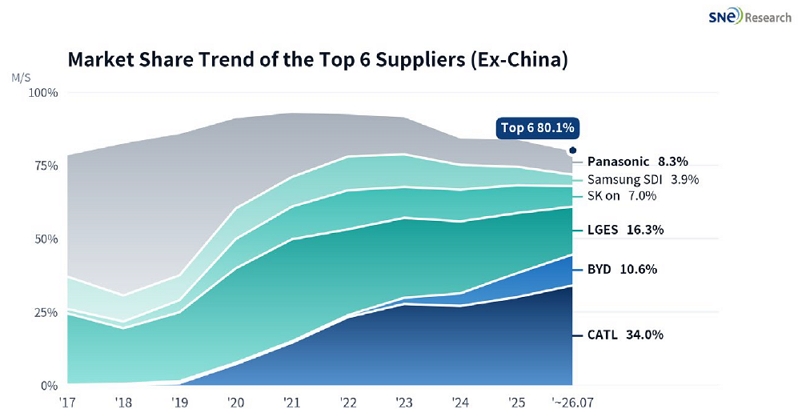
(Source: Global EV and Battery Monthly Tracker, August 2026, SNE Research)
In January-July 2026, the global EV secondary battery market excluding China grew 25.8% year-on-year, continuing its expansion. Performance by supplier, however, diverged clearly. All three Korean suppliers saw usage decline, and their combined share fell 10.4 percentage points, while Chinese suppliers including CATL and BYD increased their influence on the back of expanded supply to global OEMs, the overseas expansion of Chinese automakers, and LFP-based price competitiveness. The combined share of CATL and BYD was 44.6%, up 7.0 percentage points year-on-year, and with most of the Chinese suppliers among the top 10 posting growth rates well above the market average, the restructuring of the supply landscape is accelerating in the ex-China market as well.
Going forward, regional demand trends and supply chain regulations are expected to determine competitiveness by supplier. In Europe, where the adoption of electric vehicles is expanding and Chinese suppliers continue to enter the market, requirements for supply chain traceability are becoming clearer, with the European Union issuing guidance specifying data requirements by item ahead of the mandatory battery passport taking effect in February 2027. In North America, amid continuing policy uncertainty and production adjustments by automakers, local production efficiency and securing ex-China supply chains remain key tasks. Accordingly, not only price competitiveness but also regional production bases, long-term supply relationships with global OEMs, readiness for LFP and next-generation batteries, and supply chain information management capabilities are expected to become the main variables determining each supplier's market position.
[2] Based on battery installation for xEV registered during the relevant period.