

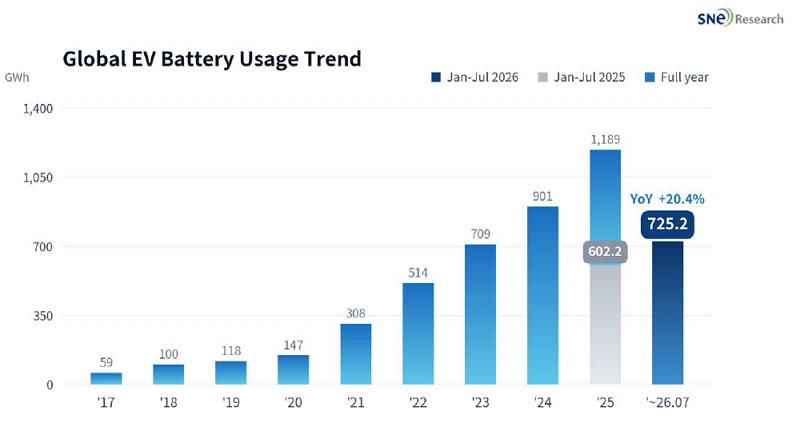
January-July 2026 Global[1] EV Battery Usage[2] Reaches 725.2 GWh, Up 20.4% Year-on-Year
- Seven
Chinese suppliers within the top 10 accounted for a 72.8% share, up 3.1
percentage points from a year earlier
Total
battery usage in electric vehicles (EV, PHEV, HEV) registered around the world
in January-July 2026 came to approximately 725.2 GWh, a 20.4% increase from a
year earlier. Usage in the single month of July was 116.0 GWh, up 22.1%
year-on-year, continuing a trend in which the monthly growth rate also exceeded
the cumulative growth rate.
(Source: Global EV and Battery Monthly Tracker, August 2026, SNE Research)
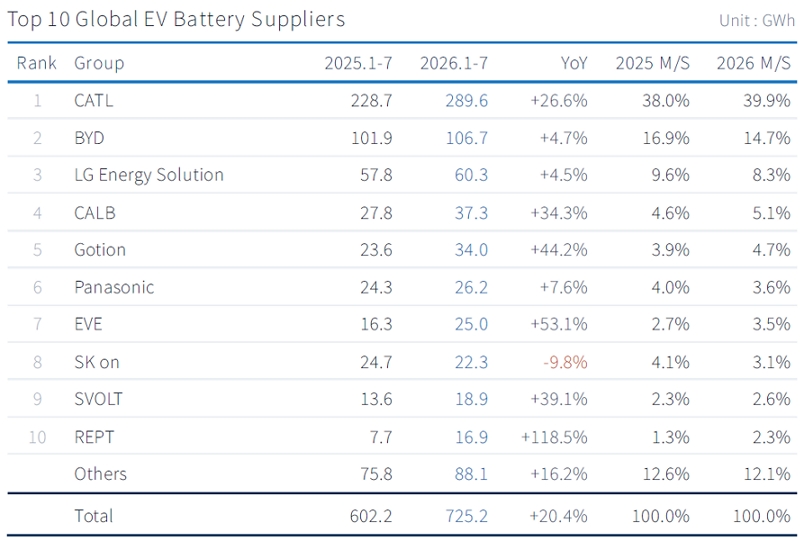
In the global EV battery market in January-July 2026, CATL held on to first place with 289.6 GWh, up 26.6% year-on-year. Its share rose 1.9 percentage points from 38.0% to 39.9%, approaching the 40% line. Second-placed BYD posted 106.7 GWh, an increase of only 4.7%, and its share fell 2.2 percentage points from 16.9% to 14.7%. The two companies' combined share was 54.6%, 0.3 percentage points lower than the 54.9% recorded a year earlier, but still more than half of the global market. Even within the top two suppliers, the center of gravity of growth has tilted clearly toward CATL.
(Source: Global EV and Battery Monthly Tracker, August 2026, SNE Research)
Among Korean suppliers, LG Energy Solution maintained third place with 60.3 GWh, up 4.5% year-on-year. Usage increased as supply continued to major global OEMs including Tesla, Hyundai Motor Group, GM and Volkswagen, but because the rate of increase fell well short of the market average, its share declined 1.3 percentage points from 9.6% to 8.3%. With the pace of EV sales diverging by customer in North America and Europe, the much faster expansion in scale by Chinese suppliers is assessed to have led to the relative contraction in share.
SK On recorded 22.3 GWh, a decrease of 9.8% from a year earlier, ranking eighth, and its share fell 1.0 percentage points from 4.1% to 3.1%. SK On's batteries are supplied to Hyundai Motor Group, Ford, Volkswagen and Mercedes-Benz, among others, but with some customers in North America and Europe continuing to adjust their EV production plans, the recovery in usage is being delayed. Going forward, improvement in the utilization rate of its North American production bases and whether it expands supply for new platform models are expected to be the key to a rebound in performance.
Japan's Panasonic took sixth place with 26.2 GWh, up 7.6% year-on-year. North American sales at its main customer Tesla underpinned the increase in usage, but this fell short of the market growth rate and its share declined 0.4 percentage points from 4.0% to 3.6%. Panasonic is maintaining its Tesla-centered supply structure while at the same time stabilizing the operation of new lines in North America and preparing for mass production of next-generation cylindrical batteries, so the pace at which it expands production capacity is expected to determine the direction of its share going forward.
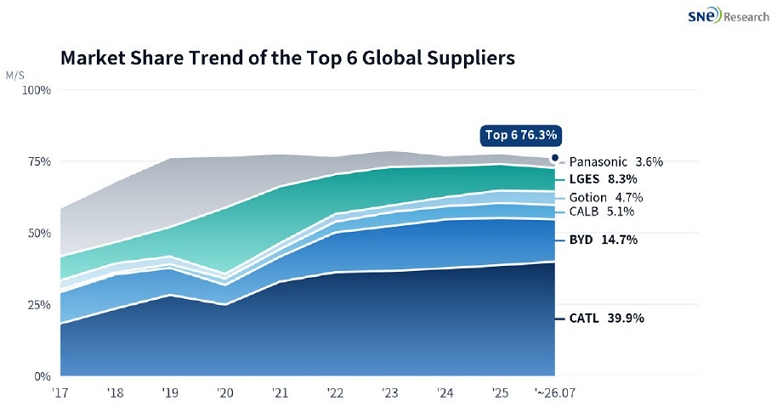
Chinese suppliers continued to post growth rates above 30% across the upper ranks. CALB ranked fourth with 37.3 GWh, up 34.3% year-on-year, and Gotion ranked fifth with 34.0 GWh, up 44.2%. EVE was seventh with 25.0 GWh, up 53.1%, and SVOLT was ninth with 18.9 GWh, up 39.1%. In particular, REPT newly entered the top 10 suppliers with 16.9 GWh, up 118.5%, while Sunwoda, which had been in tenth place until then, was pushed out of the rankings by a narrow margin. The combined share of the seven Chinese suppliers, comprising these five companies plus CATL and BYD, was 72.8%, up 3.1 percentage points from a year earlier. This is read as the result of building scale on the basis of domestic-market volume and LFP-centered cost competitiveness while broadening their supply areas to overseas OEMs and to commercial vehicles and ESS.
BYD's growth was limited to 4.7% year-on-year at 106.7 GWh, a growth rate far below the market average. This appears to reflect the slowdown in its sales growth in China, in a structure where the company's own EV sales are directly linked to battery usage. That said, it is expanding its overseas sales networks and local production bases and is strengthening product competitiveness centered on the Blade battery and fast-charging technology, so the pace at which its usage expands in non-Chinese markets is expected to be a key variable in defending its share going forward.
(Source: Global EV and Battery Monthly Tracker, August 2026, SNE Research)
The global EV battery market continued to grow more than 20% in January-July 2026, but the share of that growth was concentrated further on Chinese suppliers. Chinese suppliers widened their share by 3.1 percentage points on the basis of their domestic market scale, LFP-based cost competitiveness and rapid product transitions, while Korean and Japanese suppliers, with their absolute usage either rising or falling, all remained at growth below the market average and saw their shares decline. Competition among later-entrant Chinese suppliers is also tightening, to the extent that the composition of the top 10 suppliers has changed. More recently, requirements for supply chain information management have become considerably clearer, with the European Union issuing guidelines that specify data requirements item by item ahead of the battery passport mandate that takes effect in February 2027. With responses to supply chain regulation in North America and expanding demand for ESS and data centers also coming into play, competitiveness going forward is expected to be determined not by production scale alone but by the operating efficiency of production bases in each region, customer diversification, product mix and supply chain traceability capabilities.
[2] Based on battery installation for xEV registered during the relevant period.