

From Jan to June 2026, Global EV Battery Anode Installment Reached 732K ton, a 21.1% YoY Growth
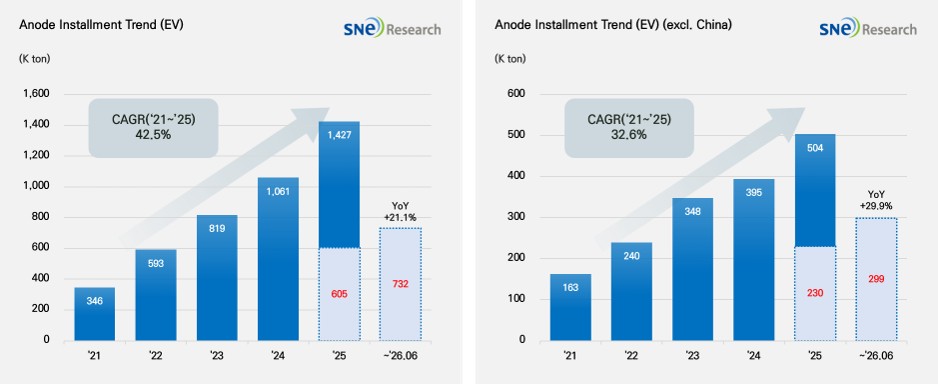
- Anode installment in the non-China market recorded 299K ton, a 29.9% YoY growth, exceeding the global average.
(Source: 2026 July Global EV & Battery Monthly Tracker (Incl. LiB 4 Major Materials), SNE Research)
During the first half of 2026, global anode material deployment for electric vehicles reached 732K tons, representing a 21.1% increase year-over-year compared to 605K tons recorded in the same period last year. Over the same period, the market excluding China expanded by 29.9% from 230K tons to 299K tons, outpacing the global average. Consequently, the non-Chinese market's share of total deployment rose from 38.0% to 40.8%, highlighting an increasingly distinct regional geographic expansion in demand.
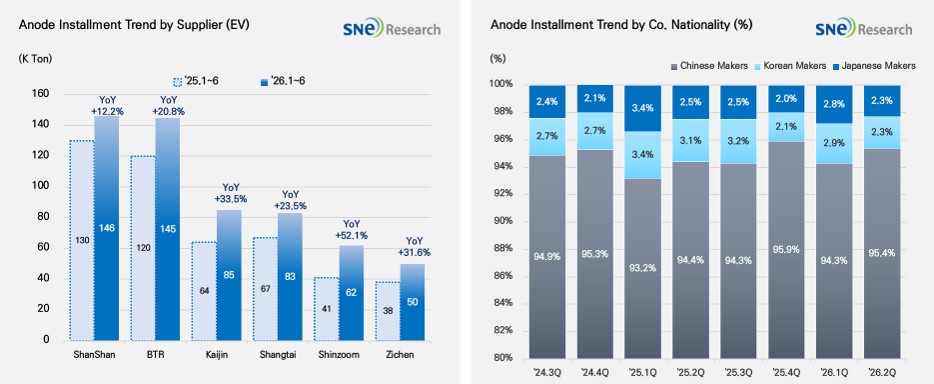
By supplier, ShanShan maintained its leadership position with a 12.2% increase year-over-year, growing from 130K tons to 146K tons. BTR closely pursued the leader, expanding 20.8% from 120K tons to 145K tons, narrowing the gap to just 1K ton. While the two suppliers maintained a formidable combined market share of approximately 39.8%, ShanShan’s growth rate trailed the market average, resulting in a significantly tightened lead at the top.
Mid-tier suppliers demonstrated even faster expansion rates. Kaijin expanded 33.5% from 64K tons to 85K tons, while Shangtai grew 23.5% from 67K tons to 83K tons. Shinzoom logged the highest growth rate among major suppliers at 52.1%, surging from 41K tons to 62K tons, and Zichen also increased 31.6% from 38K tons to 50K tons.
While top-tier suppliers expanded volumes backed by scale and established client bases, Kaijin, Shinzoom, and Zichen outpaced market average growth through new client acquisition and capacity expansion. As competition among Chinese suppliers spilled over into cost and yield improvements for synthetic graphite alongside portfolio diversification across natural and synthetic graphite products, growth trajectories across individual suppliers diverged sharply.
(Source: 2026 July Global EV & Battery Monthly Tracker (Incl. LiB 4 Major Materials), SNE Research)
By corporate nationality, Chinese suppliers captured a 95.4% market share in the second quarter of 2026, up 1.1 percentage points from 94.3% in the first quarter. Conversely, market shares for South Korean and Japanese manufacturers both fell to 2.3%. Despite rapid demand growth in markets outside China, actual supply became increasingly concentrated among Chinese companies, widening the gap between demand diversification and supply chain diversification.
Anode material deployment in the market excluding China expanded by 29.9% from 230K tons to 299K tons. Outpacing the overall global market growth rate of 21.1% by 8.8 percentage points, the expansion of battery production across North America, Europe, and Non-China Asia broadened the non-Chinese demand base.
Investments in non-Chinese manufacturing capacity also took shape. In March, POSCO Future M announced plans to construct a synthetic graphite anode material plant in Thai Nguyen, Vietnam—scalable to an annual capacity of up to 55K tons—targeting commercial mass production in 2028. In June, NOVONIX supplied qualification C-samples of synthetic graphite anode active materials from its Riverside plant in Tennessee to Panasonic Energy. As commercial mass production targets for both companies are set for 2028 and the second half of 2027, respectively, these volumes were not reflected in first-half deployment data.
Looking ahead, competition will hinge on securing compliant origins that meet regulatory mandates alongside commercial production capacity. In November 2025, China added synthetic graphite anode materials, natural-synthetic graphite blends, as well as related equipment and technology to its export control list. Meanwhile, although the U.S. Department of Commerce issued a final affirmative determination on Chinese anode active materials in February 2026, antidumping and countervailing duty orders were not instituted because the ITC ruled in March that the domestic U.S. industry had not suffered material retardation. Amid mounting localization pressures—such as Section 45X PFE requirements—qualification timelines, raw material sourcing, and silicon technology capabilities will serve as critical determinants.