

From Jan to June 2026, Global EV Battery Cathode Installment Reached 1,374K ton, a 21.6% YoY Growth
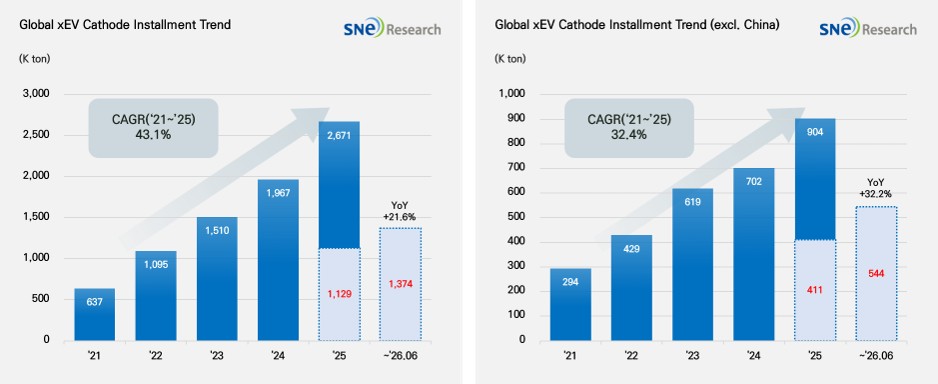
- EV battery cathode installment in the non-China market recorded 544K ton, a 32.2% YoY growth
(Source: 2026 July Global EV & Battery Monthly Tracker (Incl. LiB 4 Major Materials), SNE Research)
During the first half of 2026, global cathode material deployment for xEVs reached 1,374K tons, representing a 21.6% increase year-over-year compared to 1,129K tons recorded in the same period last year. Over the same period, the market excluding China expanded by 32.2% from 411K tons to 544K tons, outpacing the overall market growth rate. This highlights a progressively clearer shift in cathode material demand expanding beyond its historic concentration in China toward non-Chinese markets.
By chemistry type, LFP deployment increased by 29.4%, while ternary (NCx) chemistries grew by 10.1%. Consequently, the share of LFP within total cathode material deployment rose by 3.8 percentage points from 59.8% to 63.6% year-over-year. This reflects the accelerating adoption of LFP leveraged by its strengths in cost efficiency, cycle life, and thermal safety. Conversely, ternary chemistries sustained demand primarily centered on premium and high-performance electric vehicle segments.
(Source: 2026 July Global EV & Battery Monthly Tracker (Incl. LiB 4 Major Materials), SNE Research)
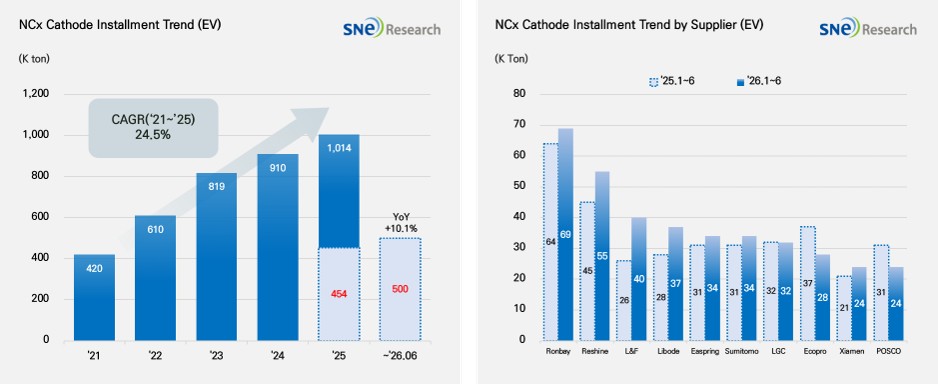
During the first half of 2026, global ternary (NCx) cathode material deployment reached 500K tons, marking a 10.1% increase year-over-year compared to 454K tons recorded in the same period last year. While demand for premium electric vehicles requiring high energy density and extended driving ranges supported this growth, performance among individual suppliers diverged in tandem with client sales trends and regional production adjustments.
By supplier, Ronbay maintained its leading position as its volume increased from 64K tons to 69K tons, followed by Reshine, which expanded from 45K tons to 55K tons. L&F grew significantly from 26K tons to 40K tons, while Libode posted substantial gains from 28K tons to 37K tons. Conversely, EcoPro declined from 37K tons to 28K tons, and POSCO contracted from 31K tons to 24K tons.
Individual supplier performance hinged on existing client delivery volumes and the timing of entry into new supply chains. L&F saw its first-half deployment surge by 53.8% while simultaneously preparing for mass production of non-Chinese LFP cathode materials in the third quarter. Meanwhile, despite experiencing a drop in first-half deployment, EcoPro initiated mass production and first shipments of high-nickel cathode materials from its Hungary plant in June, featuring an annual capacity of 54K tons.
(Source: 2026 July Global EV & Battery Monthly Tracker (Incl. LiB 4 Major Materials), SNE Research)
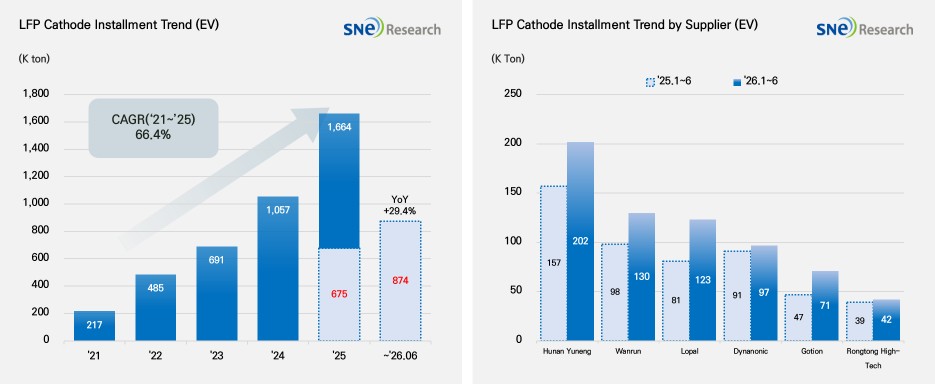
During the same period, LFP cathode material deployment reached 874K tons, representing a 29.4% increase year-over-year compared to 675K tons recorded in the same period last year. Expanding its application scope beyond entry-level vehicles into mid-sized electric vehicle segments, LFP fortified its standing as a mainstream battery chemistry.
By supplier, Hunan Yuneng retained its top position as its volume expanded from 157K tons to 202K tons. Wanrun grew from 98K tons to 130K tons, Lopal increased from 81K tons to 123K tons, and Dynanonic rose from 91K tons to 97K tons. Gotion also expanded from 47K tons to 71K tons, while Rongtong High-Tech logged 42K tons.
In the LFP market, Chinese suppliers maintained their dominance, backed by integrated value chains and substantial domestic demand. However, as aggressive capacity expansions and price wars brought severe burdens to profitability and quality control, the Chinese government initiated measures in April 2026 to curb so-called "involutionary competition" (neijuan)—introducing early-warning systems for production capacity, enforcing market price discipline, and regulating payment settlement terms.
With non-Chinese demand surging 32.2%, the strategic importance of localized production and non-Chinese supply chains escalated. In March, L&F signed a 1.6 trillion KRW mid-to-long-term LFP supply contract with Samsung SDI, while POSCO Future M broke ground on an LFP-dedicated plant in Pohang in May while simultaneously converting existing ternary production lines to launch commercial LFP mass production in the second half of the year.
Looking ahead, the critical variable will be how rapidly suppliers secure manufacturing hubs and product portfolios aligned with regional supply chain regulations. The U.S. issued Section 45X Advanced Manufacturing Production Credit guidelines regarding Prohibited Foreign Entities (PFE) in February 2026, while the EU launched a 1.5 billion euro interest-free loan program in July to support regional battery cell manufacturing. Coupled with China's tightening management of overcapacity, performance gaps among suppliers are projected to widen further, dictated by their capabilities in LFP and high-performance ternary technologies, localized sourcing, and cost-quality management.