

From Jan to June 2026, Non-China Global EV Deliveries Recorded 4.598 Mil Units, a 30.3% YoY Growth
- Europe and Asia (excl. China) lead the growth, while North America experienced a 20.5% decline.
(Source: Global EV & Battery Monthly Tracker – July 2026, SNE Research)
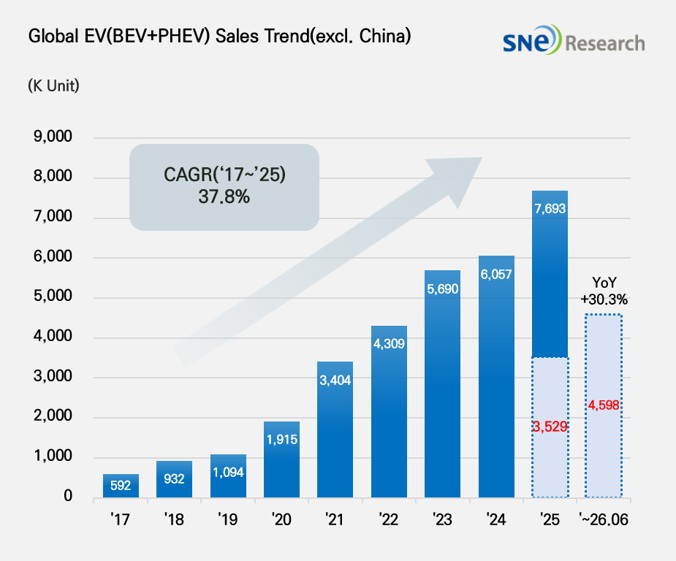
During the first half of 2026, global electric vehicle (EV, including BEV and PHEV) deliveries in the market excluding China reached 4.598 million units, marking a 30.3% increase year-over-year compared to 3.529 million units recorded in the same period last year. Significantly outpacing the overall global market growth (+5.5%), the non-Chinese market demonstrated a rapid outward shift in the gravity of market expansion. While Europe maintained its position as the largest demand hub, Non-China Asia and other emerging markets spearheaded the volume expansion with high growth rates, contrasting sharply with North America as the sole region posting negative growth.
(Source: Global EV & Battery Monthly Tracker – July 2026, SNE Research)
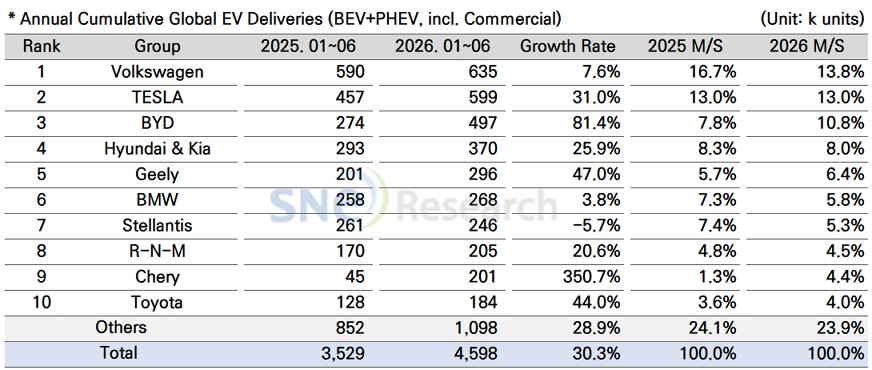
By manufacturer, Volkswagen retained its top position in the non-Chinese market with 635,000 units delivered, marking a 7.6% increase year-over-year. However, falling significantly below the overall non-Chinese market average growth rate of 30.3%, its market share contracted by 2.9 percentage points from 16.7% to 13.8%. While it continued to benefit from the recovery in European BEV demand, rapid overseas expansion by Tesla and Chinese OEMs narrowed the gap between the market leader and its pursuers.
Tesla secured second place with 599,000 units, a 31.0% increase year-over-year. Its market share remained flat at 13.0%, with a strong delivery recovery of 480,126 units in the second quarter bolstering its first-half performance. However, with intensifying competition from local and Chinese brands in Europe and weakening policy support in North America, its future growth trajectory is expected to hinge heavily on regional pricing and product strategies.
BYD retained third place with 497,000 units, surging 81.4% year-over-year, which elevated its market share from 7.8% to 10.8%. Its non-Chinese sales footprint expanded rapidly across Europe, Southeast Asia, and Latin America, with localized production and lineup expansion driving overall volume growth. The recently unveiled second-generation Blade Battery and plans to establish an overseas ultra-fast charging network within the year further reinforce its aggressive non-Chinese market strategy.
Hyundai Motor Group logged 370,000 units, up 25.9% year-over-year; however, trailing the overall market growth rate, its market share edged down slightly from 8.3% to 8.0%. Although the recovery in European EV sales and a diverse electrified lineup drove volume gains, market share competition intensified sharply amid high growth rates posted by Chinese groups including BYD, Geely, and Chery.
Geely recorded strong growth with 296,000 units (+47.0%), while Chery posted a formidable 350.7% surge year-over-year to reach 201,000 units. For Chery in particular, the expansion of its export-focused sub-brands, such as OMODA and JAECOO, served as the primary catalyst driving non-Chinese sales growth. Toyota also entered the top ten standings with 184,000 units (+44.0%). Conversely, BMW recorded modest growth at 268,000 units (+3.8%), while Stellantis declined to 246,000 units (-5.7%). Renault-Nissan-Mitsubishi (R-N-M) logged 205,000 units (+20.6%), trailing the overall market growth rate.
Deliveries from OEMs outside the top ten groups rose 28.9% to 1.098 million units, though their collective market share edged down slightly from 24.1% to 23.9%. While overall volume expanded, major Chinese players—including BYD, Geely, and Chery—grew at a faster pace, absorbing a substantial portion of the market's incremental growth. The competitive landscape in non-Chinese markets is transitioning from one dominated by legacy global OEMs to a multipolar structure where Chinese OEMs and local brands actively compete alongside established players.
(Source: Global EV & Battery Monthly Tracker – July 2026, SNE Research)
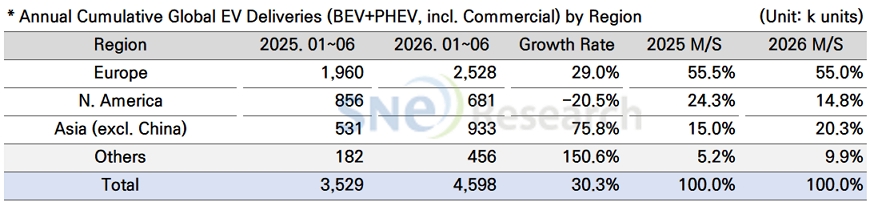
By region, Europe maintained its status as the largest demand hub in the non-Chinese market with 2.528 million units delivered, representing a 29.0% increase year-over-year. Although its market share edged down slightly from 55.5% to 55.0%, absolute delivery volumes grew substantially. Demand was sustained by compliance with stricter emissions regulations, new model rollouts, and incentive programs, with first-half data released by the ACEA in July showing the EU's passenger BEV share expanding to 20.7%.
Non-China Asia emerged as the fastest-growing core axis, surging 75.8% year-over-year to 933,000 units and elevating its market share by 5.3 percentage points from 15.0% to 20.3%. Driven by strong first-half gains in electric passenger car sales across key markets like India and Thailand, the region benefited from the concurrent effects of new vehicle launches, adoption policies, and expanding localized production. Price competitiveness and aggressive supply expansion by Chinese OEMs—including BYD, Chery, and Geely—further accelerated this growth trajectory.
Conversely, North America declined 20.5% year-over-year to 681,000 units, with its market share contracting by 9.5 percentage points from 24.3% to 14.8%. This drop is attributed to heightened purchasing burdens following the expiration of U.S. clean vehicle tax credits for new, used, and commercial vehicles in late September 2025, compounded by elevated vehicle prices and model transitions by select OEMs. Meanwhile, other regions jumped 150.6% to 456,000 units, expanding their collective market share from 5.2% to 9.9% and bolstering overall non-Chinese market expansion.
Although the non-Chinese EV market grew 30.3% overall in the first half of 2026, regional trajectories diverged sharply. North America contracted by 20.5% due to the impact of the expired federal U.S. EV tax credits, high vehicle prices, and model transition burdens. In contrast, Non-China Asia surged 75.8%, propelled by skyrocketing EV sales in major markets like India and Thailand alongside expanding local manufacturing footprints in Southeast Asia. This divergence is analyzed to stem from structural factors—such as the continuity of policy support, the availability of mass-market models, and localized production bases, rather than simple shifts in consumer demand. Looking ahead to the second half, whether European growth momentum can be sustained, how long the North American incentive void persists, and how rapidly Chinese OEMs expand their localization across Asia are projected to determine market share shifts across the non-Chinese landscape.