

From Jan to May 2026, Global Electric Vehicle Battery Electrolyte Installment Reached 591K ton, a 19.3% YoY Growth
- From Jan to May 2026, the installment of electrolyte outside China reached 222K ton, a 32.2% YoY growth.
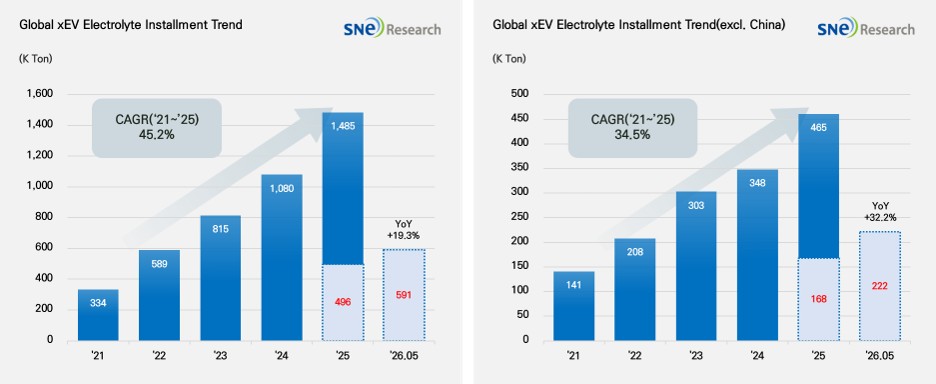
During the first five months of 2026, the global deployment of electrolyte solutions installed in registered electric vehicles (including EVs, PHEVs, and HEVs) reached approximately 591K tons, marking a 19.3% increase year-over-year. During the same timeframe, the market excluding China recorded approximately 222K tons, surging 32.2% compared to the same period last year and significantly outpacing the broader global market growth rate.
Electrolyte serves as a core material within lithium-ion batteries, facilitating the seamless movement of lithium ions between the cathode and anode. It exerts a direct influence on battery charging performance, power output, energy efficiency, lifespan, and safety, with variations in battery performance dictated by the specific formulation of electrolyte salts, solvents, and additives. As market demand intensifies for higher voltage thresholds, fast-charging capabilities, and enhanced low-temperature performance in EV batteries, the strategic molecular design of electrolytes and the technological competitiveness of performance additives are becoming increasingly paramount.
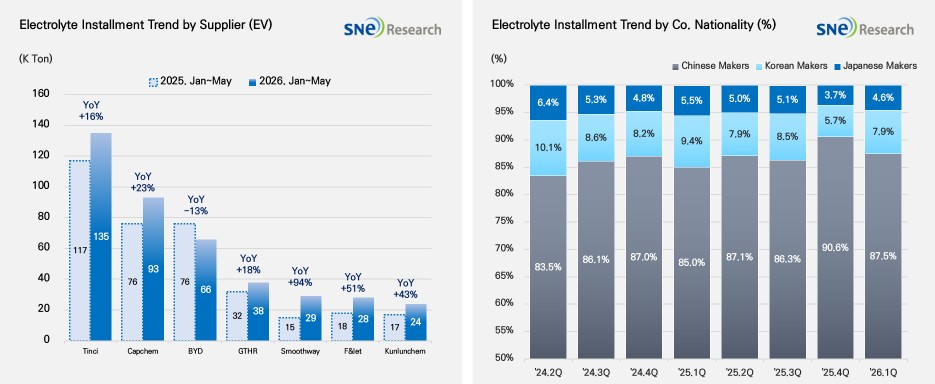
During the first five months of 2026, growth trajectories among major suppliers in the global electrolyte market diverged sharply. Tinci defended its top position in the market by recording approximately 135K tons, a 16% increase year-over-year, while Capchem expanded its volume by 23% to approximately 93K tons. Conversely, BYD logged approximately 66K tons, marking a 13% decline year-over-year and standing as the sole player among top-tier suppliers to post negative growth. Meanwhile, suppliers such as GTHR (+18%), Smoothway (+94%), F&let (+51%), and Kunlunchem (+43%) sustained an upward trajectory in market share expansion, propelled by high growth rates.
In terms of market share by corporate nationality, Chinese enterprises continued to spearhead the market, maintaining a dominant share hovering around 90%. As of the first quarter of 2026, the share of Chinese manufacturers stood at approximately 87.5%, a sequential decline compared to the previous quarter (90.6%), yet a 2.5 percentage point increase compared to the same period last year (85.0%). During the same timeframe, South Korean and Japanese companies held shares of approximately 7.9% and 4.6%, respectively. These metrics reaffirm that the China-centric supply architecture remains heavily entrenched within the electrolyte market.
(Source: 2026 June Global EV & Battery Monthly Tracker (Incl. LiB 4 Major Materials), SNE Research)
During 2026, the global electrolyte market sustained its steady growth trajectory, propelled by the expanding deployment of electric vehicle (EV) batteries. Notably, the growth rate in markets outside of China significantly outpaced the broader global average, with expanding demand centered on North America, Europe, and non-Chinese Asian regions underpinning the market's upward momentum.
Recently, the expansion of Energy Storage Systems (ESS) and data center power demand has emerged as a new growth pillar alongside existing EV demand. In particular, with the widening application of high-voltage and fast-charging batteries, the strategic formulation design of electrolyte salts (such as LiPF6 and LiFSI) and functional additives is shifting to become the core benchmark of product competitiveness. Concurrently, customer mandates for thermal stability, low-temperature performance, and extended lifespans are intensifying. While Chinese suppliers are projected to preserve their dominance leveraged by cost competitiveness and vertical integration, policy mandates for localized supply chains in North America and Europe, coupled with movements to expand non-Chinese sourcing, could present differentiation opportunities for South Korean, Japanese, and local electrolyte manufacturers. Moving forward, the competitive landscape is anticipated to restructure based on high-functional product adaptability, customized additive technologies, raw material procurement stability, and the establishment of localized production networks, rather than simple delivery volume scale-ups.