

From Jan to May 2026, Global EV Battery Anode Installment Reached 563K ton, a 17.6% YoY Growth
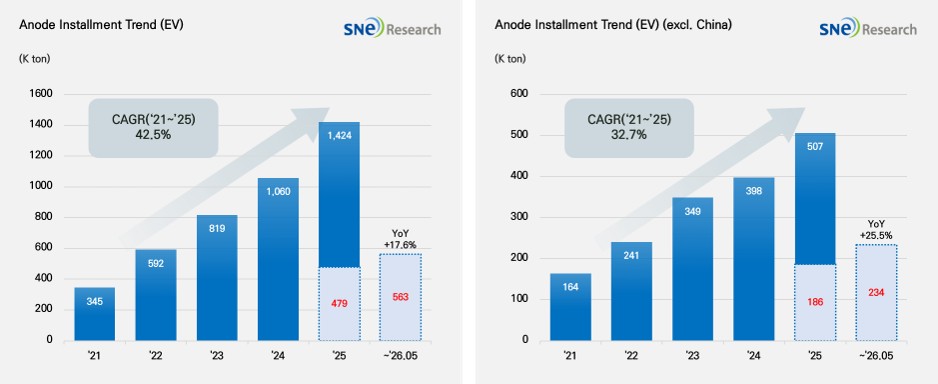
- Anode installment in the non-China market recorded 234K ton, a 25.5% YoY Growth
(Source: 2026 June Global EV & Battery Monthly Tracker (Incl. LiB 4 Major Materials), SNE Research)
Global demand for electric vehicle (EV) anode materials also maintained steady growth during the first five months of 2026. From January to May 2026, the global xEV anode material deployment reached 563K tons, marking a 17.6% increase compared to the 479K tons recorded in the same period last year. During the same timeframe, anode deployment in the global market excluding China expanded from 186K tons to 234K tons, a 25.5% surge that significantly outpaced the broader market growth rate. This trend underscores that as the global EV growth pillar shifts toward non-Chinese regions, expanding EV production and supply chain diversification centered on Europe and Asia (excluding China) are driving the uptick in anode demand.
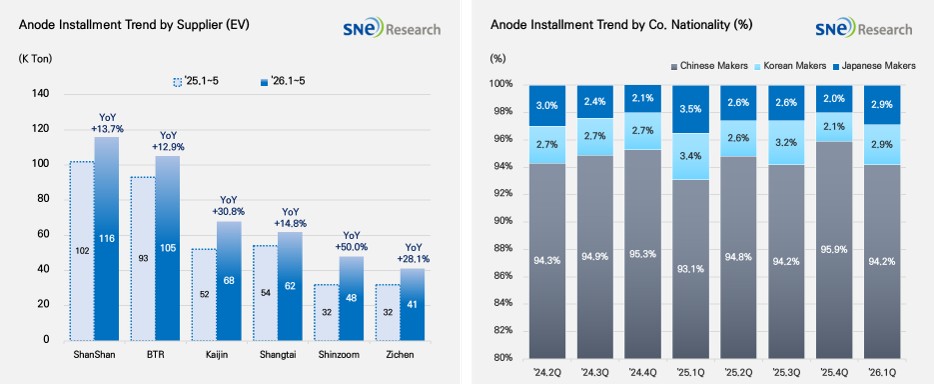
By supplier, ShanShan retained its leading position by deploying 116K tons, a 13.7% increase year-over-year. BTR also sustained its top-tier status, logging 105K tons for a 12.9% expansion. While both companies maintained stable growth momentum, they fell slightly short of the market average growth rate, opening the door for mid-tier suppliers to accelerate their pursuit.
Kaijin registered a conspicuous growth curve, surging 30.8% from 52K tons to 68K tons, while Shangtai grew 14.8% from 54K tons to 62K tons. Notably, Shinzoom achieved the highest growth rate among major suppliers, skyrocketing 50.0% from 32K tons to 48K tons, and Zichen also rapidly expanded its market presence by rising 28.1% from 32K tons to 41K tons.
As such, while the top-tier structure remains anchored by ShanShan and BTR, the competitive landscape of the anode market is gradually diversifying, with mid-tier suppliers like Kaijin, Shinzoom, and Zichen posting growth rates that significantly outpace the market average. In particular, client diversification, capacity expansions, and product competitiveness are emerging as the definitive factors driving performance polarization among manufacturers.
(Source: 2026 June Global EV & Battery Monthly Tracker (Incl. LiB 4 Major Materials), SNE Research)
In terms of market share by corporate nationality, Chinese enterprises maintained an overwhelming dominance, commanding a 94.2% share as of the first quarter of 2026. Meanwhile, South Korean and Japanese companies held a limited presence, each registering a 2.9% share. The share of Chinese manufacturers has consistently hovered between 94% and 96% in recent quarters, reaffirming that the global anode supply chain remains heavily centered around China.
Anode deployment in markets outside of China expanded from 186K tons to 234K tons, posting a growth rate of 25.5%. This significantly outpaced the global average growth rate of 17.6%, illustrating the ongoing expansion of EV production and localized supply chain initiatives in non-Chinese regions. Although local sourcing of battery materials and supply chain resilience have become paramount, particularly in North America and Europe, the current supply architecture is still predominantly shaped by Chinese players. Consequently, the expansion of the non-Chinese market has not immediately translated into supply chain diversification. Against this backdrop, securing localized production capacity and tailored supply capabilities are emerging as crucial elements for establishing future competitiveness.
During the first five months of 2026, the global anode market continued a structural trend characterized by simultaneous demand expansion and supply consolidation. While non-Chinese markets sustain growth rates that outpace the global average, Chinese suppliers preserve an absolute upper hand on the supply side. Furthermore, although the market structure remains anchored by top-tier players, the competitive landscape is gradually evolving as mid-tier suppliers post steeper growth curves. Moving forward, the definitive factors dictating long-term manufacturer competitiveness in the anode market will pivot on establishing non-Chinese supply chains, diversifying client portfolios, advancing next-generation anode technical prowess, and securing supply stability, rather than simple capacity scale-ups.