

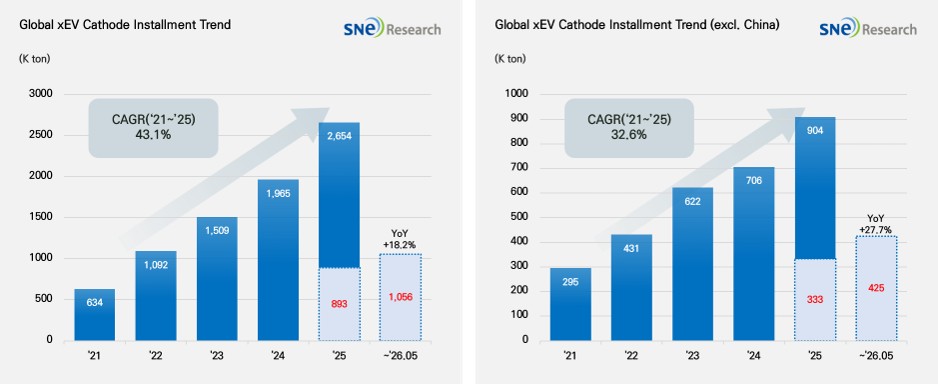
From Jan to May 2026, Global EV Battery Cathode Installment Reached 1,056K ton, a 18.2% YoY Growth
- EV battery cathode installment in the non-China market recorded 425K ton, a 27.7% YoY growth
(Source: 2026 June Global EV & Battery Monthly Tracker (Incl. LiB 4 Major Materials), SNE Research)
Global demand for electric vehicle (EV) cathode materials maintained its upward trajectory during the first five months of 2026. From January to May 2026, the global xEV cathode material deployment reached 1,056K tons, marking an 18.2% increase compared to the 893K tons recorded in the same period last year. During the same timeframe, cathode deployment in the global market excluding China stood at 425K tons, surging 27.7% from 333K tons year-over-year. This indicates that a steady recovery in the non-Chinese market continues to serve as the primary driver bolstering overall cathode demand.
In terms of the demand structure by chemistry, LFP led the market expansion with a 26.5% growth rate, whereas ternary (NCx) materials saw a modest increase of just 6.5%. As the global EV market witnesses a broader proliferation of budget-friendly models alongside intensifying price competition, automakers are increasingly adopting LFP chemistry due to its cost competitiveness and supply stability. Conversely, while ternary materials sustain demand centered on the premium EV segment, their growth pace has remained relatively moderate, making the divergence in growth trajectories between the two material types more pronounced.
(Source: 2026 June Global EV & Battery Monthly Tracker (Incl. LiB 4 Major Materials), SNE Research)
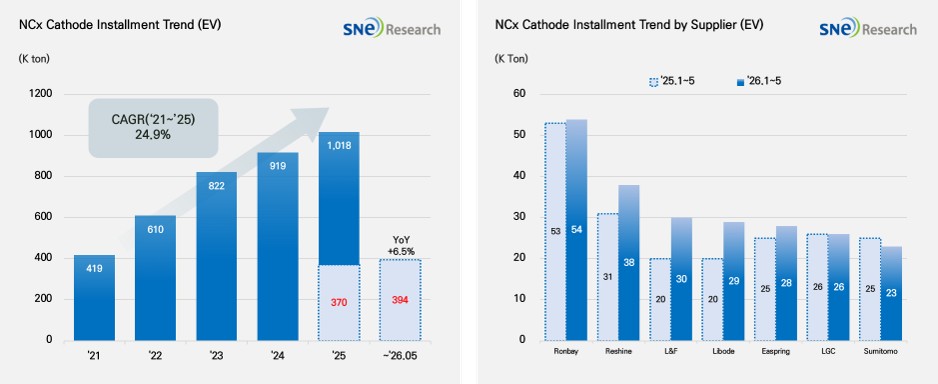
During the first five months of 2026, global ternary (NCx) cathode material deployment reached 394K tons, a 6.5% increase compared to the 370K tons recorded in the same period last year. While the broader global cathode market sustained double-digit growth, ternary materials posted a relatively capped increase, further cementing their position as a chemistry tailored primarily for premium electric vehicles.
By supplier, Ronbay retained its leading position by deploying 54K tons. Reshine expanded its volume from 31K tons to 38K tons, L&F grew from 20K tons to 30K tons, and Libode advanced from 20K tons to 29K tons, each continuing an upward trajectory. Easpring also demonstrated a stable growth stream, rising from 25K tons to 28K tons.
Overall, although the ternary market maintains its growth momentum, performance polarization among suppliers is becoming more pronounced. The divergence in growth trajectories among manufacturers is increasingly dictated by their high-value product competitiveness, client portfolios, and the varying pace of EV sales recovery across different regions.
(Source: 2026 June Global EV & Battery Monthly Tracker (Incl. LiB 4 Major Materials), SNE Research)
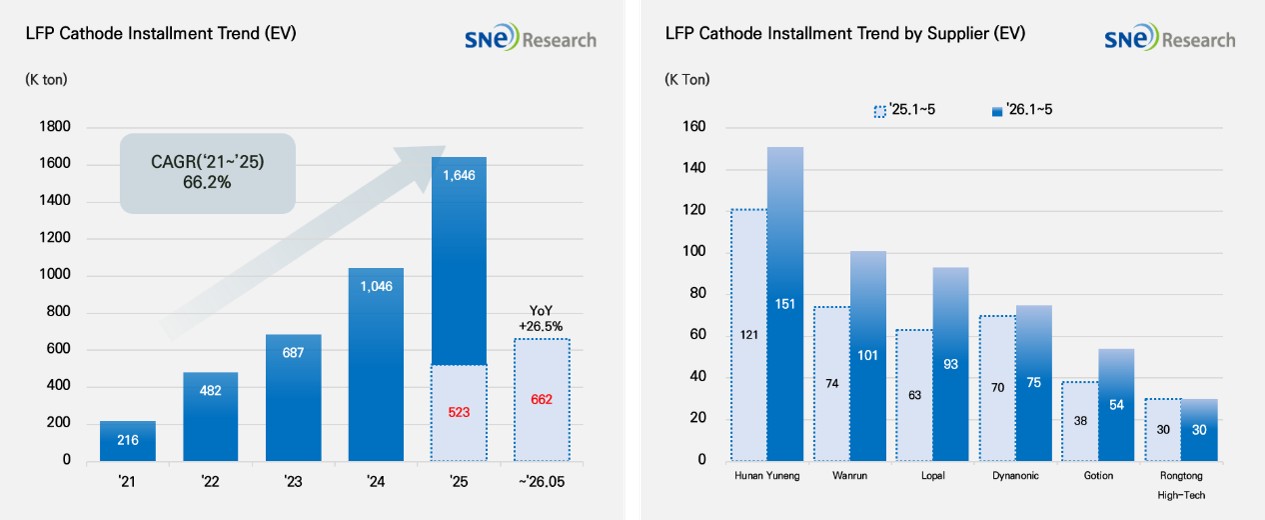
During the same period, global LFP cathode material deployment reached 662K tons, marking a 26.5% increase compared to the 523K tons recorded in the previous year and single-handedly driving the growth of the broader global cathode market.
By supplier, Hunan Yuneng retained its top position as its volume expanded from 121K tons to 151K tons. Wanrun and Lopal both registered substantial growth, jumping from 74K tons to 101K tons and from 63K tons to 93K tons, respectively. Dynanonic also saw an increase from 70K tons to 75K tons, while Gotion expanded its presence by posting a high growth rate, climbing from 38K tons to 54K tons. Conversely, Rongtong High-Tech remained flat year-over-year at 30K tons.
The LFP market continues to solidify the dominant position of Chinese suppliers. This is primarily because the China-centric value chain—spanning from raw material procurement to precursors, cathode production, and cell manufacturing—has secured both economies of scale and cost competitiveness simultaneously. Consequently, the expanding demand for LFP is transitioning into a structure that further strengthens the market dominance of Chinese material providers.
During the first five months of 2026, the global cathode material market has entered a phase characterized by a distinct restructuring of growth trajectories by chemistry and competitive landscapes among suppliers, moving beyond mere volume expansion. While LFP consistently spearheads market growth alongside the wider proliferation of global EVs, ternary materials maintain stable demand centered on the premium segment, all while performance polarization among their suppliers continues to widen.
Notably, despite a 27.7% surge in cathode demand within markets outside of China, Chinese players preserve an absolute level of influence on the supply side. Moving forward, the key variables dictating long-term manufacturer competitiveness in the global cathode market will pivot on the speed of establishing non-Chinese supply chains, LFP adaptation strategies, high-performance ternary technical prowess, and cost-efficiency benchmarks, rather than simple delivery volume scale-ups.