

From Jan to May 2026, Non-China Global EV Deliveries Recorded 3.591 Mil Units, a 26.3% YoY Growth
- Europe and Asia (excl. China) remained in an upward trend, while North America experienced a double-digit decline.
(Source: Global EV & Battery Monthly Tracker – June 2026, SNE Research)
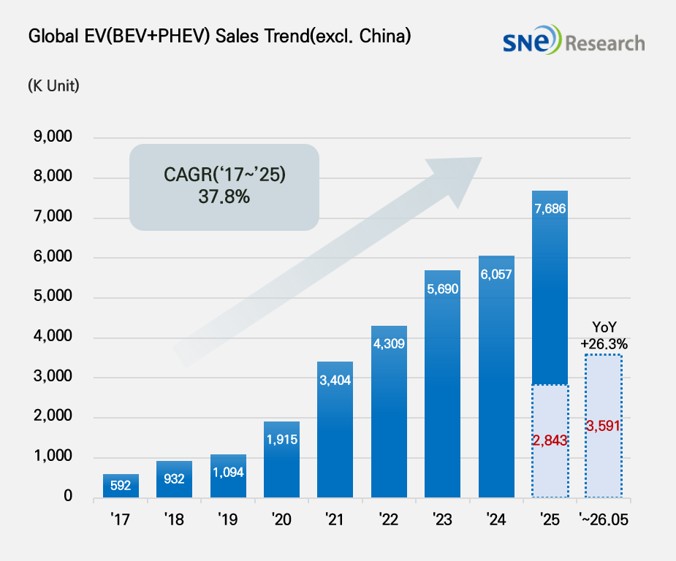
From January to May 2026, global electric vehicle (BEV+PHEV) deliveries excluding China reached 3.591 million units, marking a 26.3% increase compared to 2.843 million units recorded in the same period last year. This performance reflects the non-China market rather than the global total, where a robust recovery in Europe and high growth in the Asian market (excluding China) drove the overall expansion. Conversely, North America recorded a double-digit decline, clearly underscoring that the growth axis within the non-China market is shifting toward Europe and Asia.
(Source: Global EV & Battery Monthly Tracker – June 2026, SNE Research)
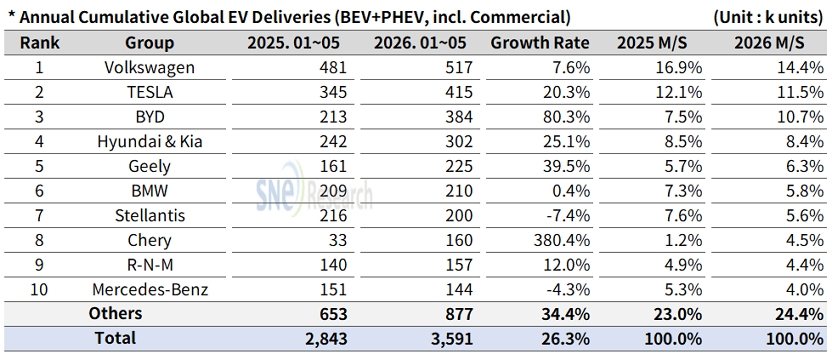
By manufacturer, Volkswagen maintained its top position, delivering 517,000 units. Although this marked a 7.6% increase year-over-year, it significantly underperformed the broader non-Chinese market growth rate of 26.3%, causing its market share to slip from 16.9% to 14.4%. While the German automaker defended its lead in terms of volume, its relative market influence softened as competitors expanded at a much faster pace.
Tesla retained the second spot with 415,000 units, a 20.3% increase year-over-year. Despite steady volume expansion, it fell short of the market average growth rate, pulling its market share down slightly from 12.1% to 11.5%. While Tesla preserves its position as an anchor EV brand in the non-Chinese arena, it faces intensifying competition driven by the aggressive overseas pushes of European legacy OEMs and Chinese automakers.
BYD held onto the third spot, registering 384,000 units, a staggering 80.3% surge compared to the same period last year. Its market share also jumped from 7.5% to 10.7%, posting the most conspicuous growth momentum among the top-tier players. This performance underscores that BYD is successfully diversifying away from its historically domestic-heavy sales architecture, rapidly scaling up its sales footprint across Europe, Asia (excluding China), and Latin America.
Hyundai Motor Group registered 302,000 units, marking a 25.1% increase year-over-year. While it maintained a growth trajectory close to the market average, its market share ticked down slightly from 8.5% to 8.4%. Although sales expansion across Europe and Asia (excluding China) drove its performance, the market share competition is intensifying due to the rapid rise of Chinese players such as BYD and Geely.
Geely delivered 225,000 units, posing a 39.5% increase that outpaced the market average, while Chery skyrocketed by 380.4% to 160,000 units, registering the highest growth rate in the non-Chinese arena. Conversely, BMW grew by a mere 0.4%, recording 211,000 units, while Stellantis posted 200,000 units (-7.4%) and Mercedes-Benz recorded 144,000 units (-4.3%), revealing a stark polarization in performance even among traditional global legacy OEMs. The Renault-Nissan-Mitsubishi (R-N-M) Alliance also recorded underperforming growth, rising 12.0% to 157,000 units.
Deliveries from other manufacturers outside the top 10 groups reached 877,000 units, surging 34.4% year-over-year, which pushed their combined market share up from 23.0% to 24.4%. This trend underscores that the competitive landscape of the non-Chinese EV market is rapidly transitioning away from being centered on traditional legacy OEMs, evolving into a highly diversified arena with the aggressive influx of Chinese players and regional niche brands.
(Source: Global EV & Battery Monthly Tracker – June 2026, SNE Research)
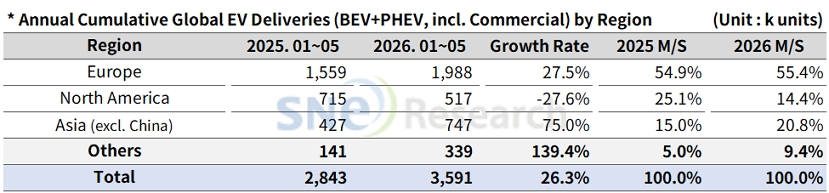
By region, Europe maintained its status as the largest demand hub in the non-Chinese global EV market, delivering 1.988 million units for a 27.5% increase year-over-year, while its market share ticked up slightly from 54.9% to 55.4%. Driven by major OEMs accelerating their new model rollouts and electrification strategies, Europe continues to serve as the epicenter of growth outside of China.
Asia (excluding China) registered the highest growth momentum, surging 75.0% to 747,000 units, which substantially lifted its market share from 15.0% to 20.8% and established it as a rapidly emerging growth pillar. This expansion was primarily propelled by Chinese OEMs, armed with cost competitiveness and agile supply capabilities, broadening their sales footprint across emerging markets such as Southeast Asia and the Middle East.
In stark contrast, North America posted 517,000 units, a 27.6% drop that marked the sharpest decline among all major regions, dragging its market share down significantly from 25.1% to 14.4% and acting as the heaviest drag on overall non-Chinese market growth. Other regions also demonstrated a distinct emerging-market-driven expansion, skyrocketing 139.4% to 339,000 units and expanding their combined market share to 9.4%.
During the first five months of 2026, the global EV market excluding China continued its steady growth trajectory, diverging from the domestic slowdown inside China. The core of this growth hinges on the stable demand recovery in Europe and the high-speed expansion in Asia (excluding China), whereas the North American market remains relatively weak due to ongoing policy uncertainties and slowing demand. Notably, with Chinese OEMs like BYD, Chery, and Geely rapidly carving out market share abroad, the non-Chinese market is witnessing an intensifying showdown between traditional global legacy OEMs and expanding Chinese players. Moving forward, regional policy shifts, localized production scale-ups, and supply chain establishment capabilities are projected to emerge as the definitive factors dictating long-term OEM competitiveness.