

From Jan to May 2026, Non-Chinese Global[1] EV Battery Usage[2] Posted 209.1GWh, a 21.8% YoY Growth
-
CATL and BYD Capture 44.3% Combined Share, Expanding Influence of Chinese
Players in Non-China Markets
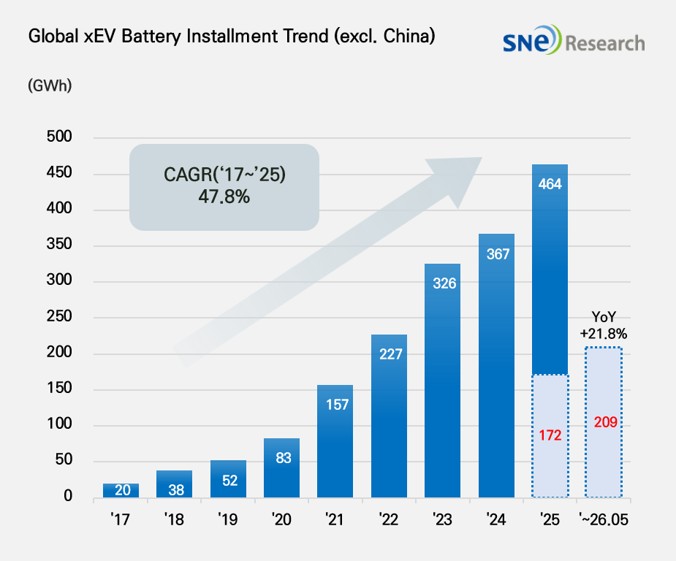
Battery installation for global electric vehicles (EV, PHEV, HEV) excluding the Chinese market sold from Jan to May 2026 was approximately 209.1GWh, a 21.8% YoY growth.
(Source: Global EV and Battery Monthly Tracker – June 2026, SNE Research)
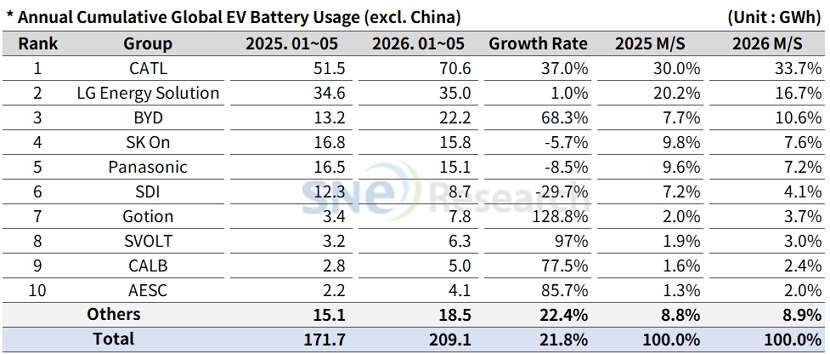
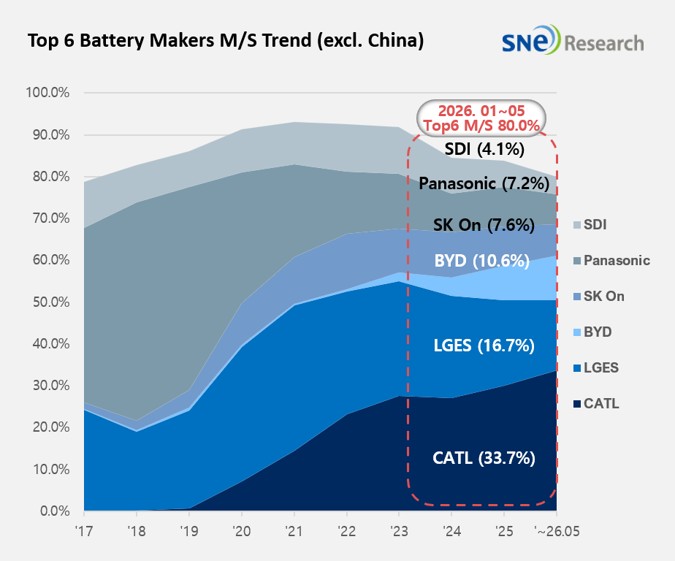
From January to May 2026, the combined market share of South Korea’s top three battery makers, such as LG Energy Solution, SK On, and Samsung SDI, in the global EV battery market (excluding China) stood at 28.4%, down 8.7 percentage points year-on-year. LG Energy Solution recorded 35.0GWh, a 1.0% increase compared to the same period last year; however, as its growth trailed the market average, its market share fell from 20.2% to 16.7%. SK On registered 15.8GWh, marking a 5.7% decrease, while Samsung SDI posted 8.7GWh, a 29.7% decline. While the overall non-China market expanded by 21.8%, the combined usage volume of the three Korean manufacturers contracted year-on-year, underscoring the increasingly prominent market share position of Chinese battery makers.
(Source: Global EV and Battery Monthly Tracker – June 2026, SNE Research)
Looking at the battery usage of the three major Korean battery cell makers by automotive client, Samsung SDI continued its supply focused on key customers such as BMW, Audi, and Rivian, yet sluggish sales of core electrified models led to a decline in its total battery usage. In particular, reflecting the weak sales performance of clients heavily reliant on the North American market, such as Rivian, Samsung SDI’s market share in the non-Chinese arena dropped from 7.2% to 4.1% year-over-year. For BMW and Audi, despite some positive impact from new EV rollouts, the slower-than-expected sales momentum of existing flagship models acted as a major factor dragging down overall installations.
SK On’s batteries were predominantly deployed in electric vehicles from major automakers, including Hyundai Motor Group, Ford, Volkswagen, and Mercedes-Benz. While stable sales and new model effects from certain Hyundai Motor Group EVs provided positive tailwinds, the slowing EV sales of core clients like Ford and Volkswagen failed to be offset by these gains. Coupled with ongoing demand adjustments and production line curbs in North America, SK On’s battery usage decreased by 5.7% year-over-year, pulling its market share down from 9.8% to 7.6%.
LG Energy Solution secured its second-place position in the non-Chinese market, recording a battery usage of 35.0 GWh. Sustained supply to major global OEMs—such as Tesla, GM, Hyundai Motor Group, and Volkswagen—along with expanded EV sales from select clients, contributed to its volume growth. However, as Chinese competitors expanded at a faster pace within the non-Chinese market, LG Energy Solution’s market share shed 3.5 percentage points compared to the same period last year. This trend underscores that under intensifying competition within global OEM supply chains, factors such as cost competitiveness, LFP product adaptability, and the strategic establishment of regional manufacturing hubs are directly dictating market share fluctuations.
CATL retained its leading position in the global (excluding China) market during the first five months of 2026, recording 70.6 GWh. Its year-over-year growth rate reached a staggering 37.0%, while its market share expanded from 30.0% to 33.7%. CATL is rapidly scaling up its footprint in the non-Chinese market by broadening its supply perimeter to global OEMs including Tesla, BMW, Mercedes-Benz, Toyota, and Kia. A key driver behind this robust growth is analyzed to be its dual tracking strategy, securing both Chinese automotive exporters and global legacy OEMs as clients across Europe, Asia, and other emerging markets.
BYD climbed to the third spot, logging 22.2 GWh for a 68.3% increase year-over-year, while its market share advanced from 7.7% to 10.6%. This non-Chinese market expansion indicates a gradual shift away from its historically domestic-heavy battery utilization structure, underpinned by growing overseas sales of its own EVs alongside increased supply to external clients. Armed with its proprietary Blade Battery, BYD is emphasizing both cost competitiveness and safety, yielding a rapid uptick in battery usage aligned with its recent aggressive expansion of overseas dealership networks.
Later-mover Chinese manufacturers such as Gotion, SVOLT, and CALB also registered steep growth curves. Gotion surged 128.8% year-over-year to 7.8 GWh, and SVOLT jumped 97.0% to 6.3 GWh. CALB also posted strong momentum, recording 5.0 GWh for a 77.5% growth rate. Riding on the coattails of Chinese automakers’ overseas ventures, these players are capturing greater supply opportunities across Europe, Asia, and emerging markets, leveraging the cost competitiveness of LFP batteries to carve out a larger presence outside of China.
Conversely, Panasonic’s battery usage slipped 8.5% year-over-year to 15.1 GWh. This downturn is largely attributed to sales shifts among specific models of its anchor client, Tesla, alongside demand adjustments in the North American market. While Panasonic remains heavily reliant on its Tesla-centric supply architecture, the company is seeking to bolster mid-to-long-term competitiveness through next-generation cylindrical battery rollouts and North American production efficiency improvements. However, given its high single-client dependency, the risk of heightened usage volatility remains pronounced during periods of broader market turbulence.
(Source: Global EV and Battery Monthly Tracker – June 2026, SNE Research)
During the first five months of 2026, the global electric vehicle (EV) secondary battery market, excluding China, maintained a steady growth trajectory, yet performance varied sharply by manufacturer. Despite expanding demand in non-Chinese markets, established non-Chinese incumbents—including the three major Korean cell makers and Panasonic—saw their market shares contract, heavily impacted by slowing sales among core North American and European clients alongside shifts in product portfolios.
In stark contrast, Chinese manufacturers, including CATL and BYD, are rapidly expanding their influence outside of China, leveraged by cost competitiveness, LFP product advantages, and broadened supply to global legacy OEMs. Consequently, the non-Chinese market has transitioned away from being a mere alternative destination for excess volume; it has reshaped into the primary battleground where incumbent South Korean and Japanese suppliers directly clash with aggressively expanding Chinese players.
[2] Based on battery installation for xEV registered during the relevant period.