

From Jan to May 2026, Global Electric Vehicle Deliveries Recorded 7.754 Mil Unit, a 3.5% YoY Growth
- Europe and Asia (excl. China) maintain growth, while China and North America , while global growth capped by sluggish demand in China and North America
(Source: Global EV and Battery Monthly Tracker – June 2026, SNE Research)
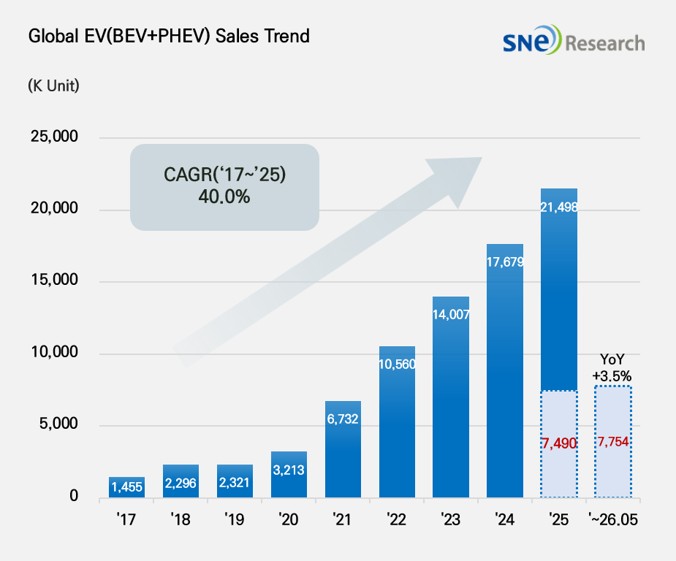
The global electric vehicle (EV, including BEV and PHEV) deliveries totaled 7.754 million units during the first five months of 2026, marking a 3.5% increase year-over-year. While the overall market maintained its upward trajectory, the growth rate remained capped in the low single digits. This slowdown was primarily constrained by China, the world's largest EV market, which continued its double-digit decline. In contrast, Europe, Asia (excluding China), and other emerging markets sustained robust growth, further accelerating a distinct regional restructuring across the global landscape.
(Source: Global EV and Battery Monthly Tracker – June 2026, SNE Research)
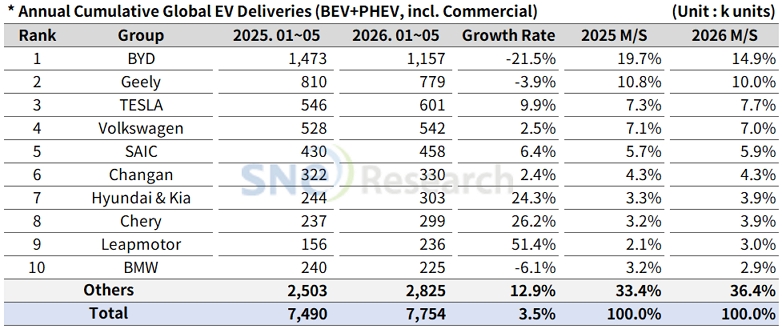
Looking at global EV deliveries by automotive group during the first five months of 2026, BYD maintained its top position with 1.157 million units, yet this marked a 21.5% decrease year-over-year. Its market share also contracted significantly from 19.7% to 14.9%, reflecting a slight weakening of its market dominance. This downturn was directly impacted by falling sales in the Chinese domestic market, as the company's overseas expansion fell short of fully offsetting the domestic slump.
Geely retained the second spot with 779,000 units, albeit experiencing a 3.9% decline. Conversely, Tesla achieved the most stable growth among the global Top 3, with deliveries rising 9.9% to 601,000 units. Its market share also climbed from 7.3% to 7.7%, demonstrating resilient competitiveness despite the broader slowdown in China. Volkswagen also capitalized on the recovery of the European market, delivering 542,000 units for a 2.5% increase.
Among major Chinese OEMs, SAIC and Changan saw capped growth, recording 458,000 units (+6.4%) and 330,000 units (+2.4%), respectively. In contrast, Chery sustained robust momentum, surging 26.2% to 299,000 units, a strong performance largely attributed to the successful expansion of its overseas footprint. Hyundai Motor Group posted 303,000 units, marking a 24.3% increase year-over-year. Its market share expanded from 3.3% to 3.9%, registering the highest growth rate among the top-tier global automotive groups, driven primarily by the recovery in Europe and expansion across non-Chinese Asian markets.
The most conspicuous growth was achieved by Leapmotor, which saw its sales skyrocket by 51.4% to 236,000 units, boosting its market share from 2.1% to 3.0%. On the other hand, BMW fell into a decline among the top players, recording 225,000 units (-6.1%). Deliveries from other manufacturers outside the top 10 groups reached 2.825 million units, a 12.9% increase, with their combined market share expanding from 33.4% to 36.4%. This trend underscores that the global EV market is diversifying its competitive landscape, transitioning away from a few dominant leaders toward a broader array of OEMs leveraging regional strengths.
(Source: Global EV and Battery Monthly Tracker – June 2026, SNE Research)
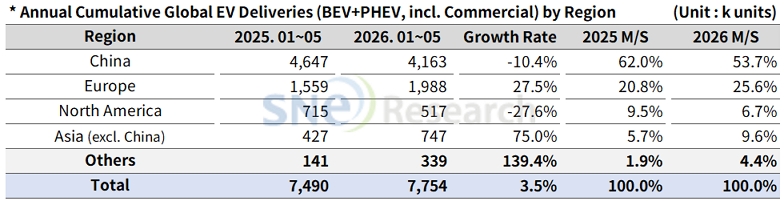
By region, China maintained its position as the largest market with 4.163 million units, but this represented a 10.4% decrease year-over-year. Its global market share also contracted from 62.0% to 53.7%, reflecting a continuous shrinkage of its weight in the global arena. Conversely, Europe recorded 1.988 million units, marking a 27.5% increase and expanding its market share from 20.8% to 25.6%. Driven by major automakers' electrification strategies and new model rollouts, Europe continued to serve as a core pillar of global market growth.
North America registered 517,000 units, a 27.6% drop that marked the sharpest decline among all major regions, pulling its market share down from 9.5% to 6.7%. This contraction is largely attributed to policy uncertainties and slowing demand in the US EV market. In stark contrast, Asia (excluding China) sustained the highest growth momentum, surging 75.0% to 747,000 units. Its market share also expanded substantially from 5.7% to 9.6%, rapidly emerging as a new growth hub for the global EV industry. Other regions also continued their emerging-market-driven expansion, skyrocketing 139.4% to 339,000 units.
During the first five months of 2026, the global EV market overall maintained moderate growth, yet regional polarization became further pronounced. While China and North America recorded double-digit declines, Europe, Asia (excluding China), and other emerging markets spearheaded global demand expansion. Concurrently, manufacturers heavily reliant on the Chinese domestic market, such as BYD and Geely, saw their growth decelerate. In contrast, companies actively pursuing overseas expansion, including Tesla, Hyundai Motor Group, Chery, and Leapmotor, posted relatively robust performances.
Moving forward, key variables dictating changes in OEM performance and market share will center on the recovery of China's domestic demand, policy shifts in North America, and the sustainability of demand across Europe and non-Chinese Asian markets. In particular, the capability to expand localized production and establish resilient supply chains in overseas markets is anticipated to emerge as a critical factor determining future global competitiveness.