

LFP Dominates Cathode Market with 72% Share in 2025, Up 19% from 2023; Strong Momentum Projected to Continue This Year
ü Reshine Claims Top
Spot in 2025 Ternary Cathode Shipments with 177K Tons; Hunan Yuneng Monopolizes
LFP Sector at 1.14M Tons, Driving Aggressive Capacity Expansion This Year
ü China’s
High-Nickel Giant Ronbay Supplies Over 80K Tons of High-Ni (≥80%) Cathodes to
CATL, Yet Slips to 4th in Overall Ternary Shipments
ü Ternary vs. LFP
Cathode Shipment Ratio Hits 28% to 72% in 2025, with LFP Share Expanding 8%
Year-on-Year
ü Sustained Strong
Sales of Chinese LFP Cathodes Paired with Rising Mineral and Lithium Prices
Anchor a Profitability Rebound for Cathode Manufacturers.
ü Future Competitive Landscape to Intensify Around High-Power High-Ni for Ternary Chemistries and High-Capacity, High-Density LMFP for LFP Alternatives.
(Source: <2026.1H> LIB 4 Major Materials SCM Analysis and Mid/Long-Term Outlook, SNE Research)
According to the <2026.1H> LIB 4 Major Materials SCM Analysis and Mid/Long-Term Outlook report published by SNE Research in early June, the global demand (installation) for lithium-ion battery cathode materials reached 4.79 million tons in 2025, while total cathode shipments recorded approximately 4.95 million tons. Compared to 2024, demand surged by 42% and shipments expanded by 34%.
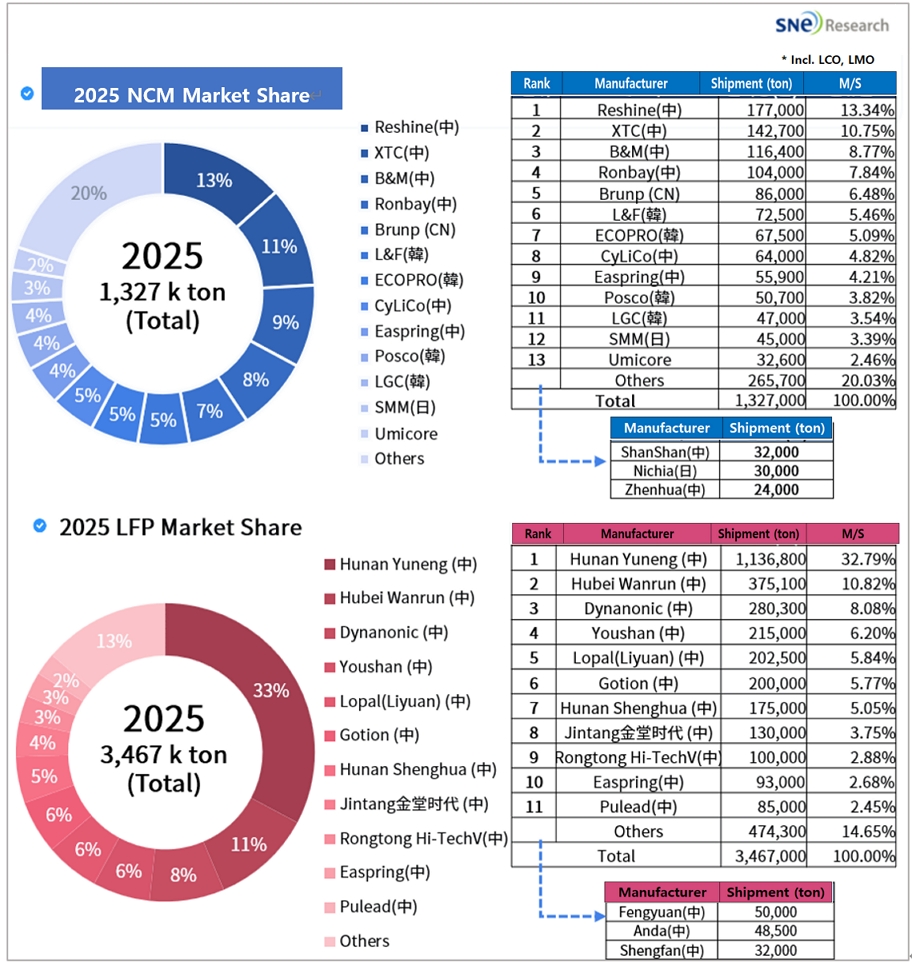
Out of the total 4.95 million tons of cathode materials shipped in 2025, LFP accounted for 3.47 million tons, commanding roughly 72% of the market. In the combined standings for both ternary and LFP chemistries, Hunan Yuneng claimed the number-one spot with 1.14 million tons shipped. Hubei Wanrun followed in second place with 375K tons shipped, while Dynanonic secured third with 280K tons. Additionally, Youshan (a subsidiary of Huayou Cobalt) climbed to fourth place with 215K tons shipped, followed by Lopal in fifth with 202.5K tons and Gotion in sixth with 200K tons.
Focusing strictly on ternary cathode manufacturers, Reshine climbed to the number-one spot with shipments of 177K tons. While its shipments stood at 52K tons in the first half of 2025, it delivered a massive 125K tons in the second half, securing the top ranking in ternary shipment volume. Centered on Mid-Ni (70% or higher) products, Reshine supplied 130K tons to CATL, 23K tons to EVE, 8K tons to CALB, 8K tons to SVOLT, and over 30K tons to other Chinese manufacturers.
XTC focused its shipments on Mid-Ni NCM, supplying approximately 77K tons to Gotion, CATL, EVE, PPES, and other Chinese players, while the remainder of its sales consisted of LCO. B&M recorded a shipment volume of 116K tons, counting CATL and LG Energy Solution (LGES) as its primary customers. Ronbay ranked fourth with 104K tons shipped, supplying around 80K tons of High-Ni NCM exclusively to CATL. Brunp, a subsidiary of CATL, directed the vast majority of its volume to its parent company and was ranked fifth. Following them, South Korea's L&F and EcoPro, along with China's Cylico, Easpring, and POSCO Future M, registered shipments ranging between 50K and 80K tons.
In 2025, LFP (Lithium Iron Phosphate) batteries firmly established themselves as the mainstream choice in the ESS (Energy Storage System) market, backed by their low cost and high safety profile. Particularly in tandem with the soaring power demand from data centers driven by expanding AI technologies, the demand for LFP ESS—which is essential for large-scale power management—is experiencing explosive growth. To counter China's aggressive pricing strategy, South Korean cathode manufacturers are diversifying their strategies by formally preparing for the development and mass production of LFP, high-voltage Mid-Ni, and LMR (Lithium-and-Manganese-Rich) cathodes. They anticipate capitalizing on windfall gains from anti-China supply chain realignments, such as the U.S. Inflation Reduction Act (IRA).
In 2026, as core mineral and lithium prices rebound during the first half of the year, the profitability of cathode manufacturers is entering a recovery phase. Concurrently, the proliferation of humanoid robots, UAM (Urban Air Mobility), and drones is driving a rapid resurgence in demand for high-power, high-capacity High-Ni NCM cathodes. Consequently, intense supply competition is expected as companies race to capture these emerging mobility markets.