

From Jan to Apr 2026, Global[1] EV Battery Separator Installment[2] Reached 5,552Mil ㎡, a 17.7% YoY Growth
- Chinese separator makers accounted for 89.6% M/S; China Maintains Dominance in Global Supply Structure
(Source: 2026 May Global EV & Battery Monthly Tracker (Incl. LiB 4 Major Materials), SNE Research)
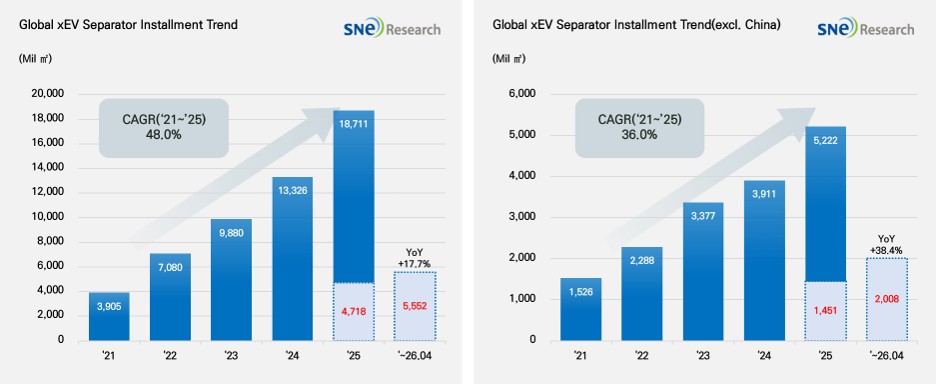
From January to April 2026, the installation volume of battery separators for electric vehicles (EV, PHEV, HEV) registered in countries worldwide reached approximately 5,552 million m², marking a 17.7% increase year-on-year. During the same period, separator installations in the global market excluding China stood at approximately 2,008 million m², growing by 38.4% compared to the previous year and significantly outperforming the overall market growth rate
The separator is a core material within lithium-ion batteries that physically isolates the anode and cathode to prevent short circuits while allowing the transfer of lithium ions. As a component that directly impacts battery safety, power output performance, and lifespan, demand for separators has been steadily rising in lockstep with the expansion of the EV market, increasing battery capacity per vehicle, and the broadening adoption of high-energy-density cells.
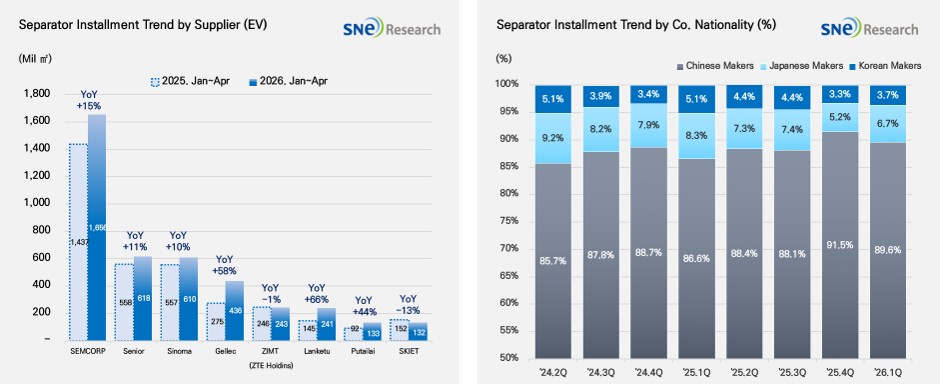
From January to April 2026, the global separator market witnessed divergent trends among major suppliers. SEMCORP recorded approximately 1,656 million m², growing 15% year-on-year to maintain its top position in the market, while Senior (+11%) and Sinoma (+10%) also sustained steady upward trends. Notably, certain manufacturers such as Gellec (+58%), Lanketu (+66%), and Putailai (+44%) posted high growth rates, signaling a push to expand their market shares. Conversely, ZIMT (ZTE Holdings, -1%) remained flat compared to the previous year, and SK IE Technology (-13%) experienced a decline, impacted by slowing demand among non-Chinese suppliers.
Looking at market share by corporate nationality, Chinese companies accounted for 89.6% of the market as of the first quarter of 2026, capturing the vast majority of the global separator industry. Japanese firms held a 6.7% share, followed by South Korean peers at 3.7%. The market share of Chinese suppliers rose by 3.0 percentage points from 86.6% in Q1 2025. During the same period, the share of Japanese companies fell from 8.3% to 6.7%, and South Korean firms dipped from 5.1% to 3.7%. This demonstrates that while the supply dominance of Chinese players is intensifying in the global separator market, the relative standing of Japanese and South Korean manufacturers is experiencing a contraction.
(Source: 2026 May Global EV & Battery Monthly Tracker (Incl. LiB 4 Major Materials), SNE Research)
From January to April 2026, the global EV battery separator market sustained its overall growth trajectory, but the center of growth diverged between the dominance of Chinese suppliers and the demand recovery in non-China markets. In the Chinese market, expanding battery cell production and an LFP-centric product mix are underpinning separator demand. Meanwhile, in markets outside China, a recovery in EV sales across Europe and emerging markets, new model rollouts by major OEMs, and increasing battery capacity per vehicle are driving the expansion of separator installation volumes. However, electric vehicle production pace adjustments by North American and some European automakers are acting as a constraint on the short-term growth potential of non-Chinese separator manufacturers.
Currently, the separator market is transitioning into a structure where supply competition in commodity products and technological competition in high-value products take place simultaneously, moving beyond a phase of simple volume expansion driven by EV demand growth. As capacity expansion races continue within China, price pressures on commodity separators are intensifying. Consequently, major players are shifting their competitive focus toward products with enhanced safety and performance, such as ceramic-coated, high-heat-resistant, ultra-thin, and fast-charging-compatible separators. Concurrently, with the expansion of the ESS market and rising power demand from data centers, battery applications beyond electric vehicles are rapidly widening. Moving forward, a separator manufacturer's competitiveness will be dictated not only by securing EV clients but also by its responsiveness to ESS products, deployment of localized supply chains in North America and Europe, and ability to mitigate reliance on China.
[2] Based on batteries installed to electric vehicles registered during the relevant period.