

From Jan to Apr 2026, Global EV Battery Anode Installment Reached 421K ton, a 14.9% YoY Growth
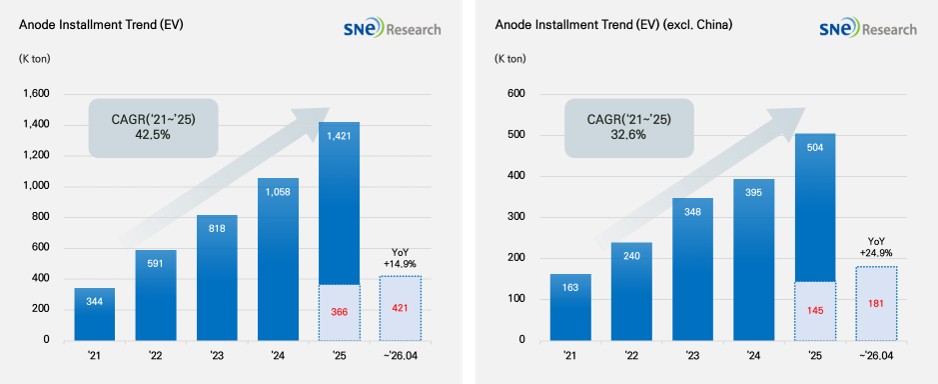
- Anode installment in the non-China market recorded 181K ton, a 24.9% YoY Growth
(Source: 2026 May Global EV & Battery Monthly Tracker (Incl. LiB 4 Major Materials), SNE Research)
From January to April 2026, the global installation volume of anode materials for electric vehicles reached 421K tons, marking a 14.9% increase compared to the 366K tons recorded in the same period of 2025. During the same period, the installation volume in the global market excluding China expanded by 24.9%, rising from 145K tons to 181K tons, significantly outperforming the overall market growth rate. This implies that even amid the growing regional temperature differences in global EV demand, production expansion and supply chain diversification movements centered on the non-China market are supporting anode material demand.
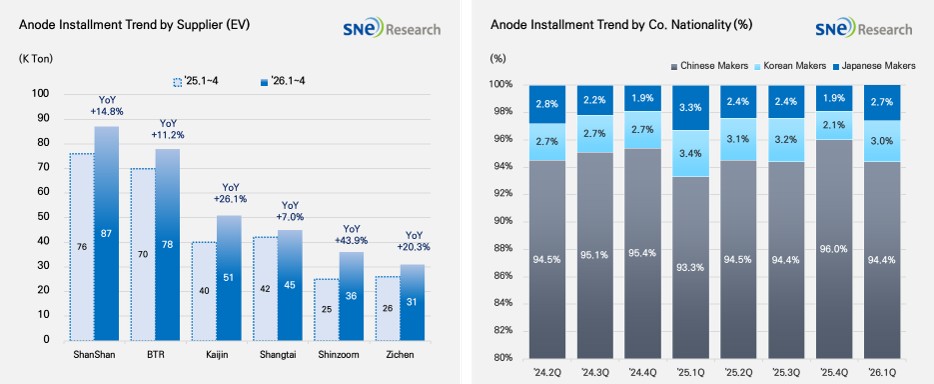
By supplier, ShanShan maintained its lead by increasing from 76K tons to 87K tons, while BTR also extended its top-tier status, rising from 70K tons to 78K tons. Kaijin recorded a notable growth trend, increasing by 26.1% from 40K tons to 51K tons, and Shangtai rose by 7.0% from 42K tons to 45K tons. Shinzoom grew by 43.9% from 25K tons to 36K tons, posting the highest increase rate among major manufacturers, while Zichen also expanded by 20.3% from 26K tons to 31K tons.
This trend demonstrates that while the leading structure centered on ShanShan and BTR remains intact, the growth of mid-tier companies such as Kaijin, Shinzoom, and Zichen is progressing at a relatively faster pace. Notably, although all major suppliers recorded year-on-year increases, the widening growth gaps highlight that customer acquisition capability, manufacturing efficiency, and product portfolio responsiveness are surfacing as defining factors for performance differentiation.
(Source: 2026 May Global EV & Battery Monthly Tracker (Incl. LiB 4 Major Materials), SNE Research)
Looking at the share by corporate nationality, Chinese companies maintained an overwhelming dominance with a 94.4% market share as of the first quarter of 2026. South Korean companies recorded 3.0%, while Japanese firms posted 2.7%. The share of Chinese companies has sustained a high level, moving from 93.3% in Q1 2025 to 94.5% in Q2, 94.4% in Q3, and 96.0% in Q4 of 2025. By maintaining the 94% range in Q1 2026, it reaffirmed that the global anode supply chain heavily operates around China.
The anode installation volume in the market excluding China increased from 145K tons in January-April 2025 to 181K tons in January-April 2026, registering a growth rate of 24.9%. This outperforms the overall global growth rate of 14.9% during the same period, demonstrating that expanding EV production and local supply chain restructuring in the non-China market are driving the growth in anode demand. Particularly as localized sourcing of battery materials and supply chain stability become crucial centered on North America and Europe, mid-to-long-term demand aimed at reducing reliance on China is taking shape in the anode market as well. However, because the current supply structure remains locked around Chinese suppliers, the expansion of the non-China market does not immediately translate into a market share increase for non-Chinese suppliers. Moving forward, the competitive axis is highly likely to expand beyond simple capacity expansions into localized responsiveness, customized supply, and responsiveness to next-generation materials such as silicon-composite anodes.
Currently, the global anode market exhibits a dual structure where demand growth and supply concentration occur simultaneously. While installations in the market excluding China are expanding faster than the global average, Chinese players maintain a mid-94% market share on the supply side. This implies that unlike the cathode market, where product-mix changes serve as the core architecture, the anode market faces higher entry barriers rooted in graphite processing capabilities, cost competitiveness, and long-term supply frameworks based on customer qualification. Future market competition is projected to be reorganized based on responsiveness to non-Chinese customers, localized production and processing foundations, the commercialization speed of silicon-composite anodes, and supply chain risk management capabilities, rather than sheer installation volume expansion.