

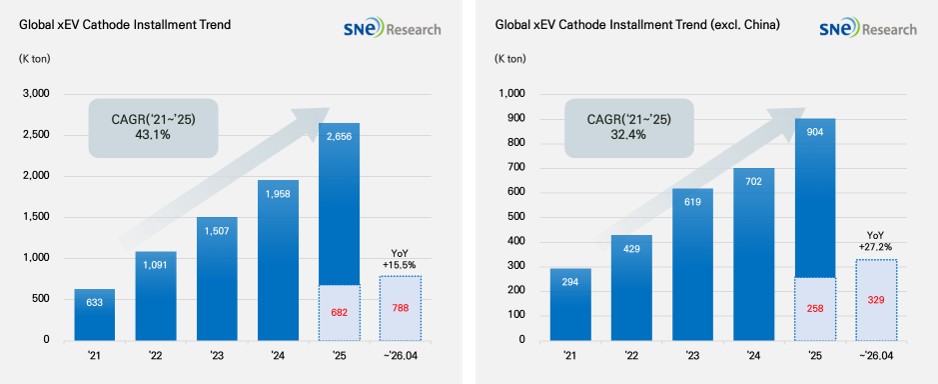
From Jan to Apr 2026, Global EV Battery Cathode Installment Reached 788K ton, a 15.5% YoY Growth
- EV battery cathode installment in the non-China market recorded 329K ton, a 27.2% YoY growth
(Source: 2026 May Global EV & Battery Monthly Tracker (Incl. LiB 4 Major Materials), SNE Research)
Global demand for EV cathode materials continued its growth trajectory through the first four months of 2026. From January to April 2026, the global installation volume of cathode materials for xEVs reached 788K tons, a 15.5% increase compared to the 682K tons recorded in the same period last year. During the same period, the installation volume in the global market excluding China stood at 329K tons, growing by 27.2% from 258K tons year-on-year, demonstrating that the recovery in the non-China market is underpinning the expansion of overall demand.
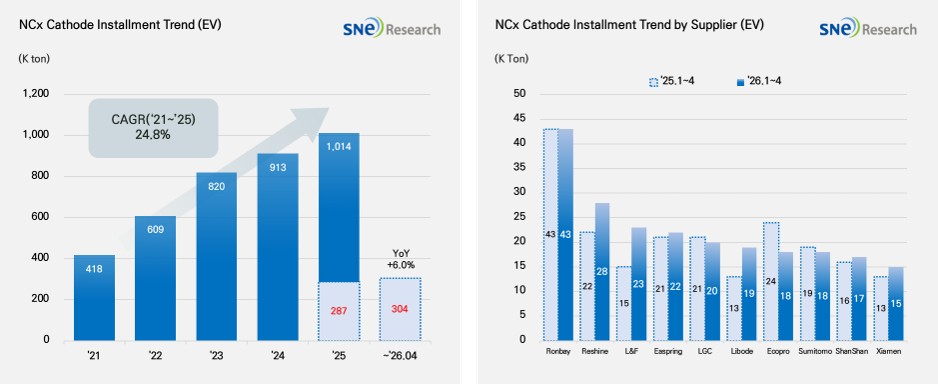
In terms of the demand structure for cathode materials, LFP led the market expansion with a 22.5% growth, whereas ternary (NCM/NCA) materials saw a modest increase of only 6.0%. While overall demand is rising, the center of growth is visibly shifting away from high-energy-density materials toward LFP, which emphasizes cost-competitiveness and supply stability.
(Source: 2026 May Global EV & Battery Monthly Tracker (Incl. LiB 4 Major Materials), SNE Research)
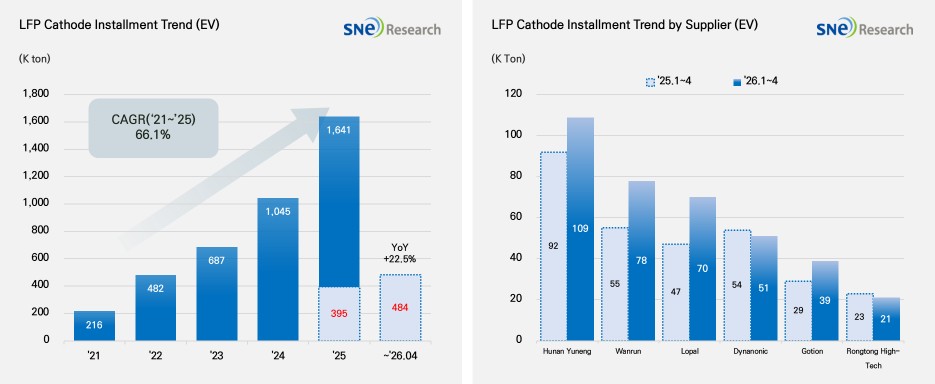
In fact, from January to April 2026, the installation volume of ternary cathode materials reached 304K tons, posting a modest 6.0% increase compared to the 287K tons recorded in the same period last year. In contrast, LFP cathode material installations stood at 484K tons, rising 22.5% from 395K tons year-on-year, driving the growth of the overall cathode material market. This trend is interpreted as a result of automakers expanding LFP adoption to achieve cost reductions and secure supply stability, amid the growing share of volume models and entry-level segments in the global EV market. Conversely, while ternary materials maintain an important position in the high-performance EV and long-range driving demand sectors, their growth rate showed a relatively gradual trend compared to LFP, reinforcing their characteristics as a premium, high-performance-focused material.
By ternary supplier, Ronbay defended its top position by maintaining 43K tons, the same level as the previous year. Reshine expanded from 22K tons to 28K tons, and South Korean supplier L&F increased from 15K tons to 23K tons, showcasing a notable recovery trend. Easpring also grew slightly from 21K tons to 22K tons, while Libode expanded from 13K tons to 19K tons, raising its profile within the rankings. On the other hand, LGC adjusted from 21K tons to 20K tons, Ecopro fell from 24K tons to 18K tons, and Sumitomo dropped from 19K tons to 18K tons. ShanShan increased from 16K tons to 17K tons, and Xiamen rose from 13K tons to 15K tons. Overall, the ternary market is exhibiting an intensifying performance differentiation among suppliers amid a gradual growth pace. In particular, while some South Korean companies showed a recovery based on high-performance products and responsiveness to non-Chinese clients, growth gaps among suppliers appeared distinctly depending on their customer portfolios and regional EV sales trends.
(Source: 2026 May Global EV & Battery Monthly Tracker (Incl. LiB 4 Major Materials), SNE Research)
By LFP supplier during the same period, Hunan Yuneng retained its top position, increasing from 92K tons to 109K tons. Wanrun and Lopal recorded significant growth, rising from 55K tons to 78K tons and from 47K tons to 70K tons, respectively. Gotion also demonstrated an upward trend, growing from 29K tons to 39K tons. Conversely, Dynanonic fell from 54K tons to 51K tons, and Rongtong High-Tech dipped from 23K tons to 21K tons, though they both defended their status as major suppliers. The LFP market shows an increasingly consolidated supply dominance of Chinese manufacturers. This is because China has strongly established integrated competitiveness across the entire LFP value chain, spanning raw material procurement, precursor and cathode production, to cell manufacturing. Consequently, the expansion of LFP demand is leading to a structure that reinforces the volume foundation of Chinese suppliers.
As of January to April 2026, the global cathode material market is evaluated to have entered a phase where material mix changes are progressing faster than simple demand growth. While the recovery of regional EV sales is emerging as a core variable in the automotive market, the cathode material market is seeing distinctly diverging growth paths by material, with the expansion of LFP and the premiumization of ternary chemistries occurring simultaneously. Notably, despite a 27.2% increase in demand excluding China, the dominance of Chinese players remains strong on the supply chain side, centered on LFP. As a result, the gap between non-China demand growth and non-China supply chain self-reliance is surfacing as a core issue. Moving forward, a manufacturer's ultimate standing in the global cathode market will be dictated by whether it can simultaneously secure regional supply chain deployment speeds, LFP responsiveness, high-performance ternary technological prowess, and cost competitiveness, rather than mere installation volume expansion.