

From Jan to Apr 2026, Non-China Global EV Deliveries Recorded 2.802 Mil Units, a 26.2% YoY Growth
- Europe and Asia (excl. China) remained in an upward trend, while North America experienced a double-digit decline
(Source: Global EV & Battery Monthly Tracker – May 2026, SNE Research)
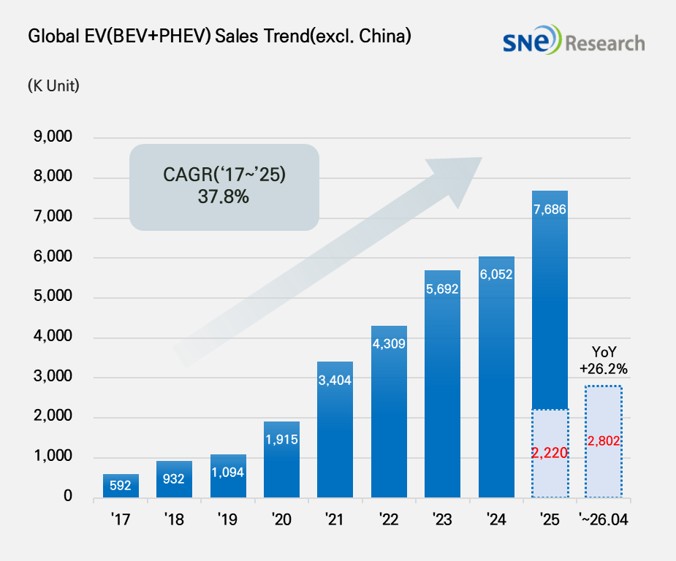
From January to April 2026, global electric vehicle (BEV+PHEV) deliveries excluding China reached 2.802 million units, marking a 26.2% increase compared to the 2.22 million units recorded in the same period last year. This performance reflects the non-China market rather than the global total, where a robust recovery in Europe and high growth in the Asian market (excluding China) drove the overall expansion. Conversely, North America recorded a double-digit decline, clearly underscoring that the growth axis within the non-China market is shifting toward Europe and Asia.
(Source: Global EV & Battery Monthly Tracker – May 2026, SNE Research)
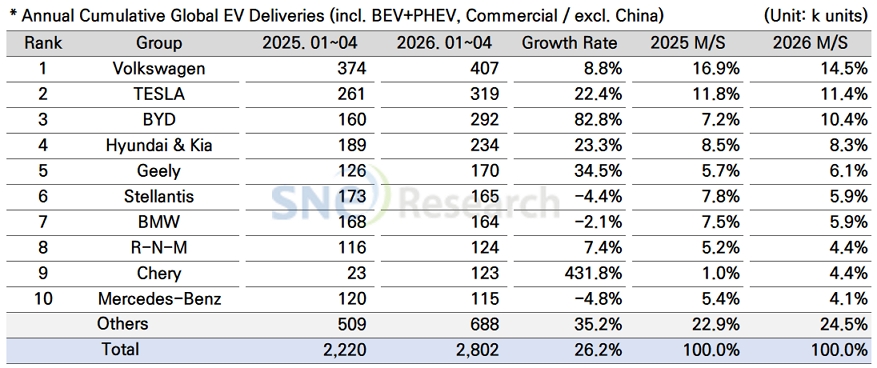
By manufacturer, Volkswagen maintained its top position, recording 407,000 units. Although its volume increased by 8.8% year-on-year, it trailed the overall non-China market growth rate of 26.2%, causing its market share to drop from 16.9% to 14.5%. While it defended its leadership in terms of sales volume, its relative influence showed a shrinking trend as late-comer manufacturers expanded at a faster pace.
Tesla ranked second with 319,000 units, marking a 22.4% year-on-year growth. Despite the volume expansion, it fell slightly short of the market's average growth rate, pulling its market share down from 11.8% to 11.4%. While maintaining its presence as a core EV brand in the non-China market, the results indicate that Tesla has entered a phase of intensifying competition rather than market dominance, amid simultaneous offensives from European and Chinese rivals.
BYD surged by 82.8% year-on-year to 292,000 units, climbing to third place. Its market share also expanded from 7.2% to 10.4%, significantly raising its profile among the top ranks. This demonstrates that its overseas sales foundation is rapidly expanding, centered on Europe and Asia (excluding China), moving beyond its previous growth structure heavily focused on the Chinese domestic market.
Hyundai Motor Group ranked fourth with 234,000 units, a 23.3% increase compared to the same period last year. Although its market share dipped slightly from 8.5% to 8.3%, it maintained its competitiveness among the top players by sustaining a growth rate close to the market average. While its regional portfolio spanning Europe, North America, and emerging Asian markets supported its sales foundation, market share competition with high-growth companies like BYD appears to be intensifying further.
Geely recorded 170,000 units, an increase of 34.5% year-on-year, while Chery skyrocketed by 431.8% to 123,000 units, clearly illustrating the aggressive expansion of Chinese automakers in the non-China market. Conversely, Stellantis decreased by 4.4% to 165,000 units, BMW slid by 2.1% to 164,000 units, and Mercedes-Benz dropped by 4.8% to 115,000 units. R-N-M posted a marginal gain, growing by only 7.4% to 124,000 units.
Sales by other manufacturers reached 688,000 units, a 35.2% increase, lifting their market share from 22.9% to 24.5%. This suggests that the competitive landscape of the non-China EV market is diversifying, moving away from its previous focus on traditional legacy OEMs toward a direction where Chinese and region-specific manufacturers are expanding together.
(Source: Global EV & Battery Monthly Tracker – May 2026, SNE Research)
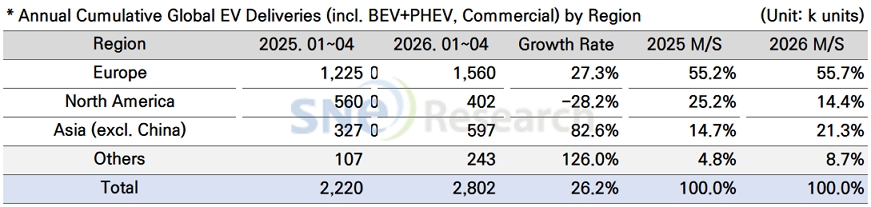
By region, Europe recorded 1.56 million units, an increase of 27.3% year-on-year, accounting for 55.7% of the global EV market excluding China. Its market share also rose slightly from 55.2% to 55.7%, maintaining its status as the largest demand source in the non-China market. Europe continued to play a central role in non-China market growth, as major OEMs focused their electrification strategies there, coinciding with regulatory compliance and the effects of new model rollouts.
Asia (excluding China) showed the fastest growth, surging by 82.6% year-on-year to 597,000 units. Its market share also rose significantly from 14.7% to 21.3%. This implies that the demand foundation within the non-China market is no longer concentrated solely in Europe and North America but is rapidly expanding into the Asian region. In particular, it is interpreted that Chinese manufacturers, equipped with price competitiveness and supply responsiveness, actively secured opportunities to expand sales in this region.
Conversely, North America registered 402,000 units, a 28.2% year-on-year decrease, marking the sharpest negative growth among major regions. Its market share also plunged from 25.2% to 14.4%, acting as a constraint on non-China market growth. Other regions expanded by 126.0% to 243,000 units, pushing their market share up to 8.7%, demonstrating that emerging markets are gradually surfacing as a growth axis that cannot be ignored.
Ultimately, the global EV market excluding China from January to April 2026 shows that, putting aside the sluggish domestic demand in China, the growth momentum remains intact. However, the nature of this growth is closer to a region-differentiated pattern rather than a simple expansion of adoption, as it simultaneously intertwines Europe's regulation-driven demand recovery, high growth in non-China Asia, and policy uncertainties in North America. Notably, as Chinese companies such as BYD, Geely, and Chery rapidly climb the ranks in the non-China market, future competition is highly likely to develop into a structure where Chinese manufacturers and traditional legacy OEMs clash directly outside the Chinese market. Therefore, the key variables in the non-China market will be regional responsiveness to pricing, policies, and localized production rather than the overall demand growth rate, with each OEM's overseas expansion strategy and supply chain localization level dictating market share fluctuations.