

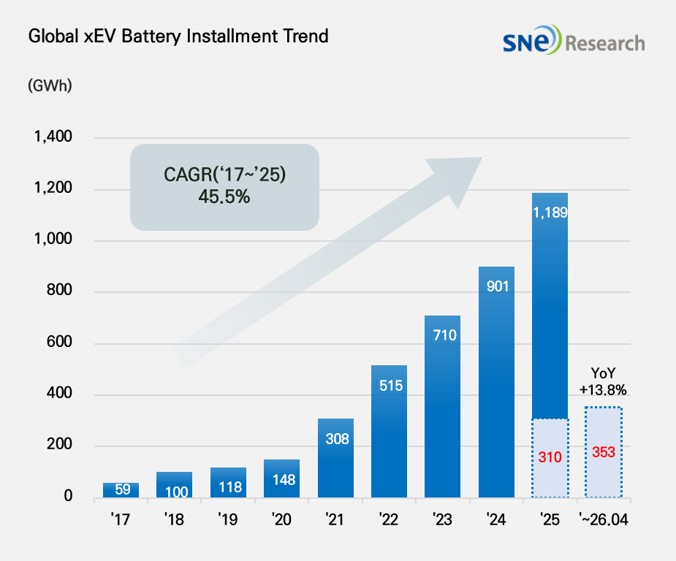
From Jan to Apr 2026, Global[1] EV Battery Usage[2] Posted 352.7GWh, a 13.8% YoY Growth
- Among the
top 10 rankers, 7 Chinese battery makers accounted for 72.2%, a 2.1%p YoY growth
From Jan to
Apr 2026, the amount of energy held by batteries
for electric vehicles (EV, PHEV, HEV) registered worldwide was approximately 352.7GWh,
a 13.8% YoY growth.
(Source: 2026 May Global Monthly EV and Battery Monthly Tracker, SNE Research)
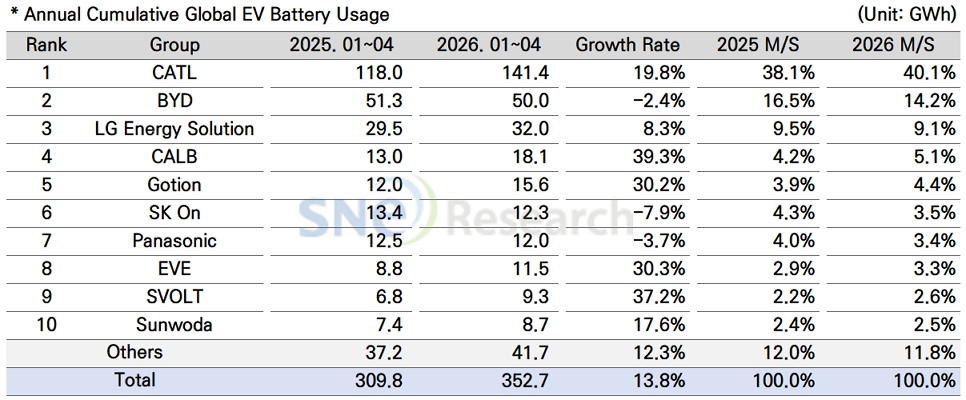
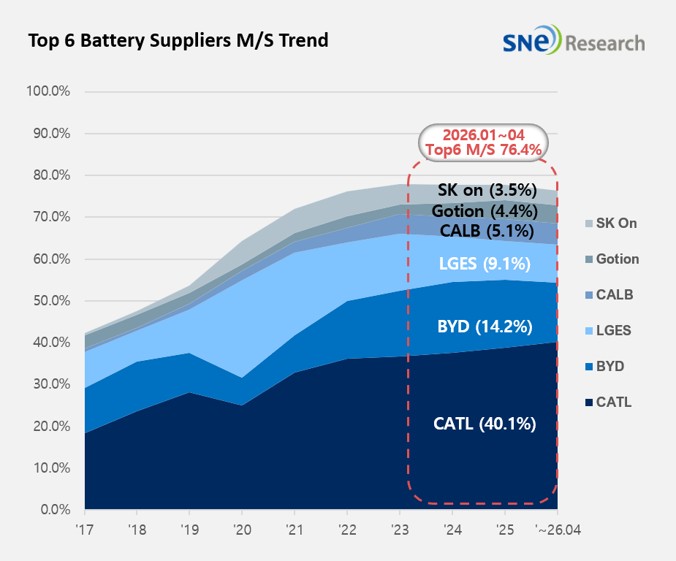
In the global EV battery market from January to April 2026, CATL maintained its top position globally, recording 141.4 GWh, a 19.8% year-on-year growth. Its market share rose by 2.0 percentage points from the same period last year to 40.1%. BYD secured the second spot with a 14.2% market share, despite a 2.4% year-on-year decrease to 50.0 GWh. The combined market share of CATL and BYD reached 54.3%, demonstrating that leading Chinese companies continue to maintain a strong dominance in the global EV battery market.
(Source: 2026 May Global Monthly EV and Battery Monthly Tracker, SNE Research)
Among domestic companies, LG Energy Solution maintained the third position, recording 32.0 GWh, an 8.3% year-on-year increase. However, as its growth lagged behind the market average, its market share fell slightly from 9.5% in the same period last year to 9.1%. LG Energy Solution's batteries are installed in major global OEMs, including Tesla, Hyundai Motor Group, GM, and Volkswagen. The analysis suggests that expanded EV sales from some of these customers contributed to the increase in battery usage. Nevertheless, its market share expansion was limited due to the rapid growth of Chinese competitors combined with demand volatility among major automakers.
SK On recorded 12.3 GWh from January to April 2026, marking a 7.9% year-on-year decrease. Its market share also declined from 4.3% to 3.5%. While SK On's batteries are supplied to major automakers such as Hyundai Motor Group, Ford, Volkswagen, and Mercedes-Benz, the decline appears to reflect slowing EV sales from key customers in North America and Europe, as well as production adjustments for certain models. In particular, the slowdown in EV demand within the U.S. market is acting as a major factor that amplifies usage volatility for battery manufacturers heavily reliant on North American clients.
Among Japanese manufacturers, Panasonic ranked 7th, recording 12.0 GWh, a 3.7% year-on-year decrease. The analysis indicates that shifting sales trends across different models of its major customer, Tesla, were directly reflected in Panasonic's battery usage. While Tesla continues to maintain a high volume of sales in the global EV market, changes in demand by model and slowing sales in certain regions are impacting its battery suppliers' performance. Consequently, Panasonic is focusing on improving production efficiency in North America and securing competitiveness in next-generation cylindrical batteries to reduce volatility stemming from its Tesla-centric supply structure.
The growth of Chinese companies was prominent across the upper ranks. CALB climbed to 4th place, recording 18.1 GWh, a 39.3% year-on-year growth, while Gotion took 5th place with 15.6 GWh, up 30.2%. EVE also recorded 11.5 GWh, a 30.3% increase, and SVOLT grew by 37.2% to reach 9.3 GWh. Sunwoda also expanded by 17.6% year-on-year to 8.7 GWh. Backed by their strong domestic automaker customer base in China, these Chinese manufacturers continue their upward trajectory while expanding their supply scope to overseas OEMs and diversifying into applications such as commercial vehicles and Energy Storage Systems (ESS).
BYD maintained its second-place position globally, recording 50.0 GWh, but this marked a 2.4% decrease compared to the same period last year. BYD's structure shows that its battery usage volatility is relatively high, as it is directly linked to the sales trends of its own electric vehicles. However, along with the expansion of BYD brand's overseas sales in the global market, enhancing product competitiveness—led by its Blade Battery and ultra-fast charging technology—is highly likely to serve as a mid-to-long-term growth engine.
(Source: 2026 May Global Monthly EV and Battery Monthly Tracker, SNE Research)
As of January to April 2026, the global EV secondary battery market continues its growth trajectory, yet demand trends by region and manufacturer are becoming increasingly differentiated. In the Chinese market, Chinese companies, led by CATL, are expanding their market share based on their solid domestic foundation and rapid product turnaround speeds. Additionally, sustained electrification demand in Europe and emerging markets is supporting the overall increase in global battery usage. Conversely, the North American market is experiencing heightened volatility due to policy shifts and production and sales pace adjustments by major automakers. Concurrently, as major automakers and battery manufacturers recently broaden their product portfolios to include ultra-fast charging, LFP, next-generation cylindrical batteries, and ESS, the competitive landscape of the future global battery market is projected to shift beyond mere EV sales expansion toward regional supply chain resilience, customer diversification, and product mix competitiveness.
[2] Based on battery installation for xEV registered during the relevant period.