

From Jan to Mar 2026, Global[1] Electric Vehicle Battery Electrolyte Installment[2] 301K ton, a 10.7% YoY Growth
- From Jan to Mar 2026,
the electrolyte market continued to be in an upward trend, while the non-China
market maintained a stable expansion in demand
(Source: 2026 Apr Global EV & Battery Monthly Tracker (Incl. LiB 4 Major Materials), SNE Research)
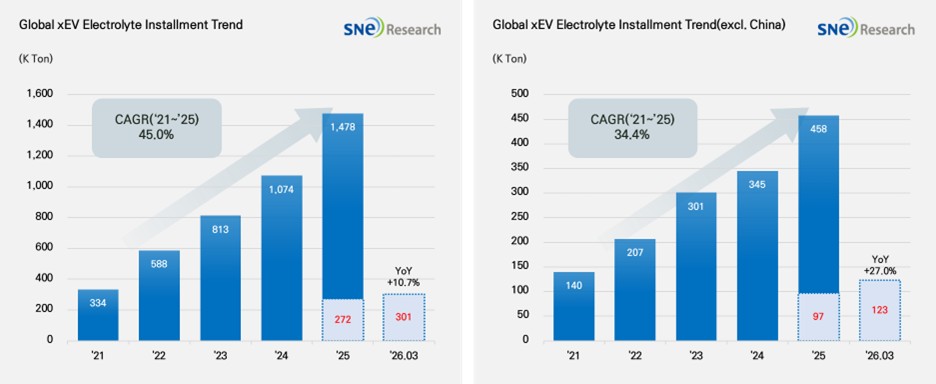
From January to March 2026, the total loading of electrolytes installed in electric vehicles (EV, PHEV, HEV) registered worldwide reached approximately 301K tons, representing a 10.7% increase year-over-year. During the same period, the market excluding China recorded approximately 123K tons, showing a significantly higher growth rate of 27.0% compared to the previous year.
As a core material that enables the movement of lithium ions within a lithium-ion battery, electrolytes directly impact charging performance, energy efficiency, safety, and cycle life. With the expansion of the electric vehicle market and the increasing adoption of high-energy-density batteries, the demand for electrolytes continues to maintain a steady growth trend.
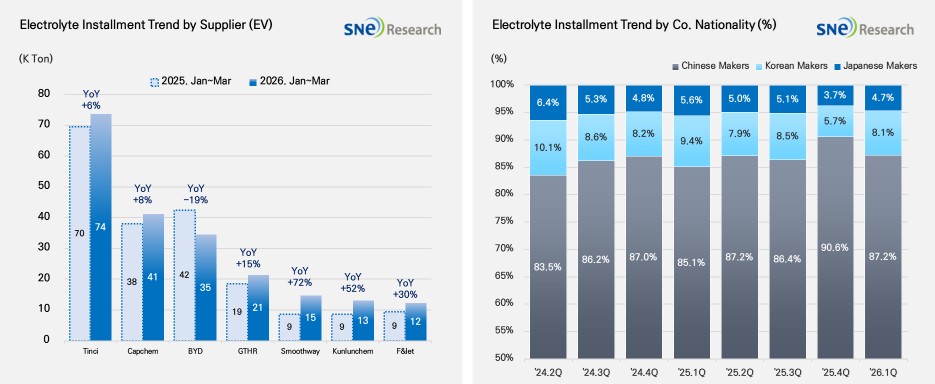
In the global electrolyte market from January to March 2026, distinct trends emerged among major suppliers. Tinci maintained its top market position with approximately 74K tons, a 6% increase year-over-year, while Capchem followed with approximately 41K tons, up 8% from the previous year. BYD recorded approximately 35K tons, representing a 19% decrease, which was the most significant decline among the major suppliers. In contrast, companies such as GTHR (+15%), Smoothway (+72%), Kunlunchem (+52%), and F&let (+30%) recorded high growth rates, signaling a trend of expanding their market shares.
In terms of market share by nationality, Chinese companies continue to dominate the market, accounting for approximately 90% of the total volume. As of the first quarter of 2026, the share of Chinese firms was recorded at 87.2%, while South Korean and Japanese companies remained at approximately 4.7% and 8.1%, respectively. This data underscores the further strengthening of the China-centric supply structure within the global electrolyte market.
(Source: 2026 Apr Global EV & Battery Monthly Tracker (Incl. LiB 4 Major Materials), SNE Research)
While the global electrolyte market continued its growth trend last year fueled by the increase in battery installations for electric vehicles, the growth rate has been slowing in 2026 as the surge in EV demand moderates. With major automakers adjusting production and battery manufacturers managing inventories, the demand for electrolytes has remained at a level of modest growth.
As price pressures persist due to expanded supply and intensifying competition within China, electrolyte suppliers are strengthening their technical competitiveness by focusing on high-value-added products. These efforts include developing solutions for high-voltage batteries, ensuring high-temperature stability, improving fast-charging performance, and applying high-functionality additives.
From a policy perspective, regulations such as the U.S. Inflation Reduction Act (IRA) and Foreign Entity of Concern (FEOC) rules, along with increased tariffs on China and discussions surrounding the EU Battery Regulation and Per- and Polyfluoroalkyl Substances (PFAS) restrictions, are forcing a reorganization of the supply chain. Consequently, the importance of localizing production in North America and Europe, ensuring the traceability of core raw materials, and responding to environmental regulations is growing.
Meanwhile, with the expansion of ESS market, electrolyte demand is partially diversifying from a focus on EVs to non-EV sectors. Moving forward, the competitiveness of electrolyte suppliers will likely be determined by their ability to develop high-performance products, localize their supply chains, comply with environmental regulations, and expand their client base within the energy storage industry.
[2] Based on batteries installed to electric vehicles registered during the relevant period.