

From Jan to Mar 2026, Global[1] EV Battery Separator Installment[2] Reached 3,779Mil ㎡, a 11.5% YoY Growth
- Sustained 2026 Growth in EV Separator Market Amid Rising Average Battery Capacity
(Source: 2026 Apr Global EV & Battery Monthly Tracker (Incl. LiB 4 Major Materials), SNE Research)
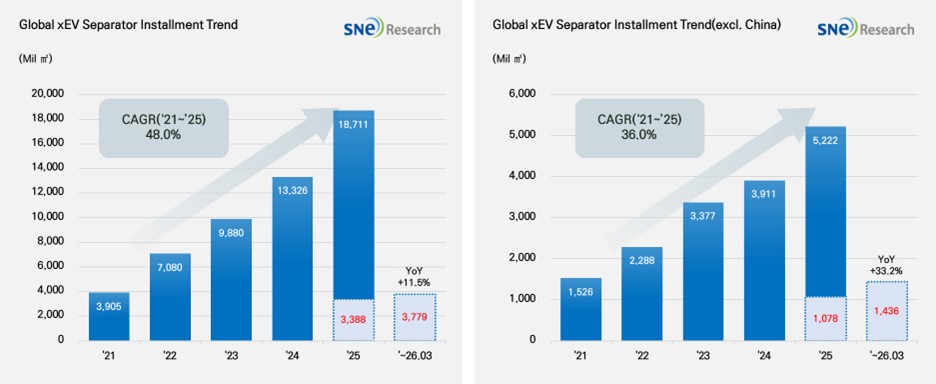
From January to March 2026, the total loading of separators installed in electric vehicles (EV, PHEV, HEV) registered worldwide reached approximately 3,779 million m², representing an 11.5% increase year-over-year. During the same period, the market excluding China recorded 1,436 million m², showing a significantly higher growth rate of 33.2% compared to the previous year.
Separators are a core material that physically separates the anode and cathode within a lithium-ion battery while allowing the movement of lithium ions, directly impacting both the safety and performance of the battery. As the electric vehicle market expands and the adoption of high-energy-density batteries increases, the demand for separators continues to rise steadily.
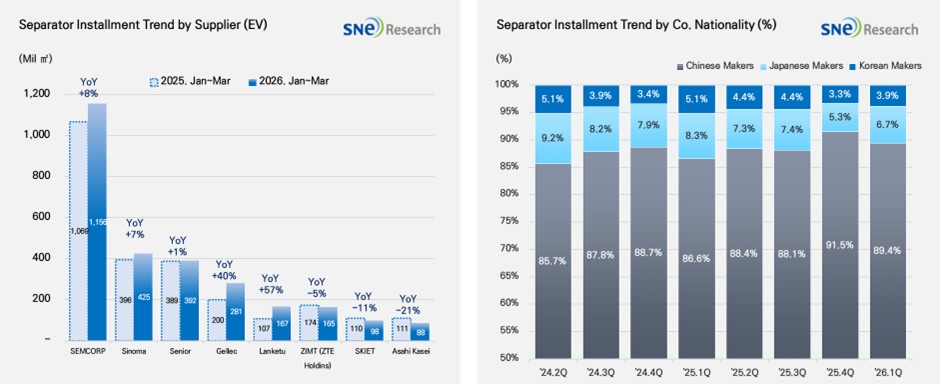
In the global separator market from January to March 2026, distinct trends emerged among major suppliers. SEMCORP maintained its top market position with approximately 1,156 million m², an 8% increase year-over-year, while Sinoma (+7%) and Senior (+1%) saw only marginal growth. In contrast, companies like Gellec (+40%) and Lanktu (+57%) recorded high growth rates, signaling an aggressive expansion of their market shares. Meanwhile, non-Chinese suppliers such as SK IE Technology (-11%) and Asahi Kasei (-21%) experienced declines, impacted by the general slowdown in demand.
In terms of market share by nationality, Chinese companies continue to hold an absolute dominance, accounting for roughly 90% of the market. As of the first quarter of 2026, the share of Chinese firms stood at approximately 89.4%; while this is a slight dip from the previous quarter, it represents a 2.8 percentage point increase compared to the same period last year. The shares of Japanese and South Korean companies narrowed to around 4% and 7%, respectively, further widening the gap with their Chinese counterparts. This underscores that the global separator market remains firmly entrenched in a China-centric supply structure.
(Source: 2026 Apr Global EV & Battery Monthly Tracker (Incl. LiB 4 Major Materials), SNE Research)
While the EV separator market showed stable growth last year driven by increasing battery installations, the growth rate has been slowing in early 2026 as the surge in EV demand moderates. With major automakers adjusting production and battery manufacturers focusing on inventory management, the increase in separator demand has remained within a limited range.
Furthermore, price pressure is intensifying for general-purpose products due to capacity expansions and heightened supply competition within China. In response, major suppliers are adjusting their operating rates while shifting their product mixes toward high-value-added offerings, such as ceramic-coated, high-heat-resistant, ultra-thin, and fast-charging-compatible separators.
In contrast, the ESS market is growing rapidly, fueled by grid stabilization efforts, the expansion of renewable energy, and rising power demand from data centers. As a result, the axis of growth in the separator market is partially shifting from EVs toward non-EV applications like ESS. Future competitiveness is expected to hinge on developing high-performance products, establishing local production in North America and Europe, reducing dependence on China, complying with environmental regulations, and successfully expanding client bases within the energy storage sector.
[2] Based on batteries installed to electric vehicles registered during the relevant period.