

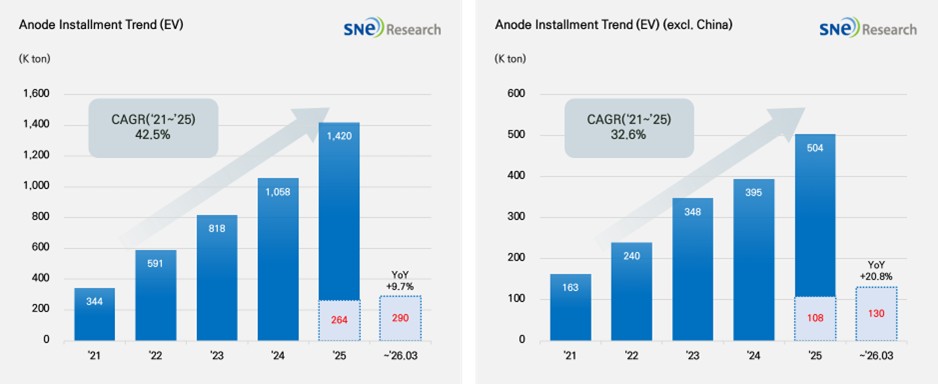
From Jan to Apr 2026, Global[1] EV Battery Anode Installment[2] Reached 290K ton, a 9.7% YoY Growth
- Anode installment in the non-China market recorded 130K ton, a 20.8% YoY growth
(Source: 2026 Apr Global EV & Battery Monthly Tracker (Incl. LiB 4 Major Materials), SNE Research)
From January to March 2026, the global loading of anode materials for electric vehicles (EVs) reached 290K tons, a 9.7% increase compared to 264K tons in the same period of 2025. During this timeframe, anode material loading in the global market excluding China grew from 108K to 130K tons, a 20.8% rise that significantly outpaced the overall market growth rate. This suggests that despite a slight slowdown in global EV demand growth, production expansion and supply chain diversification, particularly in non-Chinese markets, are supporting the demand for anode materials.
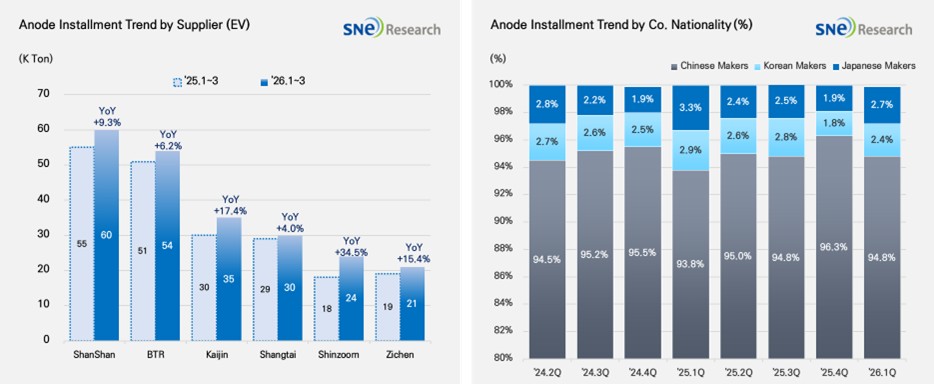
By supplier, ShanShan maintained its lead as its volume increased from 55K to 60K tons, while BTR followed closely, growing from 51K to 54K tons. Kaijin recorded a relatively high growth rate of 17.4%, increasing from 30K to 35K tons, and Shangtai showed a more moderate upward trend, rising from 29K to 30K tons. Shinzoom recorded the highest growth rate among major suppliers at 34.5%, jumping from 18K to 24K tons, while Zichen also saw an expansion of 15.4%, reaching 21K tons from 19K tons.
This trend demonstrates that while the supply structure remains centered on top-tier companies, mid-tier players are continuously moving to expand their market share through client diversification and the broadening of their product portfolios. In particular, the rise of companies outperforming the overall market growth rate suggests that the ability to secure product lines capable of high-power and high-energy density is becoming a key differentiator in performance, moving beyond a simple competition over capacity expansion.
(Source: 2026 Apr Global EV & Battery Monthly Tracker (Incl. LiB 4 Major Materials), SNE Research)
Looking at the market share by corporate nationality, Chinese companies maintained their absolute dominance with a 94.8% share as of the first quarter of 2026. South Korean and Japanese companies recorded 2.4% and 2.7%, respectively. The share of Chinese firms has remained consistently high, moving from 93.8% in Q1 2025 to 95.0% in Q2, 94.8% in Q3, and reaching 96.3% in Q4 2025. By maintaining 94.8% in Q1 2026, the data reaffirms that the global anode material supply chain continues to operate centered primarily around China.
However, compared to the fourth quarter of 2025, the share of South Korean companies rebounded slightly from 1.8% to 2.4%, and Japanese companies saw an increase from 1.9% to 2.7%. This is interpreted not as a sign that the China-centric structure is faltering, but rather as a reflection of the initial stages of localized procurement demand and supply chain diversification requirements in non-Chinese regions. Consequently, while the current anode market is sustained by the overwhelming competitiveness of Chinese suppliers, it is evolving into a landscape where complementary movements to secure regional supply stability are occurring in parallel.
Anode material loading in markets excluding China grew from 108K tons in the first quarter of 2025 to 130K tons in the same period of 2026, representing a 20.8% growth rate. This level of growth is more than double the overall global growth rate of 9.7% for the same period, demonstrating that the expansion of EV production and efforts to rebuild local supply chains in non-Chinese markets are driving the surge in anode material demand.
In particular, as supply chain stability and policy responsiveness become increasingly critical, especially in North America and Europe, the movement to reduce dependence on China across both cells and materials is gradually being reflected in the anode material market. Although Chinese companies still hold an overwhelming lead in terms of absolute volume and market share structure, the rapid growth of the market excluding China suggests that the competitive focus of the anode industry is likely to expand beyond simple production capacity to include localization capabilities, customized supply solutions, and next-generation material technology.
As of the first quarter of 2026, the global anode material market exhibits a structural characteristic where supply concentration is actually intensifying despite a slowdown in EV demand growth. While Chinese companies maintain absolute dominance, the fact that the growth rate in non-Chinese markets significantly exceeds the global average indicates that a clear direction for supply chain reorganization is taking shape.
Furthermore, considering the recent month’s trend where the U.S. and Europe have strengthened coordination over core mineral supply chains, and major battery manufacturers have accelerated the commercialization of multi-chemistry systems and next-generation anode technologies, the market is expected to move beyond simple volume competition. Moving forward, the core competitive variables will be the capacity to establish non-Chinese supply chains, the ability to respond with high-value technologies such as silicon-composite anodes, and the effectiveness of regional client management systems.
[2] Based on batteries installed to electric vehicles registered during the relevant period.