

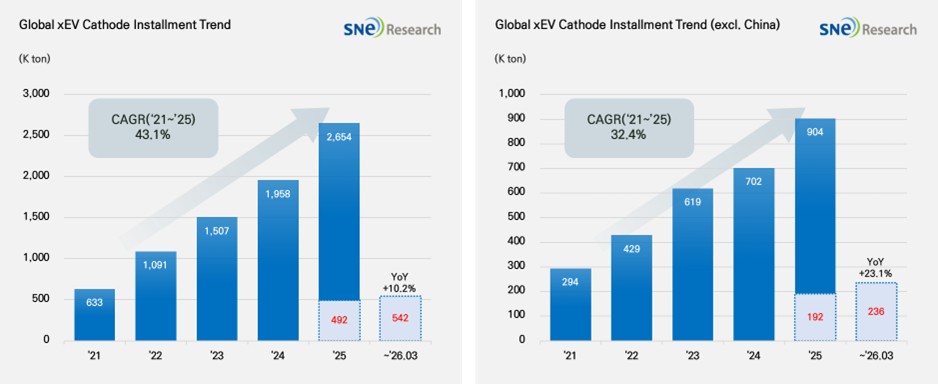
From Jan to Mar 2026, Global EV Battery Cathode Installment Reached 542K ton, a 10.2% YoY Growth
- EV battery cathode installment in the non-China market recorded 236K ton, a 23.1% YoY growth
(Source: 2026 April Global EV & Battery Monthly Tracker (Incl. LiB 4 Major Materials), SNE Research)
While the global demand for cathode materials for electric vehicles continued its upward trend, structural reorganization within the market became even more apparent. From January to March 2026, the global cathode material loading for xEVs reached 542K tons, a 10.2% increase from 492K tons during the same period last year. During this timeframe, cathode material loading in the global market excluding China recorded 236K tons, growing 23.1% compared to 192K tons in the previous year, indicating that the recovery in non-Chinese markets is driving overall demand.
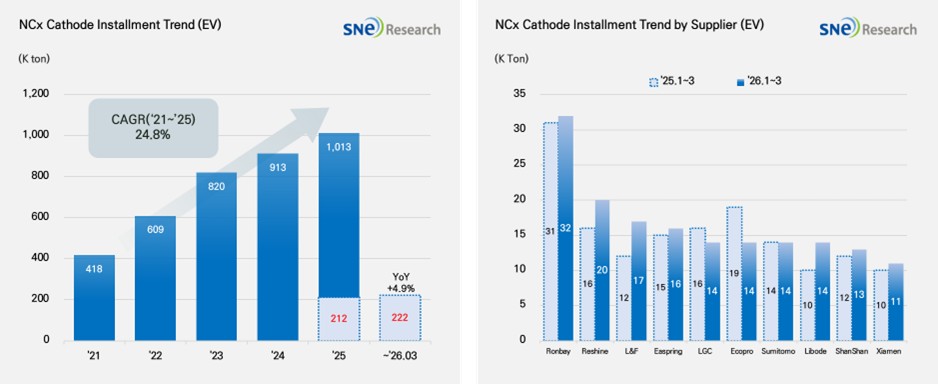
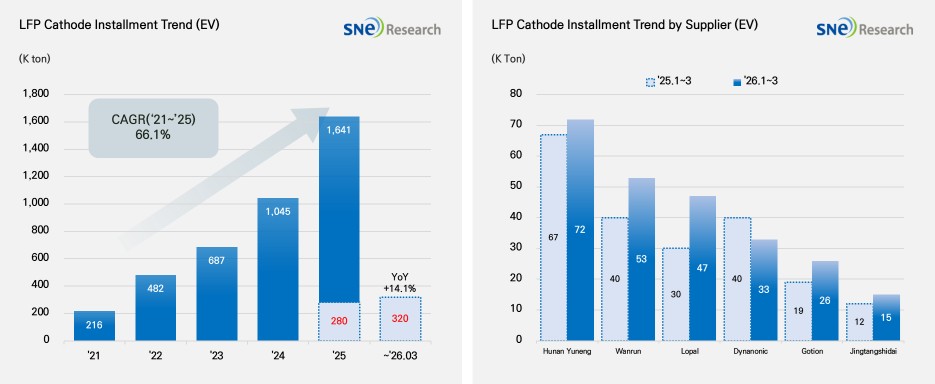
In terms of the demand structure, LFP-based materials led the market expansion with 14.1% growth, whereas the ternary (NCM/NCA) sector saw a limited increase of only 4.9%, continuing the adjustment of relative market shares. The central axis of the market is clearly shifting from a competition over energy density toward a focus on cost efficiency and supply stability.
(Source: 2026 April Global EV & Battery Monthly Tracker (Incl. LiB 4 Major Materials), SNE Research)
In practice, the loading of ternary cathode materials reached 222K tons from January to March 2026, marking a modest 4.9% increase compared to 212K tons in the same period last year. In contrast, LFP cathode materials recorded 320K tons, a 14.1% jump from 280K tons, effectively spearheading the growth of the overall cathode market. This trend is interpreted as a result of automakers increasingly adopting LFP to secure cost efficiency and supply stability as the global EV market shifts toward affordable models and entry-level segments where price competitiveness is paramount. While ternary materials maintain a critical position for high-performance EVs and long-range requirements, their growth rate remains relatively steady compared to LFP, further solidifying their role as a premium-oriented material.
By ternary supplier, Ronbay maintained its lead with a slight increase from 31K to 32K tons, while Reshine showed strong growth, expanding from 16K to 20K tons. Among South Korean suppliers, L&F demonstrated a notable recovery, rising from 12K to 17K tons, and Easpring saw a small uptick from 15K to 16K tons. Meanwhile, LG Chem (LGC) maintained its top-tier status at approximately 14K tons (down from 16K), and EcoPro also secured its place within the Top 10 at 14K tons (down from 19K), continuing its role as a major supplier. Sumitomo held steady at 14K tons, while Libode increased its presence from 10K to 14K tons. ShanShan and Xiamen also grew to 13K and 11K tons, respectively.
Overall, while the ternary market continues to grow, performance among suppliers is becoming increasingly polarized based on their client portfolios and regional recovery speeds. Chinese companies are maintaining their top rankings through price competitiveness and mass-supply capabilities, whereas South Korean firms are focusing on enhancing their responsiveness to non-Chinese clients by leveraging competitive advantages in high-nickel and high-performance products.
(Source: 2026 April Global EV & Battery Monthly Tracker (Incl. LiB 4 Major Materials), SNE Research)
By LFP supplier, Hunan Yuneng maintained its first-place position during the same period, with its volume increasing from 67K to 72K tons, while Wanrun recorded significant growth, rising from 40K to 53K tons. Lopal also rapidly expanded its market share base, increasing from 30K to 47K tons. In contrast, Dynanonic saw a decrease from 40K to 33K tons but managed to retain its status as a major supplier. Gotion grew from 19K to 26K tons, and Jingtangshidai expanded from 12K to 15K tons. The LFP market continues to see a strengthening of the supply dominance held by Chinese companies. This is due to the robustly established, China-centric integrated competitiveness across the entire value chain—from raw material sourcing and the production of precursors and cathode materials to cell manufacturing. Consequently, the expansion of LFP demand is sustaining a structure that directly leads to the reinforced dominance of Chinese suppliers.
As of the first quarter of 2026, the global cathode material market continues to grow, yet beneath the surface, a structural reorganization is fully underway amidst a general growth slowdown. The expansion trend centered on LFP reflects a market direction that prioritizes cost competitiveness and supply stability, while ternary materials are being redefined as strategic materials focused on high performance. At the same time, the recovery of non-Chinese markets is supporting the floor for global demand. However, with Chinese companies still maintaining a strong grip on the supply chain, expanding local production and securing technological competitiveness have emerged as critical mid-to-long-term tasks. As efforts to strengthen cooperation in core mineral and battery supply chains, reorganize local production, and expand LFP-based manufacturing continue—particularly in North America and Europe—the key competitive variables in the future global cathode market will shift beyond simple volume competition. Instead, success will depend on the speed of regional supply chain establishment, the adaptability of material portfolios, and the ability to simultaneously secure high-performance and low-cost technologies.