

From Jan to Mar 2026, Global FCEV Market Shows 20.6% Year-On-Year Growth
- Hyundai Tops Global FCEV Sales, Accounting for 67.3% M/S
From January to March 2026, the global Fuel Cell Electric Vehicle (FCEV) market rebounded in the 2nd half of last year following a slowdown in the 1st half, recording 2.602 units sold, a 20.6% increase from the same period last year.
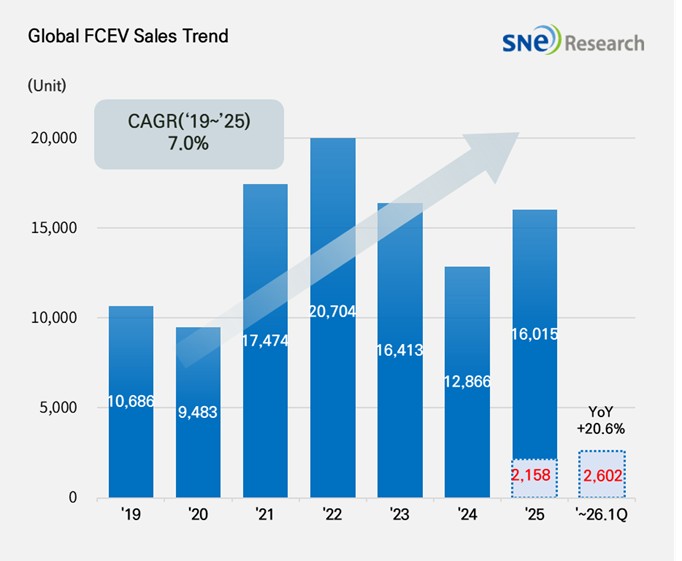
(Source: Global FCEV Monthly Tracker – April 2026, SNE Research)
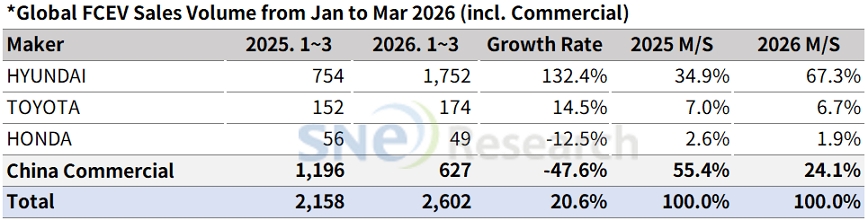
By company, Hyundai Motor maintained its top position in the market by selling a total of 1,752 units, centered on NEXO. Since the launch of the new second-generation NEXO last year, sales have steadily climbed, resulting in a high growth rate of 132.4% year-over-year in the first quarter of 2026. While maintaining its hydrogen lineup across passenger and commercial sectors with a focus on the XCIENT for commercial use, the company is currently expanding its business scope into fuel cells and water electrolysis through investments in its hydrogen fuel cell plant in Ulsan.
Toyota sold 174 units across its Mirai and Crown models, representing a 14.5% increase from the previous year, while its sales volume within Japan saw a 2.9% rise. Additionally, the company is consistently advancing hydrogen vehicle technology development and infrastructure construction. Meanwhile, Chinese companies are maintaining relatively stable sales trends by focusing on commercial vehicles and logistics transportation rather than passenger cars. Honda launched the 2025 Honda CR-V e: FCEV in the U.S. and Japan as its hydrogen passenger model, but sales reached only 49 units. As the first SUV to combine hydrogen fuel cell technology with plug-in hybrid functionality, the CR-V e:FCEV is capable of driving 435 km according to EPA standards, powered by a 4.3 kg hydrogen tank and a 17.7 kWh battery.
(Source: Global FCEV Monthly Tracker – April 2026, SNE Research)
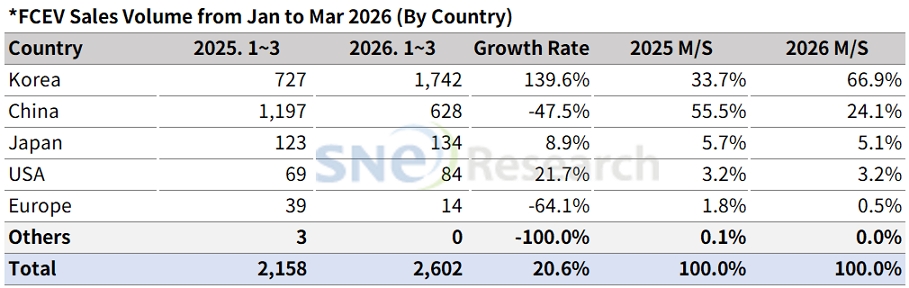
By country, Europe saw the most significant contraction, with the shrinking of the hydrogen vehicle market becoming particularly pronounced. However, the European Union has established a regulatory foundation to build hydrogen refueling infrastructure centered on major transport networks and urban hubs by 2030, leaving room for a mid-to-long-term market recovery.
China is fostering demand for medium-to-large trucks, refrigerated logistics, and industrial hydrogen through its comprehensive hydrogen application pilot projects, while expanding the core of its hydrogen vehicle market into the commercial vehicle and logistics sectors. The United States is also pushing for support for clean hydrogen hubs and medium-to-heavy-duty hydrogen refueling infrastructure; however, high hydrogen prices and the instability of refueling station operations are acting as constraints on the expansion of passenger hydrogen vehicles.
In contrast, South Korea ranked first with a 66.9% market share, bolstered by the strong sales of the Hyundai NEXO. While major developed markets such as Europe, the U.S., and Japan are showing a clear downward trend, South Korea has led a rebound in the passenger hydrogen vehicle market, driven by the launch of the new NEXO model.
(Source: Global FCEV Monthly Tracker – April 2026, SNE Research)
The 2025 launch of the Hyundai NEXO (NH2) has seen the vehicle emerge as a pivotal model leading the recovery of demand in the domestic passenger hydrogen vehicle market. From its initial release, the new NEXO has surpassed the sales performance of its predecessor, signaling a rebound in a passenger hydrogen market that had been stagnant for some time.
However, the growth axis of the global hydrogen vehicle market is increasingly shifting away from passenger cars toward medium-to-heavy-duty commercial vehicles, long-haul logistics, buses, and port transportation. Consequently, the medium-to-long-term growth potential of the hydrogen market will likely depend on the expansion of refueling infrastructure, the stabilization of hydrogen prices, and the achievement of operational economic viability for commercial vehicles. Rather than competing directly with battery electric vehicles (BEVs), hydrogen vehicles are more likely to establish themselves as a complementary technology, particularly in sectors requiring long-range capabilities, heavy payloads, and high utilization rates.