

From Jan to Mar 2026, Non-China Global EV Deliveries Recorded 2.025 Mil Units, a 23.1% YoY Growth
- Europe and Asia (excl. China) remained in an upward trend, while North America experienced a double-digit decline
(Source: Global EV & Battery Monthly Tracker – April 2026, SNE Research)
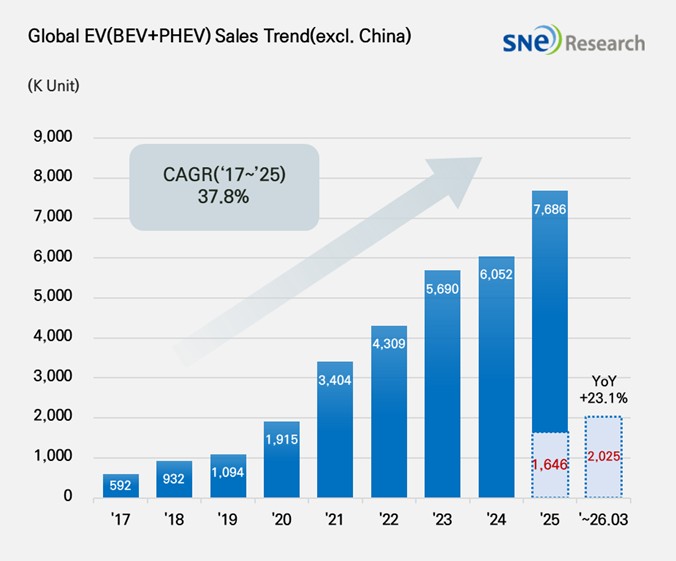
From Jan to Mar 2026, global electric vehicle (BEV+PHEV) deliveries excluding China totaled approximately 2.025 million units, a 23.1% increase from 1.646 million units in the same period last year. The latest performance results, based on the global market excluding China rather than the total global market, show that a steady recovery in Europe and high growth in the Asian market (excluding China) drove the overall expansion. In contrast, the North American market recorded negative growth, further highlighting the distinct temperature difference between regions within the market.
(Source: Global EV & Battery Monthly Tracker – April 2026, SNE Research)
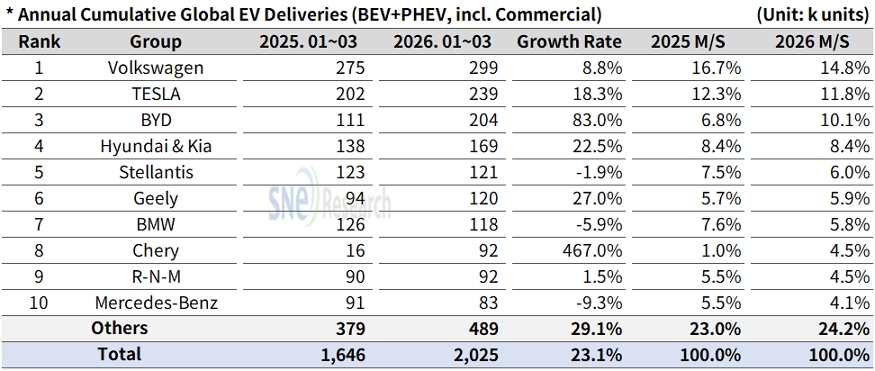
By company, Volkswagen maintained its top position with 299,000 units. However, its growth was limited to 8.8% year-over-year, which fell below the overall market growth rate, leading to a drop in market share from 16.7% to 14.8%. While it held onto its lead during the market expansion phase, the data confirmed that followers are growing at a much faster pace.
Tesla ranked second with 239,000 units, growing 18.3% compared to the same period last year. Although its sales volume expanded, it failed to keep up with the market's average growth rate, resulting in a slight decline in market share from 12.3% to 11.8%. While its presence in the non-Chinese market remains solid, its monopolistic dominance is weakening due to intensifying competition.
BYD rose to third place with 204,000 units, a sharp surge of 83.0% year-over-year. Its market share also increased significantly from 6.8% to 10.1%. This highlights the rapidly growing presence of Chinese automakers in markets outside of China, suggesting that expanded overseas sales—centered on Europe and Asia—led to the rise in rankings.
Hyundai Motor Group ranked fourth with 169,000 units, growing 22.5% compared to the same period last year. Its market share remained at 8.4%, the same level as the previous year. While the group maintained its defensive competitiveness by showing growth close to the market average, it did not achieve significant enough expansion in market share to lead a shift in the top-tier landscape.
In contrast, Stellantis recorded 121,000 units, a 1.9% decrease year-over-year, with its market share falling from 7.5% to 6.0%. BMW also saw a 5.9% decline to 118,000 units, as its market share dropped from 7.6% to 5.8%. Mercedes-Benz followed a similar trend, decreasing by 9.3% to 83,000 units, resulting in a market share of 4.1%. R-N-M (Renault-Nissan-Mitsubishi) remained effectively stagnant at 92,000 units, with its share dipping to 4.5%. While traditional OEMs failed to fully absorb the benefits of market growth, Chinese groups such as Geely and Chery rapidly expanded their presence, recording high growth rates of 27.0% and 467.0%, respectively. Notably, Chery reached a sales volume of 92,000 units—matching that of R-N-M—emerging as a symbolic example of the shifting competitive landscape within the non-Chinese market.
(Source: Global EV & Battery Monthly Tracker – April 2026, SNE Research)
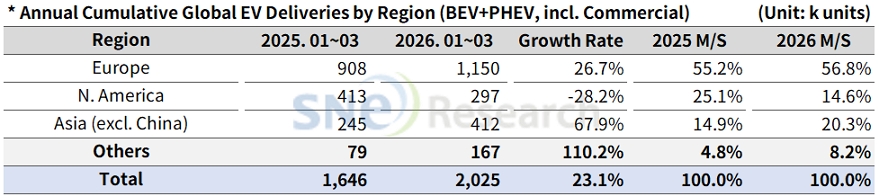
By region, Europe recorded 1.15 million units, a 26.7% increase year-over-year, accounting for 56.8% of the total global market (excluding China). Its market share also rose from 55.2% to 56.8%, maintaining its status as the core market. Europe is analyzed to have continued its role as the central axis of non-Chinese market growth, as it is a market where the electrification strategies of major OEMs are concentrated, while simultaneously reflecting the combined effects of demand recovery and the launch of new models.
Asia (excluding China) showed the fastest growth, increasing by 67.9% to 412,000 units. Its market share also rose significantly from 14.9% to 20.3%. This signifies that the demand base within the non-Chinese market is no longer concentrated solely in Europe and North America but is rapidly expanding into the Asian region. In particular, it is interpreted that companies with high price competitiveness and supply responsiveness have actively secured opportunities to expand their market share in this region.
In contrast, North America recorded 297,000 units, a 28.2% decrease compared to the same period last year, marking the largest negative growth. Its market share also plummeted from 25.1% to 14.6%. This acted as a constraining factor for growth in the non-Chinese market and is increasing the pressure on global OEMs to readjust their regional portfolios and sales strategies. Other regions also saw a 110.2% increase to 167,000 units, with their market share expanding to 8.2%, demonstrating that emerging markets are gradually emerging as a growth axis that cannot be ignored.
In conclusion, as of the first quarter of 2026, the global electric vehicle (EV) market, excluding China, is assessed to have entered a structural transition period where regional growth axes and competitive landscapes are being reshaped, moving beyond a phase of simple sales expansion. Europe is simultaneously pursuing market recovery and the reorganization of competitive order by combining demand-boosting measures with industrial protectionism. Meanwhile, North America is showing a trend toward a conservative restructuring of both demand and supply chains amid expanding tariff and policy uncertainties. In contrast, Asia (excluding China) and other emerging markets are rapidly emerging as new growth hubs. Consequently, in the future non-Chinese market, the core competitive variables for global automakers are expected to be their capacity for regional diversification, localization strategies, price competitiveness, and adaptability to policy changes, rather than mere sales volume.