

From Jan to Mar 2026, Non-Chinese Global[1] EV Battery Usage[2] Posted 117.4GWh, a 17.4% YoY Growth
- From Jan to Mar 2026, K-trio’s combined M/S recorded 29.6%, a 8.3%p YoY decline
Battery installation for global
electric vehicles (EV, PHEV, HEV) excluding the Chinese market sold from Jan to
Mar 2026 was approximately 117.4GWh, posting a 17.4% YoY growth.
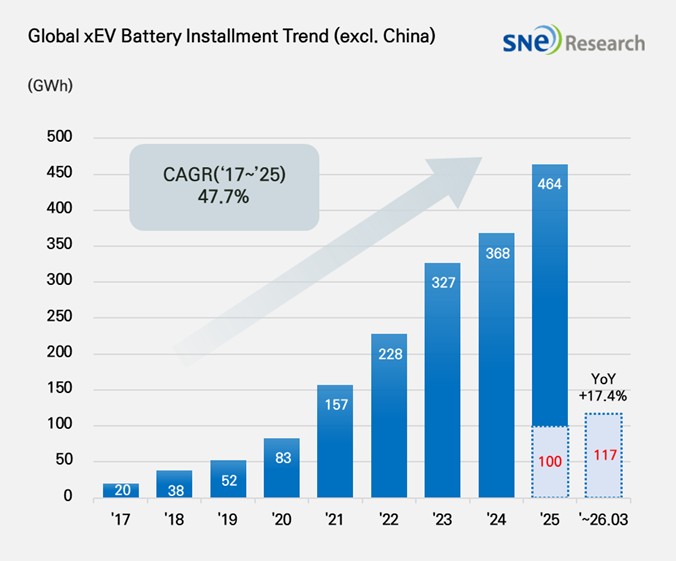
(Source: Global EV and Battery Monthly Tracker – April 2026, SNE Research)
From January to March 2026, the combined global market share (excluding China) of the three major Korean battery manufacturers—LG Energy Solution, SK On, and Samsung SDI—recorded 29.6%, an 8.3% percentage point (p) drop compared to the same period last year. All three companies experienced negative growth: LG Energy Solution declined by 0.1% (20.3GWh), SK On by 10.2% (9.0GWh), and Samsung SDI by 27.7% (5.3GWh). This is analyzed to be a result of a 28.4% drop in electric vehicle sales in the U.S. market, coupled with a slowdown in EV sales by major automakers leading to a reduction in battery consumption. Meanwhile, in the global market (excluding China), Chinese battery manufacturers such as CATL and BYD continued to expand their market share, causing the relative foothold of domestic Korean companies to further diminish.
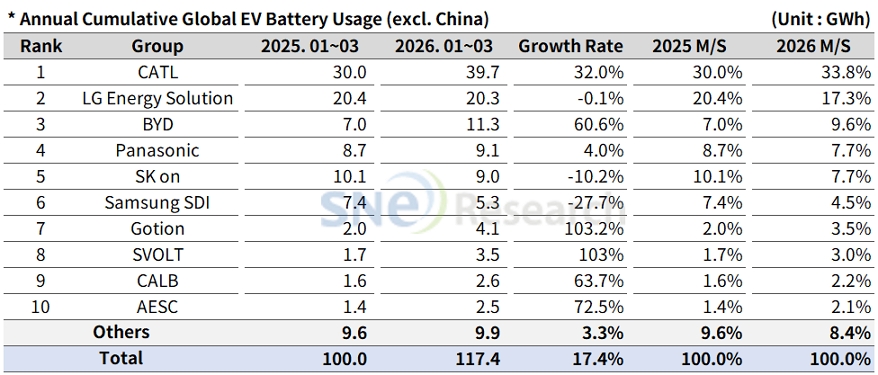
(Source: Global EV and Battery Monthly Tracker – April 2026, SNE Research)
Looking at the battery usage by vehicle manufacturers for the three major Korean companies, Samsung SDI showed the highest supply shares for BMW, Audi, and Rivian, in that order. However, as EV sales slowed down across most of its major client companies, Samsung SDI's battery installation volume declined. In particular, for clients with a high dependence on the North American market, such as Rivian and Jeep, the impact of the U.S. EV sales slump was directly reflected, leading to an even wider margin of decrease. Sales for BMW's key electrified models, including the i4, i5, i7, and iX, were generally sluggish, and Audi also failed to achieve the expected sales boost despite the launch of the Q6 e-tron.
SK On's batteries were primarily installed in vehicles from major automakers such as Hyundai Motor Group, Mercedes-Benz, Ford, and Volkswagen. In the case of Hyundai Motor Group, battery installation increased due to steady sales of the IONIQ 5 and the impact of the newly launched IONIQ 9. However, overall installation volume declined as EV sales slowed across other major clients, including Kia, Mercedes-Benz, and Volkswagen. Specifically, Ford saw a sharp drop in sales due to the production halt of the F-150 Lightning, which acted as a major factor in the decrease of SK On's battery usage. This decline was further exacerbated by the general slowdown in U.S. EV demand. Volkswagen also saw a significant drop in ID.4 sales, which led to a reduction in battery installation volume.
LG Energy Solution’s batteries were primarily installed in vehicles from major automakers such as Tesla, Chevrolet, Kia, and Volkswagen. Tesla saw a significant increase in battery installation volume driven by rising sales of the Model Y and Model YL, while Kia also saw an uptick in its use of LG Energy Solution batteries following the launch of new models like the EV4 and expanded sales of existing lineups. Renault and Skoda also showed growth, reflecting increased sales of their key electric vehicle models.
Panasonic, which maintains a high supply share for Tesla, recorded 9.1 GWh in battery usage from January to March 2026, a 4.0% increase compared to the same period last year. While sales for its primary client, Tesla, were bolstered by the standout performance of Model Y, Model 3 saw a decline, signaling a shift in demand structure between different models. Notably, with the decision to halt production of the Model S and Model X, the possibility of a decrease in battery demand due to the reduction of high-end lineups is growing. In response to these trends, Panasonic is focusing on developing next-generation 4680 and 2170 cells and improving production efficiency in North America to reduce its heavy reliance on Tesla. This is interpreted as a strategy to buffer against the risk of Tesla’s expanding battery internalization while maintaining a long-term market share within the North American market.
CATL maintained its number one position even in markets outside of China from January to March 2026, recording 39.7 GWh, a 32.0% increase compared to the same period last year. Beyond major Chinese automakers, growth was driven by a significant surge in battery installations for global OEMs, including Tesla, Audi, Toyota, and Kia. In particular, the expanded sales of Kia's EV5 and PV5 contributed to the increase in CATL’s battery installation volume, while soaring sales of JAECOO and OMODA vehicles in Asian emerging markets and Europe further supported CATL's high growth rate.
BYD recorded 11.3 GWh, a 60.6% increase year-over-year, maintaining its third-place position in the global market (excluding China). In contrast to the slowing trend in the Chinese domestic market, battery usage in non-Chinese markets saw a sharp increase as EV sales expanded significantly. The expansion of its own brand’s global sales acted as the primary growth factor, while increased supplies to overseas automakers such as Mahindra & Mahindra and KG Mobility also bolstered this upward trend. Furthermore, its customer base is widening as supplies to new clients like Suzuki, Toyota, and Jeep have begun in earnest. This shift demonstrates that BYD is successfully moving beyond its domestic-focused structure and expanding into the global market.
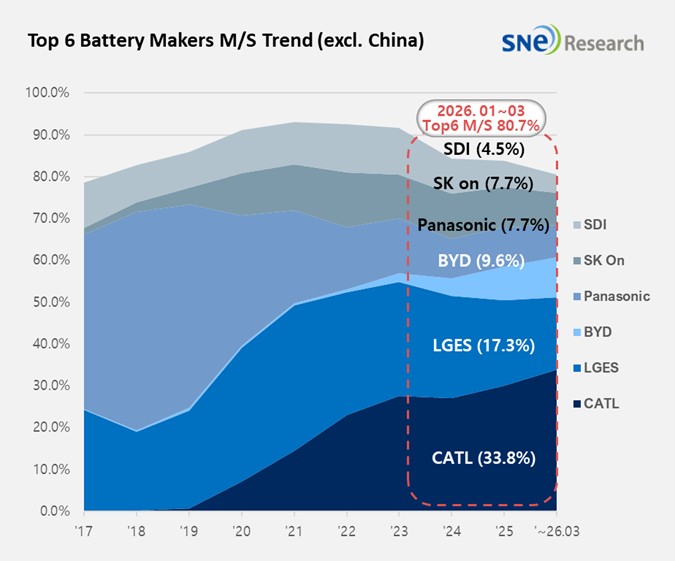
(Source: Global EV and Battery Monthly Tracker – April 2026, SNE Research)
The global secondary battery market for electric vehicles (excluding China) from January to March 2026 showed a clear regional divergence, as slowing demand in North America contrasted with growth in Europe, Asia, and other emerging markets. Excluding the impact of the Chinese domestic market, the key variables determining the performance of battery manufacturers were the pace at which global automakers adjusted their electrification plans and the sales trends of their primary models.
Major non-Chinese companies, including the three Korean battery manufacturers and Panasonic, were directly affected by the slowdown in EV sales among North American and European automakers. LG Energy Solution maintained an upward trend in battery usage thanks to expanded sales from certain clients like Tesla and Kia, yet faced a profitability burden as it recorded an operating loss in the first quarter. Conversely, SK On saw a decline in installation volume due to sluggish performance from Ford and Volkswagen, while Samsung SDI’s volume dropped following sales slowdowns for BMW, Audi, and Rivian.
In response, the three Korean companies have already begun expanding into new demand sectors, such as ESS and data center power infrastructure, to reduce their vulnerability to demand volatility in the EV battery market. They are specifically strengthening strategies to lower revenue volatility by diversifying their regional and client portfolios beyond the North American and European markets while simultaneously securing demand sources outside the electric vehicle sector.
[2] Based on battery installation for xEV registered during the relevant period.