

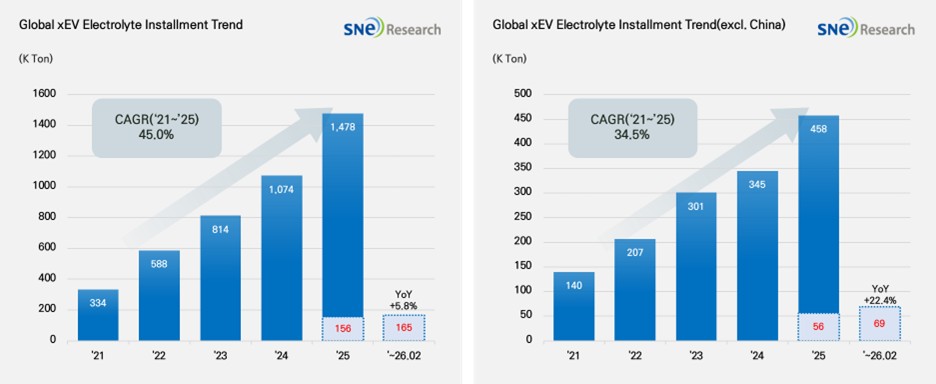
From Jan to Feb 2026, Global[1] Electric Vehicle Battery Electrolyte Installment[2] Reached 165K ton, a 5.8% YoY Growth
-From Jan to Feb 2026, the electrolyte market continued to be in an upward trend, while the non-China market maintained a stable expansion in demand
(Source: 2026 Mar Global EV & Battery Monthly Tracker (Incl. LiB 4 Major Materials), SNE Research)
In January and February 2026, the total electrolyte installation for electric vehicles (EV, PHEV, HEV) registered worldwide reached approximately 165K tons, a 5.8% increase year-year-over. During the same period, the market excluding China recorded about 69K tons, showing a relatively strong growth rate of 22.4%. As a core material that facilitates the movement of lithium ions within a battery, the electrolyte directly influences charging performance, energy efficiency, safety, and lifespan. Driven by the expansion of the EV market and the rising adoption of high-energy-density batteries, demand for electrolytes continues to maintain a steady upward trend.
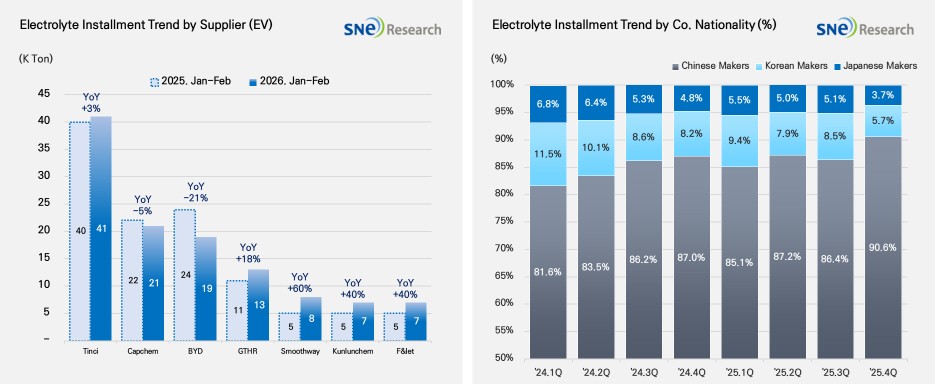
The global electrolyte market in early 2026 saw diverging performances among major suppliers. Tinci maintained its top position with approximately 41K tons, growing by 3%, while Capchem recorded about 21K tons, a 5% decrease year-over-year. BYD saw a significant decline among major players, recording about 19K tons, down 21%. Conversely, firms such as GTHR (+18%), Smoothway (+60%), Kunlunchem (+40%), and F&F (+40%) showed substantial growth, actively expanding their market presence.
In terms of market share by nationality, Chinese companies continue to dominate the market, accounting for over 90% of the total. As of Q4 2025, the share of Chinese firms was tallied at approximately 90.6%, while South Korean and Japanese companies remained at 5.7% and 3.7%, respectively. This underscores the fact that the China-centric supply structure in the electrolyte market is becoming increasingly reinforced.
(Source: 2026 Mar Global EV & Battery Monthly Tracker (Incl. LiB 4 Major Materials), SNE Research)
Last year, the global electrolyte market continued its high growth trajectory, bolstered by the rise in EV battery installations; however, entering 2026, the growth rate has shown signs of a slight slowdown. As the pace of EV demand growth moderates, electrolyte demand has also settled into a steady, yet more conservative, upward trend.
In this environment, while price stabilization pressure persists due to expanded supply and intensifying competition within China, technical competition is becoming increasingly critical, specifically in the application of high-value additives and the development of products for high-voltage and high-thermal stability. Furthermore, the trend of localization is strengthening, with expanded investments in local production and supply chain establishment for electrolytes and core raw materials, particularly in North America and Europe.
Meanwhile, with the expansion of the ESS market, electrolyte demand is gradually diversifying beyond its heavy focus on EVs. Consequently, electrolyte suppliers face an increasing need to simultaneously pursue competition in high-performance EV products and the expansion of ESS-targeted supply and customer portfolio diversification. In conclusion, while the electrolyte market is expected to maintain its growth stance, securing technological competitiveness, responding to supply chain restructuring, and diversifying application areas will serve as the key competitive factors moving forward.
[2] Based on batteries installed to electric vehicles registered during the relevant period.