

From Jan to Feb 2026, Global[1] EV Battery Separator Installment[2] Reached2,056Mil ㎡, a 5.9% YoY Growth
- Sustained 2026 Growth in EV Separator Market Amid Rising Average Battery Capacity
(Source: 2026 Mar Global EV & Battery Monthly Tracker (Incl. LiB 4 Major Materials), SNE Research)
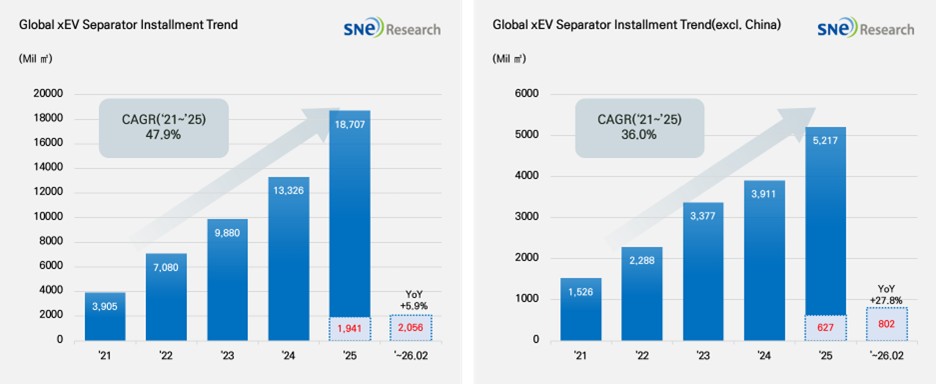
In January and February 2026, the total battery separator installation for electric vehicles (EV, PHEV, HEV) worldwide reached approximately 2,056 million m², a 5.9% increase year-over-year. During the same period, the market excluding China recorded 802 million m², demonstrating a relatively strong growth rate of 27.8%. As a core material that physically separates the anode and cathode while allowing the movement of lithium ions, the separator directly impacts both battery safety and performance. With the expansion of the EV market and the rising adoption of high-energy-density batteries, demand for separators continues to trend upward.
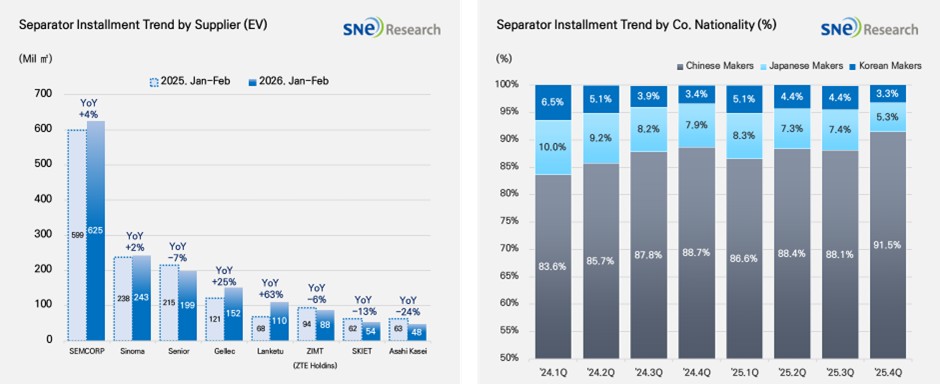
The global separator market in early 2026 saw diverging performances among major suppliers. SEMCORP maintained its top position with approximately 625 million m², growing by 4%, while Sinoma (+2%) saw only a marginal increase. In contrast, Senior (-7%) experienced a decline, whereas firms like Gellec (+25%) and Lanktu (+63%) showed significant growth, moving to expand their market shares. Meanwhile, non-Chinese suppliers such as SK IE Technology (-13%) and Asahi Kasei (-24%) recorded decreases, influenced by the overall slowdown in demand.
In terms of market share by nationality, Chinese companies continue to maintain absolute dominance, accounting for over 90% of the market. As of Q4 2025, the share of Chinese firms rose to approximately 91.5%, while the shares of Japanese and South Korean companies contracted to around 5% and 3%, respectively. This further widened the market share gap and suggests that the global separator market is increasingly consolidating into a China-centric supply structure.
(Source: 2026 Mar Global EV & Battery Monthly Tracker (Incl. LiB 4 Major Materials), SNE Research)
Last year, the global EV battery separator market maintained stable growth following the rise in battery installations; however, entering 2026, the growth rate has shown signs of a slight slowdown. In particular, as the pace of EV demand growth moderates, the increase in separator demand remains at a restricted level.
Simultaneously, increasing supply pressure—driven by intensifying competition within China and capacity expansions—is fueling pressure for price stabilization. Consequently, profitability-oriented strategies, such as adjusting utilization rates and shifting the product mix toward high-value-added offerings, are being reinforced. In contrast, the ESS market is growing rapidly due to grid stabilization efforts and the expansion of renewable energy. Accordingly, demand for ESS separators is projected to outpace the growth rate of the EV segment.
As a result, the separator market is undergoing a structural shift where the demand axis is partially migrating from EVs to ESS. For suppliers, the key factors determining future competitiveness will be competing in high-performance EV products while simultaneously expanding their ESS customer base and diversifying their product portfolios.
[2] Based on batteries installed to electric vehicles registered during the relevant period.