

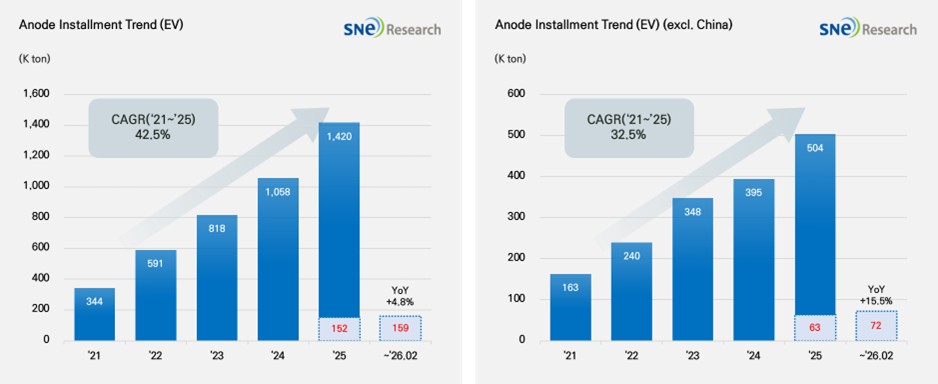
From Jan to Feb 2026, Global[1] EV Battery Anode Installment[2] Reached 159K ton, a 4.8% YoY Growth
- Anode installment in the non-China market recorded 72K ton, a 15.5% YoY growth
(Source: 2026 Mar Global EV & Battery Monthly Tracker (Incl. LiB 4 Major Materials), SNE Research)
In January and February 2026, the total anode material installation in the global electric vehicle (EV, PHEV, HEV) market was tallied at 159K tons. This represents a 4.8% increase year-over-year; although the upward trend was maintained, the growth momentum appears to have moderated compared to the past, especially considering the 7.0% decline in global EV sales. During the same period, the market excluding China recorded 72K tons, growing by 15.5% and outpacing the global average. This structure indicates that the expansion of production in non-Chinese regions is effectively buffering a portion of the demand.
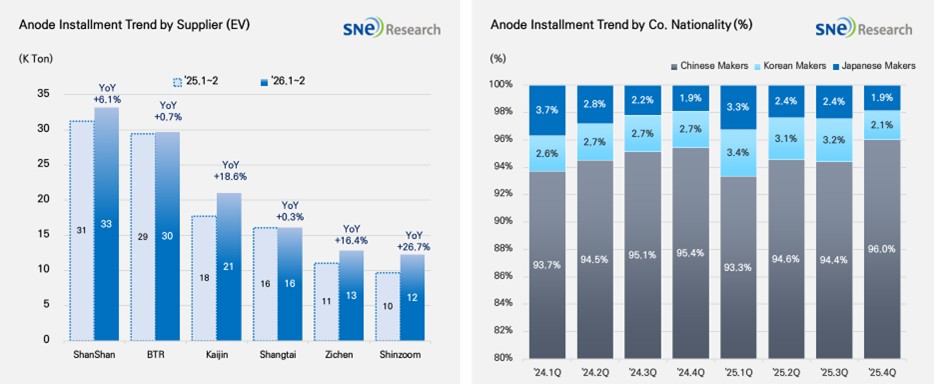
By supplier, ShanShan and BTR led the global market, forming the top tier with 33K tons and 30K tons, respectively. Both companies are maintaining their market share based on stable customer bases—primarily large-scale cell makers—and massive production capacities. Kaijin recorded a high growth rate of 18.6% year-over-year with 21K tons, while Shangtai (16K tons), Zichen (13K tons), and Shinzoom (12K tons) also showed growth, solidifying their positions within the top ranks.
Overall, the top tier continues to be dominated by Chinese suppliers, who are maintaining stable shipment flows based on their scale competitiveness, even amidst the global demand slowdown.
(Source: 2026 Mar Global EV & Battery Monthly Tracker (Incl. LiB 4 Major Materials), SNE Research)
By corporate nationality, the share of Chinese companies rose from around 93% in Q1 2025 to 96% in Q4, further strengthening their absolute dominance. This is interpreted as a result of maintaining stable shipment volumes based on massive production capacity and price competitiveness, even during the cooling phase of global EV demand. This demonstrates that the global anode market remains heavily entrenched in a China-centric supply structure.
However, along with EV performance differentiation strategies, the expansion of Silicon-composite anodes (Si-Anode) adoption is emerging as a significant mid-to-long-term variable. As requirements for high energy density and improved charging speeds increase, joint development with major battery manufacturers is intensifying. South Korean firms are seeking niche opportunities by combining strategies for non-Chinese supply chain alternatives with silicon-composite technologies. While market share expansion may be limited in the short term, technological advancement and regional diversification strategies could serve as variables for future market structure shifts.
In January and February 2026, the anode market maintained growth, but the growth rate moderated compared to the past, reflecting the impact of slowing EV sales. While markets excluding China are serving as a demand buffer with relatively high growth rates, regional trends are diverging. With Europe showing signs of recovery and the U.S. showing relative weakness following the expiration of tax credits, it is necessary to analyze non-Chinese markets by region rather than viewing them as a single unified trend.
By corporate nationality, the market share of Chinese firms climbed from approximately 93% in Q1 2025 to 96% by Q4, further solidifying their absolute dominance. This is interpreted as the result of maintaining stable shipment volumes through massive production capacity and price competitiveness, even during the cooling phase of global EV demand. This trend underscores that the global anode material market remains heavily entrenched in a China-centric supply structure.
However, along with EV performance differentiation strategies, the expanding adoption of silicon-composite anodes (Si-Anode) is emerging as a significant mid-to-long-term variable. As requirements for high energy density and faster charging speeds intensify, joint development with major battery manufacturers is accelerating. South Korean firms are seeking niche opportunities by combining non-Chinese supply chain alternatives with advanced silicon-composite technologies. While market share expansion may be limited in the short term, technological advancement and regional diversification strategies could eventually trigger shifts in the market structure.
In January and February 2026, the anode market maintained growth, but the growth rate moderated as it reflected the slowdown in EV sales. While the non-Chinese market is acting as a demand buffer with relatively high growth rates, regional trends are diverging. Europe is showing signs of recovery, whereas the U.S. is experiencing relative weakness following the expiration of tax credits. This necessitates a more granular, region-specific analysis rather than viewing the non-Chinese market as a single unified entity.
On the supply side, the dominance of Chinese firms is intensifying. A market structure where their share has reached 96% implies that the global anode supply chain has essentially locked in its reliance on China. In the short term, risks associated with supply chain control are acting as a larger variable than trade regulations, and China’s supply concentration is likely to remain a persistent burden on the global market.
In conclusion, the anode market appears to have entered a phase of ‘deepening supply concentration amidst slowing growth’ in the short term. While the expansion of silicon-composite anodes, fast-charging technology, and non-Chinese supply chain diversification policies may drive structural changes in the mid-to-long term, the likelihood of a drastic reshuffling of the current market share landscape remains limited in the near future.
[2] Based on batteries installed to electric vehicles registered during the relevant period.