

From Jan to Feb 2026, Global Electric Vehicle Deliveries Recorded 2.281 Mil Units, a 7.0% YoY Decline
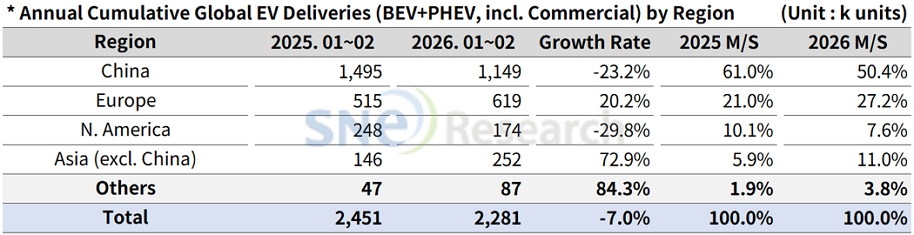
- Europe maintains steady growth (20.2%), while China sees a massive drop (-23.2%) due to Chinese New Year’s Holiday
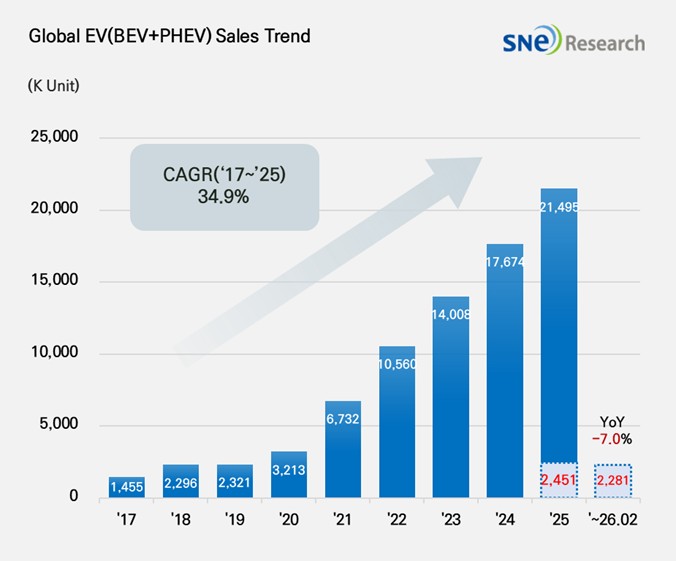
Global electric vehicle (EV) deliveries (BEV+PHEV) in January and February 2026 totaled approximately 2.281 million units, representing a 7.0% decrease compared to the same period last year. With a widening decline in the key markets of China and North America, the global market has recorded negative growth since the beginning of the year. In contrast, the European market maintained double-digit growth, highlighting a distinct regional divergence.
On a cumulative basis, the global EV market has sustained a high Compound Annual Growth Rate (CAGR) of 34.9% since 2017. However, the growth momentum is gradually slowing as a complex interplay of factors, including shifting policy environments, reduced subsidies, and intensifying price competition, takes effect.
(Source: Global EV and Battery Monthly Tracker – Mar 2026, SNE Research)
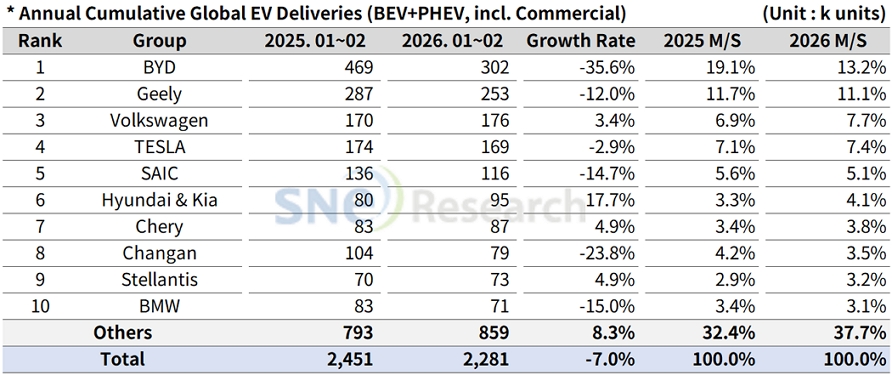
In January and February 2026, BYD experienced a temporary adjustment in the global market, selling approximately 302,000 electric vehicles, a 35.6% decrease compared to the same period last year. This decline is analyzed as a result of a combination of factors, including saturation in the Chinese domestic market, the seasonal slowdown during the Lunar New Year, and intensifying price competition. Nevertheless, BYD maintains a solid sales foundation within China and is responding to demand volatility with a broad product portfolio encompassing both PHEVs and BEVs. In particular, its strategy to expand local production hubs, centered in Europe and Southeast Asia, is expected to serve as a foundation for mitigating tariff and policy risks in the mid-to-long term.
Geely Group, which ranked second, sold 253,000 electric vehicles, marking a 12.0% year-over-year decrease. Similar to BYD, Geely appears to have entered a short-term adjustment phase, reflecting the demand slowdown in the Chinese domestic market and seasonal factors. However, its strategy of balancing BEVs and hybrids based on a multi-layered brand portfolio, including ZEEKR, Galaxy, and LYNK & CO, remains intact. Its structural competitiveness, which targets both the premium and mass markets simultaneously, is still considered effective. Notably, its strategy of technological insourcing and vertical integration in core areas such as batteries, electronics, and software acts as a positive factor in securing cost competitiveness. Despite the short-term dip in sales, Geely is analyzed to be maintaining its mid-to-long-term growth foundation through global market expansion and product mix adjustments.
The Volkswagen Group recorded 176,000 units in EV sales, a 3.4% increase year-over-year, ranking third in the global market. Considering the overall market’s 7.0% contraction, this is evaluated as a relatively resilient defense, with its market share rising from 6.9% to 7.7%, thereby strengthening its market position. This trend is interpreted as a result of maintaining stable demand within the European market across its diverse brand portfolio, including Volkswagen, Audi, Skoda, and Porsche. However, its growth momentum in the Chinese market fell sharply (-76.0%) due to intensifying competition with local manufacturers.
Tesla sold 169,000 electric vehicles; a 2.9% decrease compared to the same period last year. While overall sales declined due to drops in its major markets such as China, Europe, and North America, it maintained a steady flow by achieving triple-digit growth in Asian regions, including South Korea and Japan. It appears that intensifying competition and policy uncertainties in key regions impacted sales. As Tesla recently phased out its Model S and X lines to shift toward a software-centric strategy and advanced Full Self-Driving (FSD) technology, regional demand disparities are translating into short-term performance volatility.
Hyundai Motor Group continued its relatively stable growth trend in the global market, selling 95,000 electric vehicles, a 17.7% increase year-over-year. Regionally, sales rose by 4.8% in Europe, and the Group saw a staggering 140.3% growth rate in Asian markets (excluding China), centered on South Korea, signaling that the effects of expanding into emerging markets like India and Thailand are beginning to materialize. Conversely, North American sales fell by 27.8%, affected by short-term demand adjustments. This is interpreted as a combined result of changes in subsidy policies, inventory adjustments, and the timing of model transitions. Overall, the strategy of reducing reliance on specific regions and pursuing market diversification has proven effective, allowing the Group to maintain a stable operational stance based on its global portfolio.
(Source: Global EV and Battery Monthly Tracker – Mar 2026, SNE Research)
In the first two months of 2026, the global EV market exhibited increasingly divergent trends by region. In China, demand at the start of the year appears to have slowed, influenced by the seasonal off-peak period of the Lunar New Year and the transition of New Energy Vehicle (NEV) purchase tax benefits from a full exemption to a partial reduction system. Coupled with the fact that some demand was pulled forward into late 2025, the market is gradually moving away from its subsidy-driven high-growth phase. Furthermore, as penetration rates peak in major metropolitan areas, the focus is shifting from new demand to replacement demand. Amid ongoing price wars and expanded promotions, the reshuffling of market share among manufacturers is accelerating.
The North American market is undergoing an even faster adjustment than China. Following the premature termination of tax credits under the U.S. Inflation Reduction Act (IRA), the increased cost burden on consumers has directly led to a slowdown in demand in early 2026. Moreover, as major automakers shift their strategic focus from solely expanding Battery Electric Vehicles (BEVs) to including Hybrids and Extended-Range Electric Vehicles (EREVs), the growth momentum of the North American EV market has visibly weakened. This period is characterized by a simultaneous policy vacuum and demand adjustment.
In contrast, the European market continues to maintain a relatively stable expansionary trend compared to other major regions. Despite ongoing discussions regarding subsidy reductions or partial regulatory adjustments, the overall direction of the electrification transition remains steadfast, supported by corporate average emission standards and a consistent carbon regulation framework. Notably, the full-scale supply of new BEV models launched since the second half of 2025 is gradually broadening the sales base, while the increasing proportion of price-competitive small and mid-sized models is positively contributing to sustained demand. Combined with the expansion of regional production and supply chain restructuring, the European market is evolving into one where structural demand outweighs the influence of short-term incentives.
Asia (excluding China) and other emerging regions are also maintaining a relatively robust trajectory. However, the key takeaway is that policy axes in these markets are shifting away from simple subsidy expansions toward support mechanisms linked to local production and parts procurement. Centered on Thailand and Indonesia, factors such as localized manufacturing, parts localization, and the establishment of export hubs are emerging as critical benchmarks for market expansion. In some emerging economies, there is a growing trend to pair EV import expansion with the nurturing of domestic industries. As South America and other emerging regions also shift their policies toward a combination of tariffs, local assembly, and production incentives, localized supply chain capabilities, rather than mere sales volume, are likely to become a more decisive competitive factor moving forward.
In conclusion, the negative growth observed in the global EV market during January and February 2026 should be viewed as a temporary adjustment resulting from the interplay of policy changes and growth rate recalibration, rather than a fundamental market contraction. While China's growth has moderated due to the Lunar New Year and the reduction of purchase tax benefits, North America is experiencing a rapid slowdown in demand following the expiration of incentives under the U.S. Inflation Reduction Act (IRA).
In contrast, Europe continues its relatively stable growth trajectory, underpinned by regulatory-driven demand, while Asia (excluding China) and other emerging regions are seeing a market reshuffle centered on local production and supply chain integration capabilities. Ultimately, the core of future competition will depend on more than just expanding sales volumes; it will be determined by how flexibly companies can manage policy responsiveness, localized production systems, supply chain stability, price competitiveness, and regional powertrain strategies.