

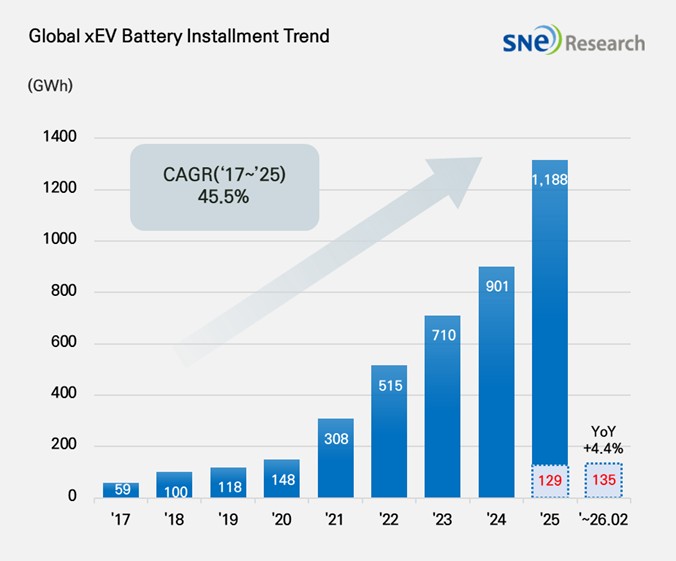
From Jan to Feb 2026, Global[1] EV Battery Usage[2] Posted 135GWh, a 4.4% YoY Growth
- From Jan to Feb 2026, K-trio’s M/S recorded 15.0%, a 2.2%p YoY decline
From Jan to Feb 2026, the amount of energy held by batteries
for electric vehicles (EV, PHEV, HEV) registered worldwide was approximately 134.9GWh,
a 4.4% YoY growth.
(Source: 2026 Mar Global Monthly EV and Battery Monthly Tracker, SNE Research)
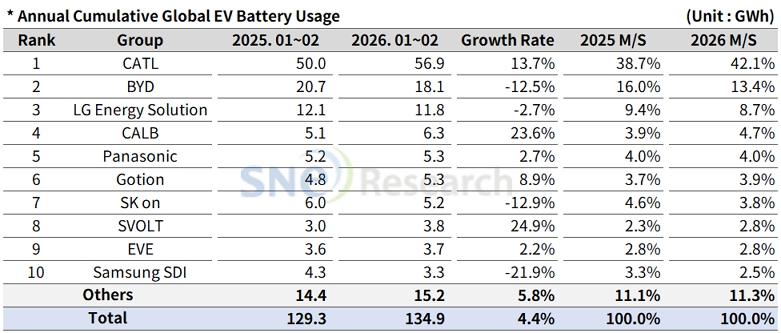
The combined market shares of LG Energy Solution, SK On, and Samsung SDI in global electric vehicle battery usage from Jan to Feb 2026 posted 15.0%, a 2.2%p decline from the same period last year. All three major companies experienced negative growth: LG Energy Solution decreased by 2.7%(11.8GWh), SK On by 12.9%(5.2GWh), and Samsung SDI by 21.9%(3.3GWh) year-on-year. This is analyzed to be primarily driven by a 29.8% plunge in EV sales in the U.S. market. This is analyzed as a result of the slowdown in electric vehicle sales by major automakers leading to a decrease in battery usage. Conversely, in the global market, certain Chinese battery manufacturers, led by CATL, continue to expand their market share, causing the relative standing of South Korean companies to further diminish.
(Source: 2026 Mar Global Monthly EV and Battery Monthly Tracker, SNE Research)
Examining the battery usage of the three major Korean manufacturers based on electric vehicle (EV) sales, Samsung SDI maintained its highest supply proportions with BMW, Audi, and Rivian, in that order. However, as EV sales slowed across its primary customer base, Samsung SDI's total battery installation volume saw a decline. In particular, for customers with high dependency on the North American market—such as Rivian and Jeep—the direct impact of falling U.S. electric vehicle sales led to an even sharper decrease in battery usage. BMW saw reduced installations as sales declined across its core electrified lineup, including the i4, i5, i7, and iX. Meanwhile, Audi's sales remained sluggish despite the launch of the Q6 e-tron. Furthermore, the introduction of the Q6 e-tron created a cannibalization effect, reducing sales of the existing Q8 e-tron, which ultimately contributed to the overall drop in battery installation volume.
BYD recorded 18.1GWh in January and February 2026, a 12.5% decrease compared to the same period last year, yet it managed to maintain its position as global number two. The significant drop in battery usage was primarily driven by a decline in domestic Chinese sales of its own BYD brand vehicles. Conversely, battery installation volume surged for certain customers and new brands, such as Xiaomi and Fangchengbao, due to their expanding sales. Growth was also observed among some commercial vehicle and overseas clients, including XCMG and Mahindra & Mahindra; however, the ongoing sluggish performance of major customers like Xpeng, Denza, and NIO was insufficient to offset the overall downward trend. This pattern demonstrates that while BYD is pursuing customer diversification, it remains highly susceptible to volatility in its own EV sales due to a structural reliance on internal demand.
(Source: 2026 Mar Global Monthly EV and Battery Monthly Tracker, SNE Research)
The global EV battery market in January and February 2026 suggests that the industry has moved beyond a simple growth phase and entered a structural transition period, characterized by divergent trends across different regions and OEMs. While the Chinese and North American markets are experiencing slowdowns or declines, growth in Europe, Asia (excluding China), and other emerging markets is driving global demand, clearly shifting the market's center of gravity toward a more diversified axis. These shifts are directly reflected in battery demand; consequently, manufacturers with a high dependency on specific regions are seeing increased volatility in their performance.
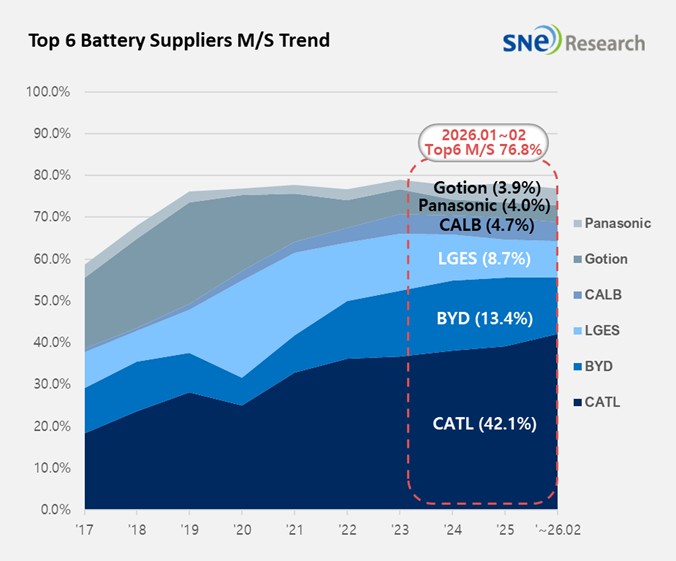
By manufacturer, CATL further strengthened its market dominance by securing both Chinese OEMs and global automakers simultaneously, while BYD experienced increased volatility due to a decline in its own internal demand. Panasonic maintained a stable trend despite its Tesla-centric structure, though the impact of upcoming shifts in vehicle portfolios appears inevitable. Meanwhile, the three Korean battery manufacturers saw their market shares decline as they were directly impacted by the EV sales slowdown among their customer base, which is heavily dependent on the North American market.
Consequently, the future battery market is expected to move beyond simple EV sales growth; instead, supply chain diversification in response to regional demand shifts and the expansion of customer portfolios will emerge as key competitive factors. In particular, expanding cooperation with global OEMs, entering new markets, and implementing strategic product-mix responses will likely determine the mid-to-long-term competitiveness of battery manufacturers.
[2] Based on battery installation for xEV registered during the relevant period