

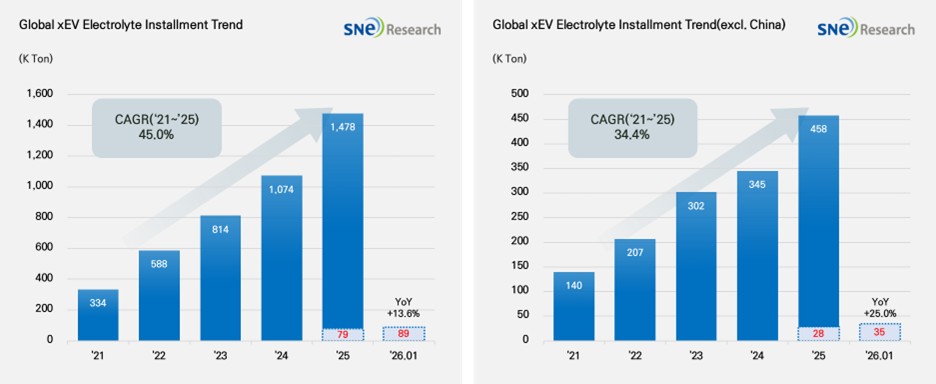
In Jan 2026, Global[1] Electric Vehicle Battery Electrolyte Installment[2] Reached 89K ton, a 13.6% YoY Growth
- In Jan 2026, the
electrolyte market continued to post a double-digit growth, while the non-China
market showed a stable expansion in demand
(Source: 2026 Feb Global EV & Battery Monthly Tracker (Incl. LiB 4 Major Materials), SNE Research)
In Jan, the total installment of electrolyte used in electric vehicles (EV, PHEV, HEV) registered around the world was approx. 89K ton, posting a 13.6% YoY growth. Particularly in the global market outside China, the total usage of electrolyte for electric vehicles recorded 35K ton and 25.0% YoY growth, continuously exhibiting a stable expansion in demand.
Electrolyte is one of the key materials and facilitates the transfer of lithium ions inside batteries, directly affecting the battery charging speed, safety, and battery life. With the electric vehicle market expanding and demand for high-performance batteries increasing, the electrolyte market is expected to continue strong growth in the mid-to-the-long run.
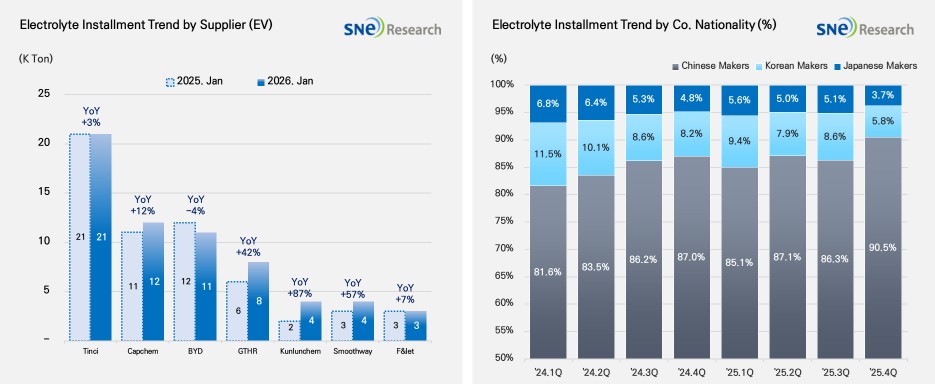
In Jan 2026, key suppliers in the global electrolyte market demonstrated noticeable growth. Tinci maintained its top position, recording 21K tons, a 3% increase year-on-year, followed by Capchem, which grew 12% to reach 12K tons. BYD recorded 11K tons, a slightly 4% decrease compared to the previous year, while GTHR reached 8K ton, a 42% increase.
In terms of market share by nationality, Chinese companies continue to dominate the electrolyte market. As of the fourth quarter of 2025, the market share of Chinese firms reached 90.5%, while South Korean and Japanese companies recorded 5.8% and 3.7%, respectively. These figures represent a slight decrease compared to the same period last year. As the supply structure increasingly centers around Chinese suppliers, it is becoming more critical for non-Chinese companies to secure and enhance their competitiveness.
(Source: 2026 Feb Global EV & Battery Monthly Tracker (Incl. LiB 4 Major Materials), SNE Research)
Last year, the global electrolyte market confirmed its robust demand base by recording double-digit growth, driven by the increasing volume of EV battery installations. While Chinese suppliers maintained a dominant influence, South Korean and Japanese firms continued their growth trajectories, although the overall supply structure remained centered around China. In 2026, the market is expected to continue its expansion, fueled not only by EV demand but also by the growth of power grids and Energy Storage Systems (ESS).
In early 2026, a clear trend toward "regional procurement" emerged, particularly in North America and Europe, as investments in local production and supply chain integration for electrolytes and raw materials began to take a more concrete shape. Simultaneously, intensifying safety requirements have sharpened the competition for advanced additives, enhanced thermal stability, and high-voltage compatibility. Furthermore, the price volatility of core materials and potential supply-demand adjustments are re-emerging as critical market variables. Consequently, while the electrolyte market will maintain its growth stance in 2026, the key strategic imperatives will involve technical competitiveness, adaptation to supply chain realignments, and customer diversification across both EV and ESS applications.
[2] Based on batteries installed to electric vehicles registered during the relevant period