

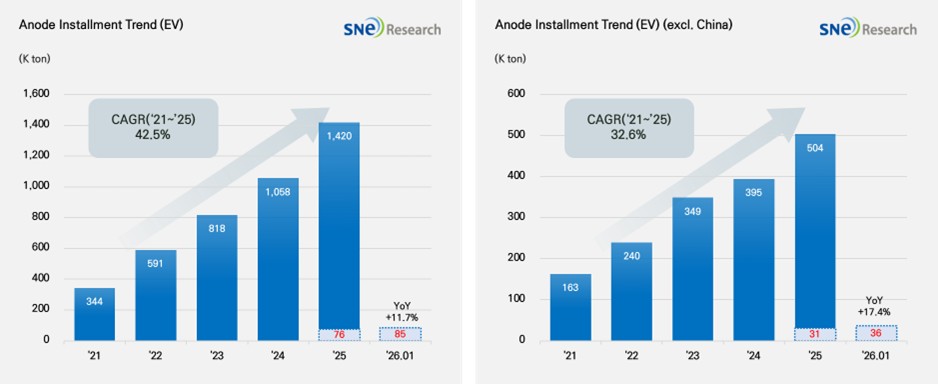
In Jan 2026, Global[1] EV Battery Anode Material Installment[2] Reached 85K ton, a 11.7% YoY Growth
- Anode installment in the non-China market recorded 36K ton, a 17.4% YoY growth
(Source: 2026 Feb Global EV & Battery Monthly Tracker (Incl. LiB 4 Major Materials), SNE Research)
In January 2026, the total amount of anode materials deployed in the global electric vehicle market (EV, PHEV, HEV) reached 85,000 tons, representing a 11.7% year-on-year (YoY) increase. While growth persisted, the pace of expansion has noticeably moderated compared to previous years, especially considering that global EV sales declined by 2.1% during the same period.
The market excluding China recorded 36,000 tons, growing by 17.4% and outperforming the global average. This trend indicates that the expansion of production in non-Chinese regions is effectively buffering the demand for anode materials against the broader global slowdown.
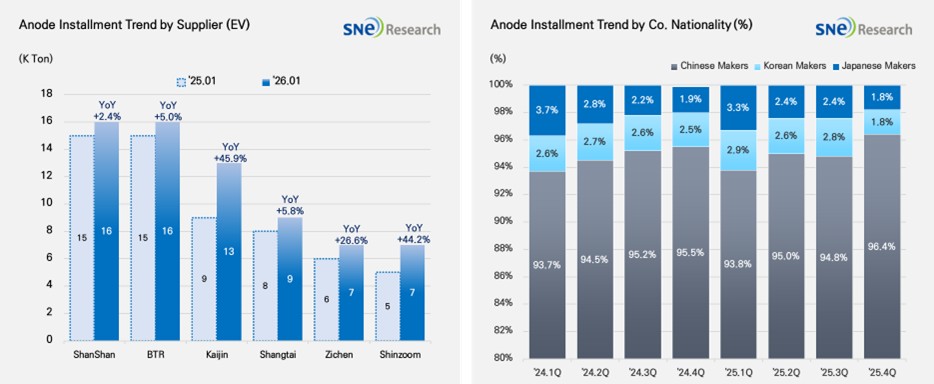
By supplier, ShanShan and BTR are leading the global market, forming a joint leadership position with 16,000 tons each. Both companies are maintaining their market share by leveraging stable customer bases—primarily large-scale cell manufacturers—and massive production capacities. Kaijin recorded the highest growth rate among top players, surging 45.9% year-on-year (YoY) to 13,000 tons. Other major suppliers, including Shangtai (9,000 tons), Zichen (7,000 tons), and Shinzoom (7,000 tons), also strengthened their market positions with double-digit growth.
Overall, the top-tier rankings remain heavily concentrated among Chinese suppliers. Even amidst the global demand slowdown, these companies continue to maintain stable shipment flows by leveraging their superior economies of scale and cost competitiveness.
(Source: 2026 Feb Global EV & Battery Monthly Tracker (Incl. LiB 4 Major Materials), SNE Research)
By nationality, Chinese companies further solidified their absolute dominance, with their market share rising from the high 93% range in Q1 2025 to the mid-96% range by Q4 2025. This result is attributed to their ability to maintain stable shipment volumes even during the global EV demand slowdown, leveraged by massive production capacities and superior price competitiveness.
In contrast, the market share of South Korean companies declined from the high 2% range to the high 1% range, while Japanese companies also saw their presence shrink from the low 3% range to the high 1% range. This trend underscores that the global anode market remains deeply entrenched in a China-centric supply structure, making it increasingly difficult for non-Chinese players to gain a foothold.
Despite the current market dominance of graphite, the adoption of Silicon-composite anodes (Si-Anodes) is emerging as a critical mid-to-long-term variable, driven by strategies to differentiate EV performance. As requirements for higher energy density and faster charging speeds intensify, joint development projects between major battery manufacturers and material suppliers are accelerating. South Korean companies, in particular, are seeking niche opportunities by combining non-Chinese supply chain alternatives with advanced silicon-composite technologies. While market share expansion may be limited in the short term, this dual strategy of technical sophistication and regional diversification has the potential to reshape the future market structure.
The anode market maintained its upward trajectory in January 2026, but the growth rate has noticeably moderated as the impact of the EV sales slowdown begins to take hold. Although anode deployment continued to see double-digit increases despite a decline in global EV demand, this represents a clear deceleration compared to previous high-growth phases. This trend underscores that material demand remains closely synchronized with the broader automotive sales cycle.
While the non-China market is acting as a "demand buffer" with relatively high growth rates, the supply side tells a different story: the dominance of Chinese enterprises is intensifying. With their market share surging to the 96% level, the global anode supply chain has effectively become entrenched around China. Leveraging both economies of scale and aggressive price competitiveness, Chinese suppliers are successfully maintaining and even expanding their footprint despite the global market slowdown.
Consequently, the anode market is judged to have entered a phase of "intensified supply concentration amidst slowing growth" in the short term. In the mid-to-long term, factors such as the expansion of silicon-composite anodes, increasing requirements for fast-charging technology, and policies aimed at diversifying non-Chinese supply chains may trigger structural changes. However, the possibility of a rapid overhaul in the current market share landscape remains limited in the near future. The future trajectory of the market will be determined by the pace of global EV demand recovery and the commercialization progress of next-generation anode technologies.
[2] Based on batteries installed to electric vehicles registered during the relevant period.