

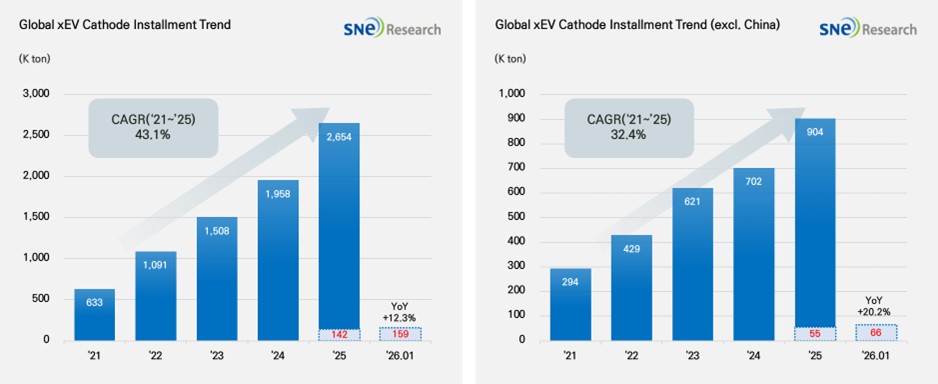
In Jan 2026, Global EV Battery Cathode Installment Reached 159K ton, a 12.3% YoY Growth
- EV battery cathode installment in the non-China market recorded 66K ton, a 20.2% YoY growth
(Source: 2026 Feb Global EV & Battery Monthly Tracker (Incl. LiB 4 Major Materials), SNE Research)
In January 2026, the total amount of cathode materials deployed in electric vehicles (EV, PHEV, HEV) globally reached 159,000 tons, representing a 12.3% year-on-year (YoY) increase. The market excluding China recorded 66,000 tons, growing by 20.2% and significantly outperforming the global average. This trend underscores that the recovery in EV demand and the expansion of production in non-Chinese regions are directly translating into increased demand for cathode materials.
In terms of demand structure, LFP chemistries continue to lead the growth, while ternary systems (NCM/NCA) showed a more moderated upward trend, resulting in an ongoing adjustment of relative market shares. The market’s central axis continues to shift from competition over energy density toward a focus on cost efficiency and supply stability.
(Source: 2026 Feb Global EV & Battery Monthly Tracker (Incl. LiB 4 Major Materials), SNE Research)
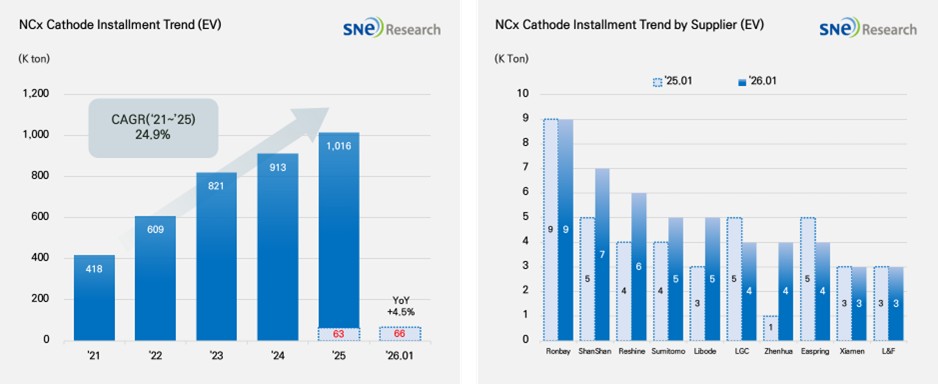
By type, the deployment of ternary (NCx) cathode materials in January 2026 reached 66,000 tons, a 4.5% year-on-year (YoY) increase. While the upward trend persists, its growth remains limited compared to the rapid expansion of LFP. In terms of suppliers, China's Ronbay maintained its top position with approximately 9,000 tons, followed by ShanShan (7,000 tons) and Reshine (6,000 tons). Japan's Sumitomo and Korea's L&F also secured top-tier spots, each recording volumes between 3,000 and 5,000 tons.
As automakers intensify their cost-reduction strategies and expand mid-to-low-end model lineups, the ternary market is increasingly polarizing toward premium and high-energy-density demand. Chinese suppliers are successfully defending their market share through economies of scale and cost competitiveness. Meanwhile, Korean and Japanese manufacturers are focusing their strategic efforts on meeting high-specification demand in the North American and European markets.
Consequently, while ternary materials have established themselves as "strategic materials for high performance," their short-term demand momentum is becoming increasingly sensitive to regional trade environments and shifts in OEM product mixes.
(Source: 2026 Feb Global EV & Battery Monthly Tracker (Incl. LiB 4 Major Materials), SNE Research)
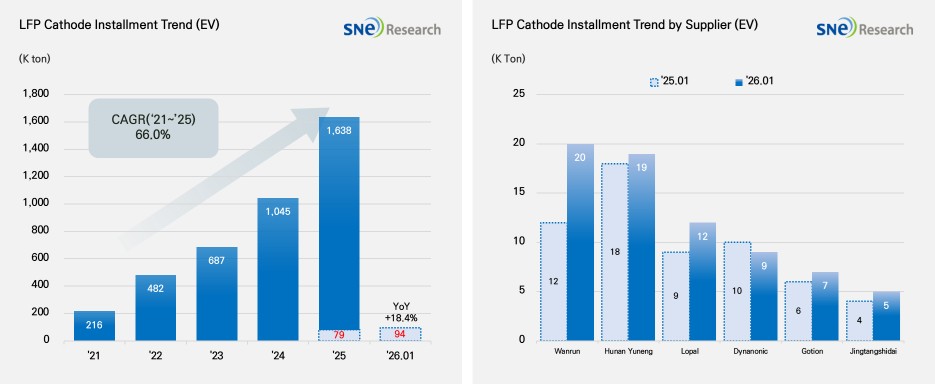
During the same period, the deployment of LFP cathode materials reached 94,000 tons, an 18.4% year-on-year (YoY) increase. LFP accounted for approximately 59% of total cathode weight, maintaining its majority share and market leadership. As global OEMs continue to expand mid-to-low-end models and intensify cost-reduction strategies, demand is steadily shifting toward price competitiveness and supply stability over pure energy density.
By supplier, Wanrun ranked first with approximately 20,000 tons, closely followed by Hunan Yuneng (19,000 tons). The top-tier rankings were dominated by Chinese firms, including Lopal (12,000 tons), Dynanonic (9,000 tons), Gotion (7,000 tons), and Jingangshida (5,000 tons). While the rollout of entry-level EVs is expanding in Europe and parts of Asia, the LFP supply chain remains overwhelmingly centered in China. Despite localized production efforts and technical internalization attempts in non-Chinese regions, the integrated advantages of Chinese players, from raw material sourcing to the unified precursor-LFP process, make a rapid restructuring of the supply landscape unlikely in the short term.
Although the cathode market maintained growth in January 2026, it appears to be entering a phase where the effects of the EV sales slowdown are being gradually reflected. With global EV sales declining by 2.1% YoY, the growth rate of cathode deployment has also moderated compared to the high double-digit surges of the past. This suggests that the cooling demand for EVs is beginning to impact material demand with a slight time-lag.
Despite broader adjustments, it is encouraging to note that the EV market excluding China grew by 21.2%, exhibiting a relatively strong recovery. This structure suggests that production expansion and model diversification in non-Chinese regions are effectively buffering the demand for cathode materials. However, the overall market trajectory remains heavily influenced by the volatility of the Chinese market, and global growth momentum has undeniably weakened compared to previous years.
In conclusion, the cathode market in early 2026 is defined more by ‘structural realignment amidst slowing growth’ than by ‘continuous expansion.’ The future direction of the market will be determined by three key factors: the recovery of global EV demand, the intensification of competition within China, and the pace of production ramp-up in non-Chinese regions.