

In Jan 2026, Global Electric Vehicle Deliveries Recorded 1.218 Mil Units, a 2.1% YoY Decline
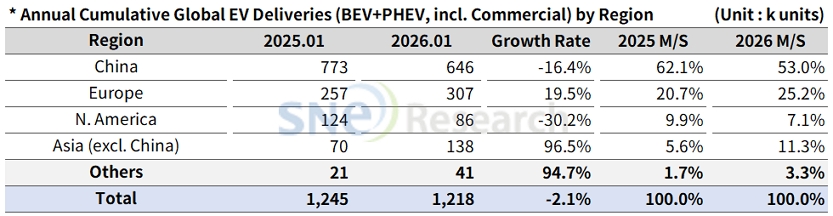
- Europe maintains steady growth (19.5%), while China and North America see double-digit declines
(Source: Global EV and Battery Monthly Tracker – Feb 2026, SNE Research)
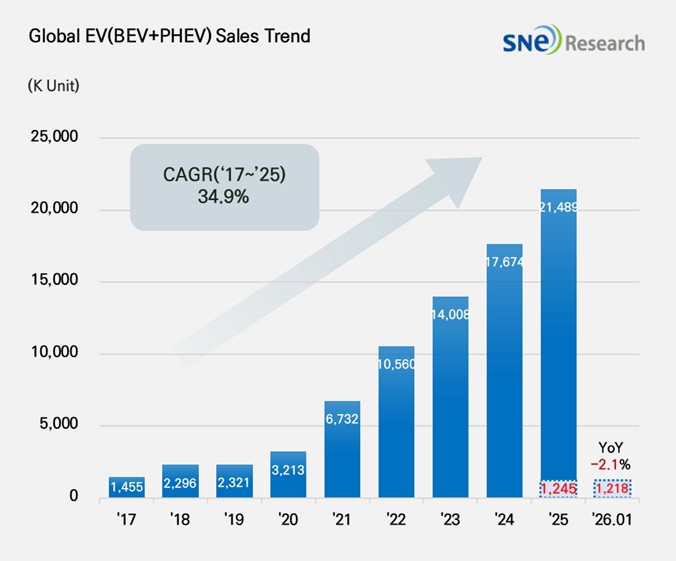
In January 2026, global electric vehicle (BEV+PHEV) deliveries totaled approximately 1.218 million units, representing a 2.1% year-on-year (YoY) decline. Amid a general slowdown in demand, the global market recorded negative growth at the start of the year, driven by deepening contractions in the Chinese and North American markets. Conversely, the European market continued its double-digit growth, highlighting a distinct divergence in regional performance.
On a cumulative basis, the global EV market has maintained a robust Compound Annual Growth Rate (CAGR) of 34.9% since 2017. However, recent trends indicate a gradual loss of growth momentum, as complex factors, including shifting policy landscapes, reduced subsidies, and intensifying price competition, begin to converge.
(Source: Global EV and Battery Monthly Tracker – Feb 2026, SNE Research)
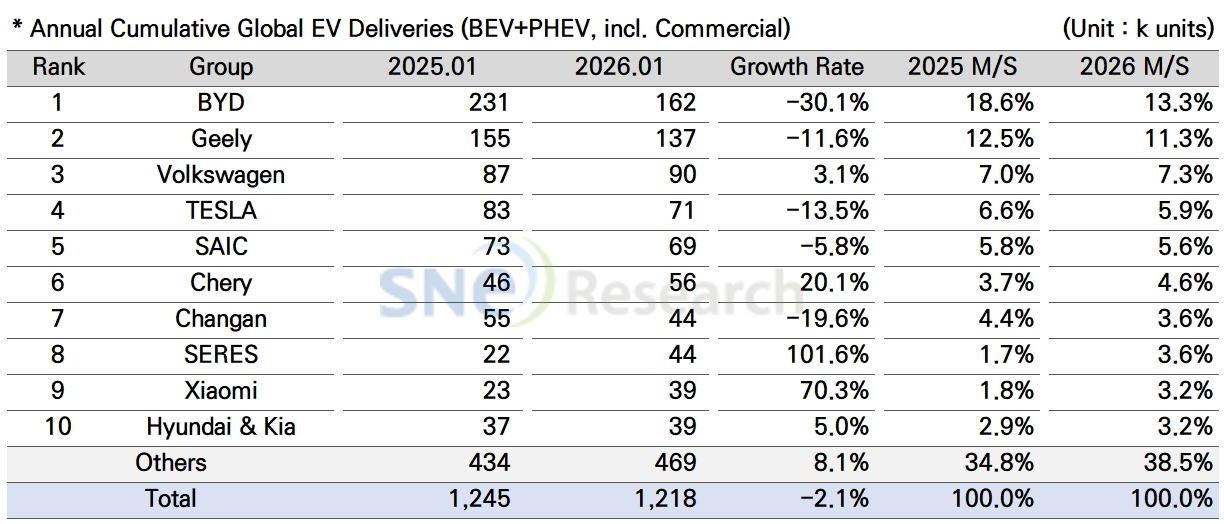
In January 2026, BYD experienced a temporary market adjustment, selling approximately 162,000 electric vehicles, a 30.1% year-on-year (YoY) decrease. This decline is attributed to a combination of seasonal off-peak effects in the Chinese domestic market, inventory rebalancing, and intensifying price competition. Despite this, BYD maintains a rock-solid sales foundation in China and is effectively managing demand volatility through its extensive product portfolio spanning both PHEVs and BEVs. Furthermore, its strategy of expanding localized production hubs in Europe and Southeast Asia is expected to serve as a buffer against tariff and policy risks in the long term. While short-term performance has slowed, BYD’s profitability-driven strategy—underpinned by its vertical integration of battery technology and superior cost competitiveness—remains intact.
Ranked second, Geely Group recorded sales of 137,000 electric vehicles in January 2026, an 11.6% YoY decrease. The group has entered a short-term adjustment phase, reflecting the broader slowdown in domestic Chinese demand and seasonal factors. However, Geely’s dual-track strategy—pairing BEVs with hybrids across a multi-layered brand portfolio including ZEEKR, Galaxy, and LYNK & CO—remains a core strength for capturing both premium and mass-market segments. The group’s focus on vertical integration and in-house technology development in batteries, electronics, and software continues to drive cost efficiency. Despite the dip in monthly sales, Geely is evaluated to be maintaining its long-term growth trajectory through global expansion and strategic product mix optimization.
In January 2026, Tesla recorded sales of 71,000 electric vehicles, a 13.5% year-on-year (YoY) decrease. While overall sales dipped, regional performance showed a stark contrast. The decline was primarily driven by the Chinese market, which plummeted 45.2% YoY due to fierce competition and aggressive pricing from local brands. In contrast, performance remained relatively resilient in North America (+2.9%) and Europe (+3.6%). This defensive performance in Western markets is attributed to strategic price adjustments, the introduction of new entry-level trims, and sustained brand loyalty. Although Tesla continues its push into FSD (Full Self-Driving) and software-based revenue models, regional demand imbalances are currently heightening short-term earnings volatility.
Hyundai Motor Group maintained a stable growth trajectory in January 2026, selling 39,000 electric vehicles, a 5.0% YoY increase. Regionally, Hyundai delivered solid results in Europe (+7.3%) and saw a massive surge in Asia (excl. China) with a 234.4% growth rate, signaling the successful expansion into emerging markets. However, the North American market saw a 38.1% decline, impacted by a combination of subsidy policy shifts, inventory rebalancing, and model transition periods. Overall, Hyundai’s strategy to reduce regional dependency and diversify its global footprint is proving effective, allowing the group to maintain operational stability through a balanced global portfolio.
(Source: Global EV and Battery Monthly Tracker – Feb 2026, SNE Research)
In January 2026, the global EV market witnessed a stark contrast between Europe’s growth and the synchronized slowdown in China and North America. Starting this year, as incentive structures and regulatory frameworks shift across major regions, the market is entering a phase where policy adaptability and supply chain realignment—rather than short-term sales fluctuations—will dictate long-term direction.
As of 2026, the Chinese EV market has entered a period where policy-driven momentum is structurally weakening. This follows the transition of the New Energy Vehicle (NEV) purchase tax policy from ‘full exemption’ to a ‘reduced rate’ system. The phased reduction of tax benefits, which lasted through late 2025, led to a pull-forward in demand during the second half of last year. Consequently, January 2026 saw a natural demand adjustment coupled with a high base effect from previous years. As policy support wanes, the market is being forced to shift from subsidy reliance to a more self-sustaining competitive environment.
Simultaneously, with penetration rates rising rapidly in major metropolitan areas, the Chinese domestic market is nearing a maturity stage, moving past its initial high-growth phase. As a result, the market share of replacement demand is expanding over new-entry demand. Amidst this transition, persistent price wars and aggressive promotions are creating significant profitability pressures for OEMs. Specifically, concerns over oversupply in the mid-to-low-end segments remain, accelerating a market consolidation centered around top-tier players.
The European EV market maintained a double-digit growth rate in January 2026, exhibiting the most stable trend among major global regions. Despite ongoing discussions regarding subsidy cuts and policy adjustments, the overarching drive toward electrification remains structurally sound, underpinned by strict carbon emission regulations and fleet-wide emission targets. Specifically, the market foundation is expanding as the supply of new BEV models launched in late 2025 reaches full scale. The increasing share of compact and mid-sized BEVs with improved price competitiveness is enhancing consumer accessibility. Furthermore, amidst shifting trade regulations against low-cost Chinese imports, the localization of production within Europe is strengthening supply stability. Consequently, Europe is evaluated as being in a phase where structural electrification persists independently of short-term incentive fluctuations.
The North American EV market entered a distinct adjustment phase in January 2026, recording the steepest decline among global regions. Since the expiration of federal EV tax credits in late September 2025, rising price burdens have led to a rapid deceleration in demand. Simultaneously, as North American consumer preferences shift back toward Internal Combustion Engines (ICE) and Hybrids, major OEMs are recalibrating their EV rollout timelines. The strategic pivot from a BEV-only focus to a more diversified approach—centered on Hybrids and EREVs (Extended Range Electric Vehicles)—is also acting as a factor that limits immediate BEV demand.
The Asian market (excluding China) continues its growth trend in early 2026. However, a significant shift is occurring as policy pivots from simple "subsidy expansion" to "incentives linked to local production and supply chains." Thailand is refining its EV3/EV3.5 programs to manage fiscal burdens while reinforcing its strategy as a production and export hub—granting operational flexibility while tightening conditional management. Indonesia has effectively scaled back CBU (Completely Built-Up) incentives as of 2026, demanding local production and compliance with TKDN (Local Content Requirement) in proportion to import volumes. Consequently, the market is consolidating around OEMs capable of meeting localization mandates. Success in this region now depends on an OEM’s execution in adapting to these evolving local production requirements.
While the global EV market recorded short-term negative growth in January 2026, this is interpreted as a temporary adjustment phase where policy shifts and growth-rate recalibrations converge. China is seeing moderated growth due to the transition to a purchase tax reduction system and rising domestic penetration. Europe maintains a stable expansion driven by regulatory mandates. Conversely, North America faces weakened momentum following the expiration of federal incentives, with OEM strategies pivoting toward Hybrid-centric portfolios. In the Rest of Asia, supply chain competitiveness has emerged as the core variable as the market restructures around local sourcing requirements.
Ultimately, while the global EV market remains on a long-term expansion path, it is moving away from the era of hyper-growth led by government policy. Future competitiveness will be determined by: ▲ policy adaptability ▲ local production and supply chain stability ▲ cost competitiveness ▲ optimized powertrain mix strategies.