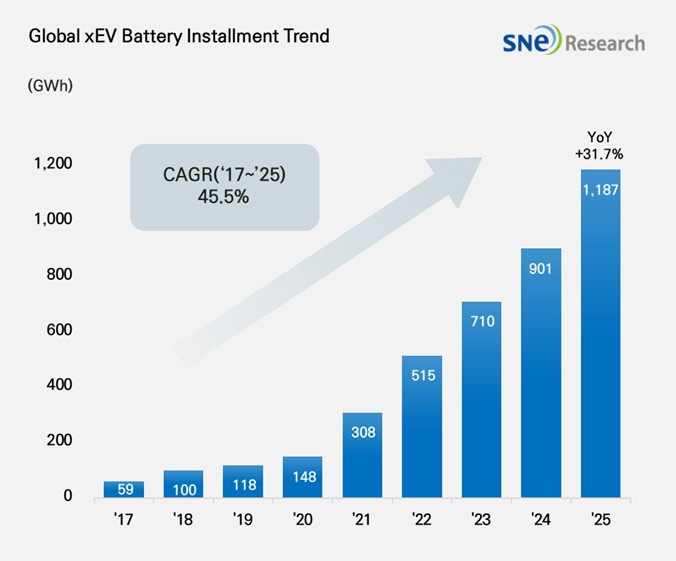
From Jan to Dec 2025, Global EV
Battery Usage
Posted 1,187GWh, a 31.7% YoY Growth
- From Jan to Dec 2025, K-trio’s M/S recorded 15.4%, a 3.3%p YoY
decline.
From Jan to Dec 2025, the amount of energy held by batteries
for electric vehicles (EV, PHEV, HEV) registered worldwide was approximately 1,187GWh, a 31.7% YoY growth.
(Source: 2026 Jan Global Monthly EV and Battery
Monthly Tracker, SNE Research)
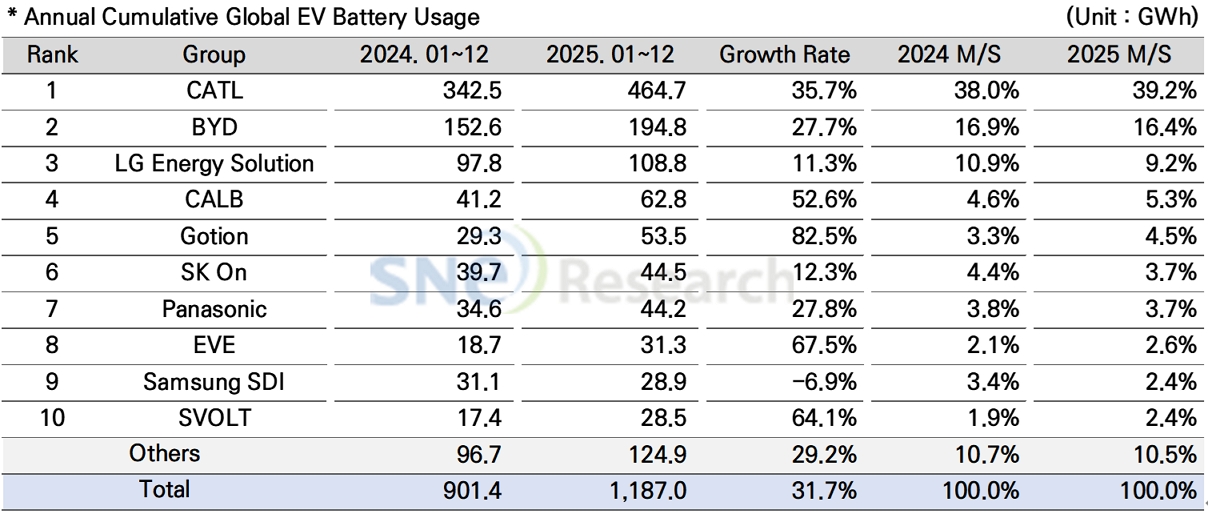
The combined market shares of LG Energy Solution, SK
On, and Samsung SDI in global electric vehicle battery usage from Jan to Dec in
2025 posted 15.4%, a 3.3%p decline from the same period last year. LG Energy
Solution remained 3rd on the list with 11.3%(108.8GWh) YoY growth.
While SK On ranked 6th with a 12.3%(44.5GWh) growth, Samsung SDI
posted 6.9%(28.9GWh) degrowth.
(Source: 2026 Jan Global Monthly EV and Battery
Monthly Tracker, SNE Research)
Looking
at the battery usage of the three major South Korean manufacturers based on
electric vehicle sales, Samsung SDI showed a high supply concentration in the
following order: BMW, Audi, Rivian, and Jeep. BMW equips its major electrified
models, such as the i4, i5, i7, and iX, with Samsung SDI batteries. In
particular, the strong sales performance of the flagship i4 and i5 models
served as a factor that partially offset the overall decline in Samsung SDI’s
installation volume. Audi also saw positive reception, particularly in Europe,
for the Q6 e-Tron, which is based on Audi's PPE platform and equipped with SDI
batteries. However, due to sluggish sales of the existing Q8 e-Tron, the total
volume of SDI batteries installed in Audi vehicles experienced a slight
decrease. In the case of Jeep, sales of the Wagoneer S, which features SDI’s 100kWh
high-capacity battery pack, were notably prominent. While Rivian utilizes
Samsung SDI batteries for its R1S and R1T models, the growth in SDI's
installation volume remained limited. This was due to the expansion of the Standard
trim (which may use different cells) and the overall sales slump of Rivian
vehicles.
SK On's batteries were primarily installed in major vehicles from manufacturers such as Hyundai Motor Group, Mercedes-Benz, Ford, and Volkswagen. In the case of Hyundai Motor Group, the IONIQ 5 and EV6 showed the highest installation volumes. Additionally, steady sales of Volkswagen’s ID.4 and ID.7 had a positive impact on SK On's annual battery installation figures. Conversely, sales of the Ford F-150 Lightning, which is equipped with high-capacity batteries, plummeted following Ford's announcement to halt production at the end of 2025. Furthermore, with the dissolution of BlueOval SK—the joint venture between SK on and Ford—the slowdown in EV demand in the U.S. market is expected to act as a burdening factor for SK On’s future installation volumes.
LG Energy Solution’s battery usage was primarily driven by installations in major vehicles from manufacturers such as Tesla, Chevrolet, Kia, and Volkswagen. Despite the continued sluggish global sales of Tesla models equipped with LG Energy Solution batteries, the company saw an 11.2% year-on-year increase in installation volume. This growth was bolstered by the expansion of the Chevrolet EV lineup, along with strong sales performance from key models including the Kia EV3, Hyundai Casper (Inster) EV, and Renault Scenic. However, following the cancellation of a battery supply contract with Ford and the suspension of operations at Ultium Cells plants, a shift in business strategy for the U.S. market—such as a strategic pivot toward ESS (Energy Storage Systems)—is expected.
Panasonic, which primarily supplies batteries to Tesla, ranked 7th with a total battery usage of 44.2 GWh in 2025. To reduce its heavy reliance on Tesla, Panasonic is focusing on improving the efficiency of its North American production lines and developing next-generation 4680 and 2170 cells. As the conversion of its Kansas and Nevada plants gains momentum, its cost structure is stabilizing, and discussions for new collaborations with North American automakers are expanding, establishing a foundation for demand diversification. This strategy is expected to buffer the risks associated with Tesla's expansion of in-house battery production and support the maintenance of its mid-to-long-term market share in North America. Furthermore, Panasonic is shifting away from an EV-centric business structure by promoting the expansion of ESS (Energy Storage Systems) battery production. The company is actively diversifying its business portfolio to respond to the increasing power demand driven by North American grid stabilization and the proliferation of AI data centers.
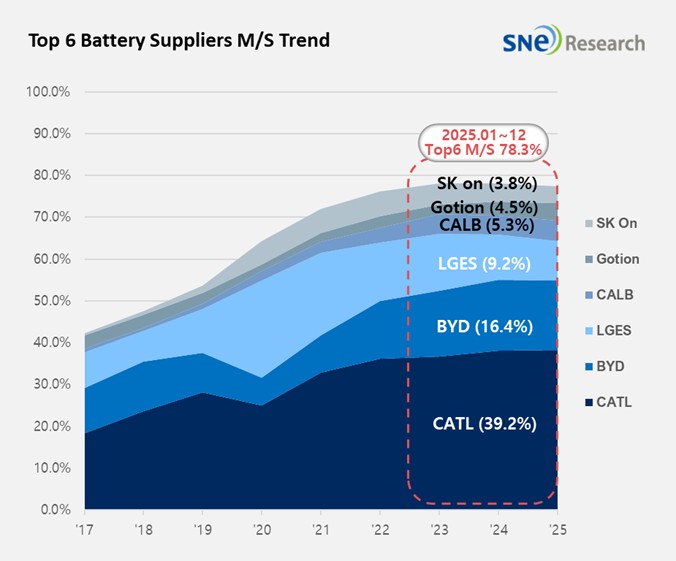
China's CATL firmly maintained its position as the global leader, recording a battery usage of 464.7 GWh, a 35.7% increase compared to the same period last year. Not only are major Chinese OEMs such as ZEEKR, AITO, Li Auto, and Xiaomi adopting CATL's batteries, but a vast number of global OEMs, including Tesla, BMW, Mercedes-Benz, and Volkswagen, are also utilizing their products. Meanwhile, while maintaining a portfolio centered on lithium-ion batteries, CATL is also accelerating its efforts to preoccupy the next-generation battery market by promoting the commercialization of sodium-ion batteries. In particular, CATL is reportedly planning to expand full-scale mass production of sodium-ion batteries in 2026 for application in both passenger and commercial vehicles. Based on its strengths in cost competitiveness and performance in low-temperature environments, CATL is expected to broaden its application range significantly.
BYD ranked second globally, recording a battery usage of 194.8 GWh, a 27.7% increase compared to the previous year. As a company that vertically integrates the production of both batteries and electric vehicles (BEV+PHEV), BYD is expanding its sales across various vehicle segments based on its superior cost competitiveness. It is rapidly broadening its presence not only in the Chinese domestic market but also in international markets. Notably, amid this ongoing global expansion, BYD's battery usage in Europe reached 14.9 GWh in 2025, representing a staggering 201.4% year-on-year increase. Meanwhile, to further secure its cost-competitive edge, BYD is increasing investment in the commercialization of sodium-ion batteries. The company is reportedly working on establishing a dedicated production capacity of 30 GWh per year.
(Source: 2026 Jan Global Monthly EV and Battery Monthly Tracker, SNE Research)
The 2025 EV battery market is evaluated as a year in which performance volatility among manufacturers widened, driven by diverging regional demand trends and competitive dynamics, even as global EV demand growth persisted. In the Chinese market, persistent pressure to lower battery cell prices continued due to the strengthened price competitiveness of LFP-centric solutions. In the European market, despite a recovery in EV sales, the expanding market share of Chinese manufacturers acted as a constraint on the profitability improvements of South Korean battery makers. In North America, as uncertainty over EV demand grew, major automakers began full-scale adjustments to their electrification strategies. Consequently, the recovery of utilization rates and shipment volumes for domestic cell manufacturers was slower than expected. Given these trends, the earnings recovery for South Korean battery cell makers in 2026 is likely to be delayed due to the slowdown in North American EV demand and intensifying competition in Europe. In particular, any further increase in demand volatility within North America is expected to weigh heavily on both shipment volumes and profitability. However, since structural demand for ESS is expected to expand following changes in the policy and regulatory environment, it is considered a key variable that could partially buffer the downside risks by improving product mixes and defending facility utilization rates. Ultimately, 2026 is projected to be a year where performance divergence among manufacturers will widen based on their response strategies to key customers, rather than a broad EV-driven market rebound.
Based on battery
installation for xEV registered during the relevant period.